Cultural center
FortressWesel
Wesel Fortness (Wesel)
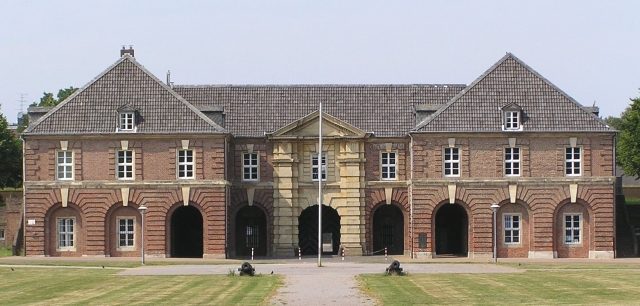
The Wesel Citadel is the largest preserved fortress in the Rhineland and was built in Wesel between 1688 and 1722 according to plans by Johan de Corbin in the shape of a five-pointed star, with each "point" representing a bastion. The citadel was the core of the Wesel fortress. Today, the citadel is used as a cultural center.
Architecture+
The architectural principles of the citadel are based on the principles of Sébastien Le Prestre de Vauban, the most important fortress builder of his time. The construction costs of the section built between 1668 and 1700 are estimated at 373,452 Reichstalers. Significant financial resources also flowed into the construction in subsequent years; for the years 1701 and 1702, an expenditure of 221,600 Reichstalers is estimated. The entire Wesel fortress was equipped with 250 cannons during this period.
In 1687, Frederick William of Brandenburg ordered the construction of a citadel to expand Wesel as a fortress city. It was to be built in the south of the city with a connection to the existing city fortifications and equipped with five bastions and five ravelins, which also received recessed flanks. The main gate of the citadel was built in 1718. Presumably until the middle of the 18th century, the citadel was reinforced on its south and east sides with extensive works. During its occupation from 1805–1814, the French built a two-story brick building without a basement in the citadel, which still stands today: the former Barracks VIII.
The main gate is representatively designed. In the southern of the two wings is a prison cell where, among others, the eleven Schill officers awaited their trial.
Current Use+
Due to the de-fortifications after the First World War in 1919/1920, the former fortifications have now disappeared. In particular, the complex is open towards the Rhine and Lippe, the original enemy side. Only a street name now commemorates the field gate there.
The following buildings have been preserved:
- Main gate complex with curtain wall, bridge, tenaille, bridge, and moat from 1718 (Jean de Bodt), renovated in 1823, now houses the Municipal Museum, Schill Casemate section. Although this gate was also fortified, it actually represented the connection to the city.
- Officers' Prison from 1727 (privately owned)
- Garrison Bakery No. II from 1809, used by the City Archives with a restoration workshop.
- Barracks No. VIII from 1809, renovated for the Music and Art School of the City of Wesel.
- Grain Magazine around 1835, today houses the Prussia Museum Wesel.
Take Mobile History with you
You are reading this text for free. Premium adds what matters on the road: descriptions read aloud, sites found through your camera, whole regions taken offline.
- Every description, including the ~17,700 Premium sites
- Audio guide: have descriptions read to you on location
- AR finder: see sites through your camera, with distance and bearing
- Unlimited saved sites
14 days free, then from €2.99 a month. Cancel anytime.
Source: Wikipedia · Licence: CC BY-SA 4.0
This description draws on the facts documented in the linked Wikipedia article; Wikipedia content is licensed under CC BY-SA 4.0. Wording and editing: Mobile History.
Location: 51.6517, 6.6153