Cultural facilitie
CastleNürnberg-Gleißhammer
Zeltner Castle
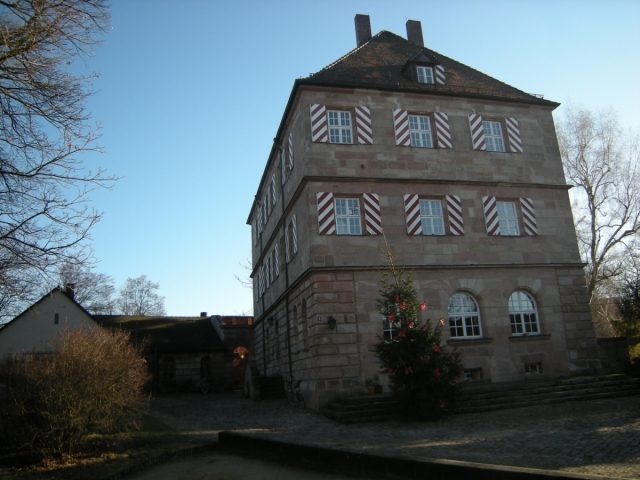
The manor house, known as "Zeltnerschloss" since the 19th century, originated as a hammer mill castle. The Gleißhammer with its ironworks is one of Nuremberg's oldest documented industrial facilities: In the early 14th century, Conrad Stromer "the Tall" from the well-known Nuremberg family, descended from the imperial ministerialis, was the owner. In 1336, he sold the Gleißhammer to the imperial mint master Konrad Groß, the founder of the Heilig-Geist-Spital. In 1370, Konrad Groß the Younger granted the Imperial City of Nuremberg the right of access and a pre-emptive right for Nuremberg citizens over his seat. In 1403, the mining entrepreneur and financial broker Herdegen Valzner bought the hammer mill and seat from Sebald Groß and renewed the Imperial City's right of access in 1408. The merchant, who had become rich in Bohemian mining and whose ancestors came from Großenfalz near Sulzbach, in the heart of Upper Palatinate mining, finally intended to "build a mighty house there" at Gleißhammer, as Nuremberg chronicler Müllner wrote. Valzner had already prepared and assembled the wooden construction parts on site when the Nuremberg Council refused permission. Thereupon, the timber was used for the construction of a new Valzner town house, and the construction of the manor house was abandoned.
After the death of the entrepreneur in 1423 and his son of the same name in 1427, the property remained in the hands of the widow for some time and is said to have been inherited in 1448 by her sister Anna, wife of Jakob Toppler, son of the famous Rothenburg mayor Heinrich Toppler. In 1476, Conrad Toppler, Stephan Peßler, Martha Haller, and Margaretha Tetzel, daughter of Jakob Toppler, were joint owners. Margaretha and her son Friedrich Tetzel owned the seat in the early 16th century. They witnessed its burning down in the Landshut War of Succession in 1504 by soldiers under the Palatinate banner led by Balthasar von Seckendorff. In the First Margrave War in 1449, occupied by Nuremberg mercenaries, the seat had still withstood an attack by enemy troops.
Although the hammer mill was back in operation in 1522, the seat, however, was gone when it was sold as "Hammerweier, darinnen ein Burkstal" (hammer pond, with a castle site within) by Friedrich Tetzel to his cousin Sigmund Fürer. The latter immediately resold the property to the merchant Jörg Schlaudersbach. The buyer then had a new, solid manor house built in 1523 and again granted the Imperial City the right of access in 1524. In the Second Margrave War, the hammer mill was surrendered without a fight by the Nuremberg occupation, yet it was set on fire by the margravial troops on May 31, 1552, along with the new manor house.
Apparently, the building had not been completely ruined, because the son of the owner who died in 1552, Christoph Schlaudersbach, already declared in 1556 that he maintained a "herrn hauß" (manor house) among other buildings on his property. The younger Schlaudersbach died in 1562 at Lake Constance, after he had been expelled from the Imperial City for acts of violence against his wife. Since he had also left numerous debts, the Gleißhammer with its seat was sold in a forced sale to Endres and Jakob Imhoff, who were related to the Schlaudersbach family.
Jakob Imhoff then had the manor house, still scarred by the war, demolished down to its foundations and plinth walls in 1569 by master builder and stonemason Hans Fuchs, and rebuilt on the old site. In addition, the building was extended by about 5 meters to the east and provided with a stair tower half-integrated into the internal structure, as well as with corner turrets. The builder also desired three main entrances, whose portals were to be executed in the style of the Italian Renaissance, with a "welsch Architrav" (Italian architrave) and four accompanying columns. On the ground floor, a vaulted summer hall and the entrance hall were planned, which was also to be made accessible for carriages. Even the existing cellar was to be renewed during the reconstruction. To the south, Fuchs was to erect a crenellated wall and fill the space between the manor house and the wall with rubble and expand it into a Zwinger (outer bailey).
According to an illustration in the so-called Cnopf sketch book, the building, like its medieval predecessor, stood on an island in the Gleißhammer pond. Additionally, the seat was protected by a gatehouse located to the west, which was reached via a wooden bridge. The hammer mill was apparently no longer in operation at this time, as Johannes Müllner noted in 1623 "a beautiful pleasure house surrounded by a pond and gardens," where years ago "a hammer had been." In 1632, the manor house is said to have been included in the strategic plans of the Swedish King Gustav Adolf before his meeting with the imperial army under Wallenstein.
The Imhoff family owned Gleißhammer Castle until 1654, when it passed to Georg Seifried Koler, who had married Susanna Imhoff. In 1667, Paul Sigmund Koler, married to Katharina Imhoff, appears as the owner. He was succeeded in 1685 by Johann Joachim Nützel. In 1713, Jobst Wilhelm Ebner von Eschenbach the Elder, married to Nützel's daughter Maria Sophia, acquired the seat. He is still attested as owner in 1749. In 1755, Jobst Wilhelm Ebner the Younger, who died in 1763, followed. His widow Helena Eleonora applied in 1778 for the construction of another tenant house in the castle courtyard to accommodate more tenants. In 1779, one of the outbuildings in the courtyard burned down. Shortly thereafter, Gottlieb Christoph Scheurl von Defersdorf acquired the castle and had some alterations carried out since 1782. This began with the installation of two interior walls on the ground and second floors, which were intended to provide better structural stability for the internal framework. A "pointed" turret on the "rear gable" was to be rebuilt in 1782 and given a gabled roof construction.
The Nuremberg council consultant Eberhard Jodokus König von Königsthal finally bought the castle around 1790. In 1795, Königsthal applied not only for replacement of the outbuilding destroyed in 1779 and earlier flood damage, but also for a significant reconstruction and extension of the so-called Bastion building, which had emerged from the gatehouse. The lord of the castle wanted to accommodate staff and other tenants in the new rooms. The construction measure was approved in June 1795; however, it was forbidden to increase the number of fireplaces and tenants. In 1796, the southern courtyard building was also to be renewed.
In 1845, the manor house was damaged by a devastating flood. In the same year, the property, in need of repair, was sold to the manufacturer Johann Zeltner, owner of the famous ultramarine factory, as Wilhelm Georg Eberhard König von Königsthal was financially overwhelmed with its restoration. The buyer had the buildings extensively renovated and half of the castle pond filled in. Under the manufacturer, who also belonged to the National Assembly in the Paulskirche in Frankfurt am Main in 1848, the new name Zeltnerschloss became common. In 1884, Zeltner's son-in-law, Edwin Beckh, inherited the property. He had a tower built south of the castle, which, however, was demolished again in 1920. After Beckh's death in 1908, the heirs had a wooden veranda added to the eastern enclosure.
In 1920, the Deutsche Reichsbahn acquired Zeltnerschloss from the Beckh family, which suffered severe damage during a bombing raid in 1943. During the restoration in 1955, the building was repaired by the Bundesbahn in a rather economical manner. The reconstruction of the corner turrets and gables was omitted, and a hip roof was installed. The city of Nuremberg acquired the complex in 1981 and established a "Kulturladen" (cultural center) in Zeltnerschloss in the 1980s.
Take Mobile History with you
You are reading this text for free. Premium adds what matters on the road: descriptions read aloud, sites found through your camera, whole regions taken offline.
- Every description, including the ~17,700 Premium sites
- Audio guide: have descriptions read to you on location
- AR finder: see sites through your camera, with distance and bearing
- Unlimited saved sites
14 days free, then from €2.99 a month. Cancel anytime.
Source: Wikipedia · Licence: CC BY-SA 4.0 · Image: http://schloesserrundschau.de/bayern/schloesser01/nuernberg26.html
This description draws on the facts documented in the linked Wikipedia article; Wikipedia content is licensed under CC BY-SA 4.0. Wording and editing: Mobile History.
Location: 49.4472, 11.1094