Cultural Events
CastleFeucht
Zeidler Castle
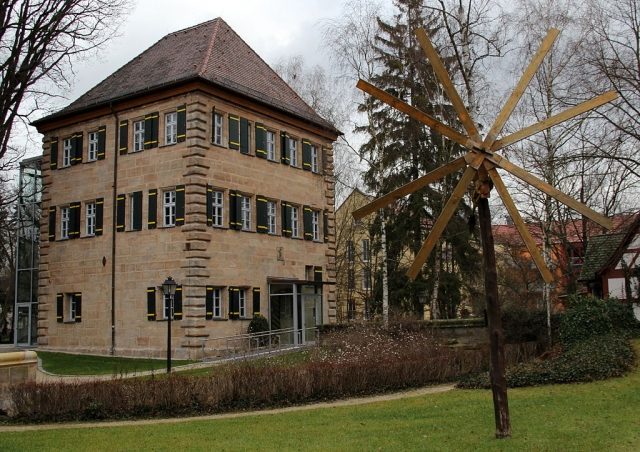
The Zeidlerschloss, also known as Schloss im Kartäuserweiher, is one of three preserved castles in Feucht, alongside the Pfinzingschloss and the Tucherschloss. The castle has been owned by the market town of Feucht since 1976. In 2009/2010, the castle underwent extensive renovation and was fitted with an extension for fire safety reasons. It is used for events, and the market town of Feucht rents it out for family celebrations and parties.
The castle garden may not be entered after dark. Since April 1996, a Klapotetz, a rattling wind chime typical of the southern Styrian partner community of Leutschach, has adorned the castle garden.
In 1427, the Nuremberg citizen Burckard Peßler acquired the imperial fiefdoms, including the so-called Kartäuserweiher, from the indebted Hutt family. The wealthy merchant immediately began building a manor house in the Kartäuserweiher. This became clear in 1428 when the Council of the Imperial City of Nuremberg demanded the usual assurance from Peßler that the pond house under construction, should it ever be sold, would only be alienated to Nuremberg citizens or to the Council itself. This condition was recalled in the late 15th century when the Peßlers leased the right of residence to Konrad Konhofer, pastor of St. Lorenz, and the Nuremberg citizen Schuler. In 1480, after an inheritance agreement, Steffan Peßler took over the manor and the family's other properties in Feucht. In 1503, he sold the manor house in the pond, a half-timbered construction on a solid base, with all outbuildings and the bathhouse, two Zeidel mother properties, the mill, which had been converted into a brass hammer mill, and the manorial rights over 13 properties to Katharina Harsdorffer, wife of Fabian Harsdorffer. The timing proved quite unfortunate for the buyer, as a year later the town and the seat were burned down in the Landshut War of Succession.
Katharina Harsdorffer died in 1508, followed by her husband in 1519, whereupon the inheritance fell to Gabriel and Katharina Nützel, daughter of Katharina Harsdorffer from her first marriage to Nikolaus Groß. The couple is said to have rebuilt the manor around 1519. In 1535, the property was sold by the heirs of Nikolaus Nützel to Christoph Mordeisen, who married Brigitte Nützel in 1539. In 1543, Mordeisen sold all properties and rights to the brothers Hieronymus and Ludwig Schnöd.
During the Second Margrave War, the manor was reduced to rubble and ashes on May 16, 1552. However, the Schnöd brothers had already sold the property to the Nuremberg Council in 1550, so the Imperial City had to bear this damage. In 1556, the burnt-out ruin with its associated properties and rights was given to the then Council consultant Dr. Christoph Gugel, albeit with the condition that he restore the seat. The current structure largely dates back to the construction measures of Dr. Gugel.
After the death of the builder in 1577, his daughter Maria Salome Tucher took over the seat after an inheritance dispute. In 1594, her son-in-law and nephew Philipp Jakob Tucher inherited it, who got into a lot of trouble with the Council, the Margravial office of Burgthann, and several neighbors, especially because of the planned expansion of the hammer and mill works. Before 1616, Tucher sold to the Margravial administrator and provost administrator of Solnhofen, Philipp Jakob Grötsch, who had married Jakobina Welser. This marriage connection likely facilitated the acquisition of the property by the Margravial official. However, in 1616 he had to grant the Imperial City the right of pre-emption for Nuremberg citizens and a right of opening for the Imperial City in case of war.
Already in 1626, the manor changed hands to a Christoph Adam Holbeck, who immediately thereafter sold to Georg Christoph Örtel and his wife Maria, née Haller. In 1649, the Nuremberg Council consultant Dr. Justin Hardesheim acquired the castle in Kartäuserweiher from the daughters of Örtel, who had already died in 1633. The lawyer was followed in 1660 by the patrician Hans Wilhelm Schlüsselfelder; his heirs sold the seat in 1680 to the Nuremberg citizen Johann Andreas Waldmann.
The history of ownership remained very turbulent: Waldmann was soon followed by Georg Hannibal Braun, then in 1695 by Christof Gottlieb Löffelholz. Until 1747, the castle had eight more changes of ownership, until it was finally sold by the Nuremberg citizen and Hessian court councilor Andreas Philipp König in 1747 to the lower judge Johann Konrad Schneider. The lawyer kept the pond house until his death. In 1779, it passed to Heinrich Kühnlein, with whom a period of rapid change began again. Again, the seat became an object of speculation several times, until it came to Georg Christoph von Oelhafen in 1804. While a predecessor had already sold some parts of the property, it was now completely broken up in 1806/07, until only the manor house with one acre of garden area remained. The Kartäuserweiher was drained and filled. In 1809, Johann Georg Heerdegen acquired the small remaining property, then shortly thereafter the Oelhafen family again, then in 1818 Christoph Wilhelm von Volckamer.
In 1842, the master mason Simon Wild bought the manor house. Under his son, a neighboring stable with a courtyard was acquired in 1860 and a farm was established. In 1887, the Schwabach Paulus Gutmann bought it as an agricultural property, from whom it passed via a Johann Humann to Georg and Maria Hausner. Thereafter, the ownership history became quieter again. The Hausner family kept the manor house until 1976, when it was acquired by the market town of Feucht.
Architectural Description+
The manor house, built around 1560, was an archetypal Nuremberg pond house. The solid sandstone ashlar building stood in the water and could only be reached via a drawbridge. A description from 1709 lists three floors, with only a "small writing room" in addition to a storage cellar and a vault on the ground floor. The living rooms and chambers, as well as a kitchen each, were located on the two upper floors. An inner and an outer farmyard with two Voithäuser stood in the forecourt in front of the Kartäuserweiher at that time.
Take Mobile History with you
You are reading this text for free. Premium adds what matters on the road: descriptions read aloud, sites found through your camera, whole regions taken offline.
- Every description, including the ~17,700 Premium sites
- Audio guide: have descriptions read to you on location
- AR finder: see sites through your camera, with distance and bearing
- Unlimited saved sites
14 days free, then from €2.99 a month. Cancel anytime.
Source: Wikipedia · Licence: CC BY-SA 4.0 · Image: http://de.wikipedia.org/wiki/Datei:Zeidlerschloss_%284%29.jpg
This description draws on the facts documented in the linked Wikipedia article; Wikipedia content is licensed under CC BY-SA 4.0. Wording and editing: Mobile History.
Location: 49.3764, 11.2139