Cultural Events
Museum
CastleSpenge
Werburg Castle
p3
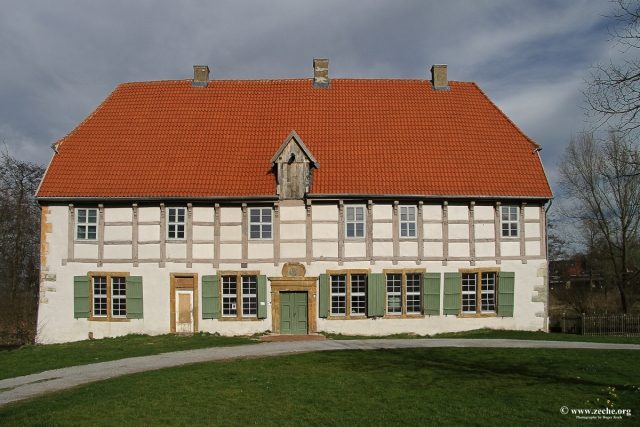
Werburg House is a moated castle in Spenge, Herford district, North Rhine-Westphalia. The building ensemble consists of the manor house, the gatehouse, and two farm buildings. It is located on the Spenger Mühlenbach. Behind the Werburg ensemble is a large pond. The Werburg is located west of the town center of Spenge. To the north and south is a landscape protection area.
It was first mentioned in a document in 1468, as was the nearby Mühlenburg. This occurred in a document in which the owner Heinrich Ledebur, a member of a Westphalian noble family, transferred the Werburg property to his son Johann. The gatehouse, in the Weser Renaissance style, dates from 1596. In May or June 1629, Werburg House was plundered by a cavalry company. From 1643, the Münch family came into possession of Werburg House. The next registered change of ownership dates from 1941. Alhard Freiherr von den Bussche Münch sold the house to the city of Spenge.
The gatehouse was sold to Mrs. Johanne Märtens in 1968, but after being repurchased in 1991, it now houses the civil registry's wedding room. The half-timbered barn and a small brick building are the only remaining farm buildings.
Existing Buildings+
The manor house existing today is a single-wing structure with a stone ground floor and a half-timbered upper floor. The original building from the 15th century was extensively renovated at the beginning of the 17th century, probably in 1612/14, whereby the building was extended and the half-timbered upper floor was created. In the 18th century, minor alterations were made, including the baroque entrance portal and the half-hipped gables of the roof.
The equally single-wing gatehouse is a rather high-quality stone building in the forms of the Weser Renaissance, dated by inscription to 1596.
The half-timbered farm building, extensively renewed during the last renovation, dates from the 19th century. A pigsty from the early 20th century complements the ensemble. A larger farm building, probably designed in the style of a Low German hall house, was still present around 1800 but no longer exists today.
Renovation and New Use+
The Werburg gatehouse was extensively renovated in 2005/06 and has since been used as a wedding room and archive for the city of Spenge.
Since 2007, the manor house of the ensemble has been undergoing renovation, having until then preserved the condition of the 18th/19th century in an exceptionally untouched state. The complex is to be preserved as an attractive excursion destination and serve as a cultural community center for the city of Spenge. The manor house will be central, housing a children's museum that offers supplementary programs as an extracurricular learning place for science, social studies, and history lessons.
The large barn serves as a space for art exhibitions, workshops, and seminars and can be used for family celebrations. A modern toilet facility and a small kitchen have been installed in the former pigsty.
Predecessor Buildings+
The preservation and renovation measures were accompanied by a total of eight campaigns of architectural-historical and archaeological investigations, which also provided clues about the original buildings. According to these, the original manor house, built around 1450, was directly connected to a surrounding castle wall. This wall was 1.2 m thick at the foundation and founded on oak piles that had been felled in 1574. Around this wall ran a water-filled moat, which enclosed a smaller area inside than the outer moat laid out around 1597, which is still visible today as water-bearing in the terrain. In the south of the original complex, a small bastion was archaeologically proven, which is no longer visible above ground today. It is likely to be the western part of a gatehouse from the mid-15th century.
During construction-accompanying investigations in the manor house, ammunition supplies from the Renaissance period were found: a store of approx. 1600 iron crossbow bolts and 54 cannonballs (four iron, 50 stone) of 8 to 12 cm diameter, now rusted together into a large lump of iron.
Take Mobile History with you
You are reading this text for free. Premium adds what matters on the road: descriptions read aloud, sites found through your camera, whole regions taken offline.
- Every description, including the ~17,700 Premium sites
- Audio guide: have descriptions read to you on location
- AR finder: see sites through your camera, with distance and bearing
- Unlimited saved sites
14 days free, then from €2.99 a month. Cancel anytime.
Source: Wikipedia · Licence: CC BY-SA 4.0 · Image: http://www.zeche.org/
This description draws on the facts documented in the linked Wikipedia article; Wikipedia content is licensed under CC BY-SA 4.0. Wording and editing: Mobile History.
Location: 52.1421, 8.4764