To be privately owned
CastleGudensberg
Wenigenburg Castle
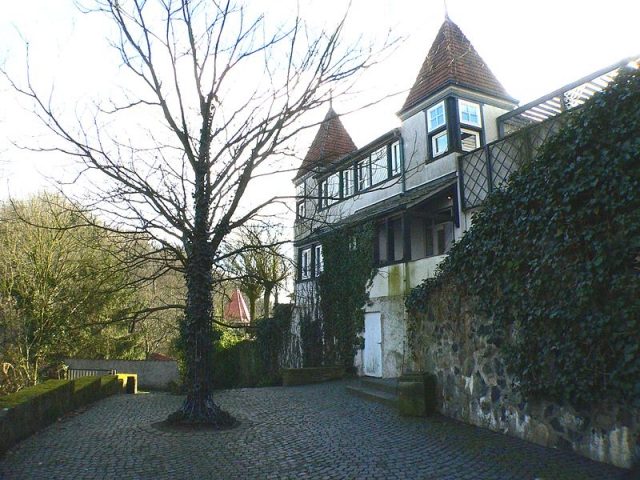
The Wenigenburg (also Unternburg or Hiegenberg) is a vanished Romanesque hilltop castle at 226 m above sea level in the North Hessian town of Gudensberg. It was an outwork of the Obernburg.
The year of construction and the builder are unknown, but the castle probably originated from an economic farm of the Obernburg, on the basalt cone in front of the Obernburg, and was probably fortified already during the time of the Counts of Hessengau from the Werner family. Landgrave Heinrich I of Hesse paid "25 shillings of light Heller" to the guards of the "Unternburg" in 1272.
In 1312, the castle was stormed by Count Heinrich IV of Waldeck in connection with its recapture for the Landgraviate of Hesse. During the siege of Gudensberg in 1387, it was completely destroyed on September 2, 1387, by the Archbishop of Mainz Adolf I of Nassau after a futile defense by Thile von Wehren, and was not rebuilt. Parts were later incorporated into the Gudensberg town fortifications.
Parts of the current buildings probably originated in the 16th and 17th centuries. Tower guards inhabited the Wenigenburg; they alerted the town's residents in case of fire. From 1717, the town musician, who was also responsible for fire alarms, lived on the hill.
From 1738 to 1860, the Lukas family owned the castle, and from 1862, the Hiege family. The latter founded a music school at Wenigenburg. After Sunday service, the music students played choral music from the hill. The hill was therefore called "Hiegenberg" by the people of Gudensberg. In 1900, the music school was closed. From the end of the 19th century until 1975, there was a restaurant in the castle. In 1911, the 23rd Hessian Town Day took place in the newly built Great Hall.
After extensive restoration, the Wenigenburg is now in private hands.
Pictorial Representation+
The oldest verifiable pictorial representation of the Wenigenburg is depicted in Wigand Gerstenberg's regional chronicle of Thuringia and Hesse. In 1627, the engraving of the city of Gudensberg by the engraver Matthäus Merian the Elder was made. In the Topographia Germaniae, Matthäus Merian published this view of the Wenigenburg from 1642 to 1688.
Current Use+
The current buildings are privately owned. A visit is not possible.
Take Mobile History with you
You are reading this text for free. Premium adds what matters on the road: descriptions read aloud, sites found through your camera, whole regions taken offline.
- Every description, including the ~17,700 Premium sites
- Audio guide: have descriptions read to you on location
- AR finder: see sites through your camera, with distance and bearing
- Unlimited saved sites
14 days free, then from €2.99 a month. Cancel anytime.
Source: Wikipedia · Licence: CC BY-SA 4.0 · Image: http://de.wikipedia.org/wiki/Wenigenburg_%28Gudensberg%29#mediaviewer/Datei:Gudensberg_Wenigenburg.jpg
This description draws on the facts documented in the linked Wikipedia article; Wikipedia content is licensed under CC BY-SA 4.0. Wording and editing: Mobile History.
Location: 51.1769, 9.3651