Priest's office
CastleAltdorf bei Nürnberg-Rasch
Welser Castle Rasch
In 1312, with the widow Elspet Harder von Rasch, a family emerged that belonged to the lower ministerialis, but had acquired a small part of the Rasch imperial fiefs. Gustav Voit assumed an earlier affiliation of the Harders with the service of the Counts of Hirschberg, perhaps due to their marriage connections. Whether they resided in the early 14th century at the former imperial ministerialis seat of Hohenrasch is questionable. It cannot be ruled out that they already had a seat in the village at that time, while the site of the ruined castle merely remained to them, as attested in 1547, as an imperial forest fief. The Harder seat could have originated from a castle guard estate endowed with fiefs, as can be observed in the vicinity of other larger castles.
In 1322, Konrad, called "der Eschbercher", described himself as "Lord of Rasche", whose affiliation with the Harders is disputed. In 1339, Berthold Harder "von Rasche" appears. In 1362, the younger Konrad Harder von Rasch sold peasant properties near the "Gybelspurg" to Emperor Charles IV and by 1374 already named himself after Prackenfels Castle. His relative "Conrad der Harder, Prennberger genannt", gave up properties in Rasch and Prackenfels from 1383 and became a citizen of Nuremberg in 1388, where he appears as a member of the Greater Council from 1401 to 1408.
The largest part of the Rasch imperial estates – it comprised six hides, a castle was not mentioned – had been pledged in 1299 by King Albrecht I with the Hofmark Altdorf to Emicho Count of Nassau, whose successors sold it in 1360 to Burgrave Albrecht of Nuremberg. After the sale of the pledge to Palatine Count Ruprecht II in 1393, Konrad Harder soon entered into negotiations with Anna Waldstromer, who already held Prackenfels as a pledge, and with his brother-in-law Hans Strupperger, who belonged to the Palatine Count's retinue. Both interested parties finally bought a share of the Harder properties in 1396. The Strupperger property included the so-called Burgstall, which probably referred to the forest with the vanished imperial castle in the Hofbach district.
In the early 15th century, Jakob Strupperger, who appears in 1427 as the uncle of Albrecht Harder, took over the small knight's estate from his father. According to Klöhr, a new seat near the church on a former farm was built under him at that time, from which the later property No. 27 (since 1819 rectory) emerged.
The exploration of the landscape around Nuremberg, ordered in 1504 by the imperial city council before the outbreak of the Landshut War of Succession, explicitly listed only one seat of the Struppergers in Rasch. Georg Strupperger, who was married to Ursula von Wipfeld and died in the spring of 1541, also resided here. Ursula remarried before 1543 to the Nuremberg citizen Reinhart Rech, son of the wealthy entrepreneur Sebald Rech.
Soon after he took possession, a dispute broke out with the peasant neighbors, who saw their grazing, cattle driving, fishing, and wood rights violated. The Nuremberg Landpflegamt, which had been trying to mediate since 1543, reached a contractual agreement in 1547, which rejected Rech's claims to the wood in the Kaar district (Rascher Berg) and referred to the forest with the old Burgstall "im Hofbach". This contract also states that the seat of the knight's estate was sometimes called "Nidern-Rasch" by its owners; furthermore, it shows that it was no longer known at that time when the "old castle" on the mountain had been abandoned.
Only shortly after the arbitration, Reinhart and Ursula Rech sold the knight's estate with its feudal rights in 1550 to the Nuremberg citizen Andreas Oertel, who had not chosen the time of his purchase particularly fortunately, because the Second Margrave War soon broke out, and enemy troops burned down the seat on May 29, 1552.
The seat remained in ruins, while Oertel, who united his Rasch estate with Grünsberg acquired in 1556, or his son of the same name, had the castle there restored by 1561. Together with Grünsberg, the knight's estate Rasch fell in 1578 to the younger Oertel's son-in-law Sigmund Haller von Hallerstein (1530–1589), who rounded off the property complex by purchasing further estates in Rasch and Prackenfels [cf. Prackenfels]. After the death of his son of the same name in 1620, the "Burgstall" Rasch with the associated estates was sold in 1646 to the grandson Johann Andreas Haller for 2,100 guilders, who sold them with the now restored seat in 1651 for 4,500 guilders to the imperial city of Nuremberg. This leased the estates to the Altdorf caretaker Georg Pömer, and after his death in 1653, to his son Georg Christoph Pömer.
An illustration on a border map of the Amberg government for the Haimburg office from this period shows the manor house as a gabled building with two or three full stories, with a curved gable and two flanking towers with Welsch hoods at the front corners. Whether this representation is reliable must remain open. However, the seat was in a very poor structural condition at that time, as became clear during an assessment in 1654 by Altdorf construction workers.
After some sales negotiations for the manor house, which was in need of renovation, had been broken off without result, it was leased in 1664 to Johann Martin Loefen von Heimhof, who resided in nearby Oberrohrenstadt, until it was sold in 1678 to the widow Magdalena Cregel and her son from her first marriage, Hieronymus Felix Welser (from the Augsburg line). In 1684, he acquired the Eismannsberg estate from Maria Wurmrauscher, née von Pelckhofen, and her sons for 4,200 guilders, but sold it as early as 1688 to Marquard Leopold Schütz von Pfeilstadt for 6,400 guilders. Welser was succeeded after his death in 1715 by his son Carl Friedrich, who had alterations carried out to the outbuildings of the seat in 1735. In 1756, the childless estate owner bequeathed his Rasch properties to his nephew Johann Burkhard Volckamer von Kirchensittenbach, bailiff of the Lorenzi forest office. His son Christoph Adam Friedrich then left the manor house in 1794 to his widow Katharina Helena, née Scheurl von Defersdorf. According to her description in 1809 for the Royal Bavarian Rentamt Altdorf, the seat consisted of a residential house with extensions, the barn, a cellar house, the bakery, a washhouse, the pigsties, and the flower garden. Finally, the widow fell into economic difficulties, which around 1813 led to a forced auction and dismemberment (fragmentation) of the property complex. The manor house was acquired by the Altdorf Rentamtmann Flechsel in 1816 for 5,200 guilders. Already in 1819, he sold the building to the Rasch parish foundation, which then established the new rectory there. The property is still used as a rectory today.
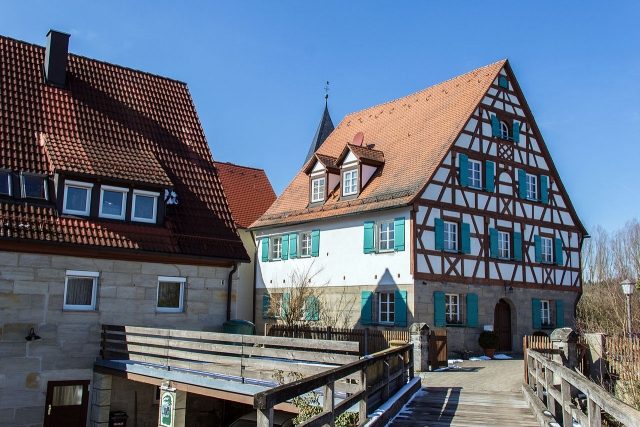
The current main building with the clearly structured half-timbered gable on the east side, only exposed in 1929, probably dates from the second half of the 17th or early 18th century. The wing added at a right angle to the north, also half-timbered except for the later massively renewed west side, was probably built only after 1760. The defensive wall adjoining to the east, still attested by an etching from 1810, as well as a gate tower, probably fell victim to demolition in the first half of the 19th century.
Take Mobile History with you
You are reading this text for free. Premium adds what matters on the road: descriptions read aloud, sites found through your camera, whole regions taken offline.
- Every description, including the ~17,700 Premium sites
- Audio guide: have descriptions read to you on location
- AR finder: see sites through your camera, with distance and bearing
- Unlimited saved sites
14 days free, then from €2.99 a month. Cancel anytime.
Source: Wikipedia · Licence: CC BY-SA 4.0 · Image: http://commons.wikimedia.org/wiki/File:D-5-74-112-187_02.jpg?uselang=de
This description draws on the facts documented in the linked Wikipedia article; Wikipedia content is licensed under CC BY-SA 4.0. Wording and editing: Mobile History.
Location: 49.3675, 11.3749