The remains of the Castle can be visited
CastleMarkgrafneusiedl
Markgrafneusiedl Castle
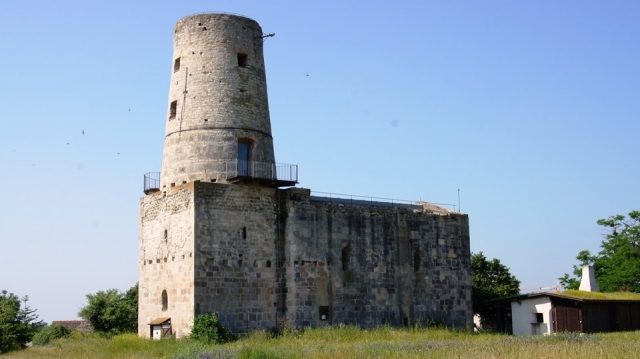
Around 1220, a fortified building made of ashlar stones was erected at the edge of the Wagram. It was part of the defense ring of the Ostmark against Bohemia and Hungary. The fortified tower later also acquired a sacred function, as a church dedicated to St. Martin.
In 1368, it was no longer mentioned as a church but as a "fortress" with St. Martin's Chapel, which suggests that the object retained its defensive character as a secular fortress and castle of the nobility. During the Swedish invasion in 1645, the inhabitants sought refuge in the fortified complex for the last time. However, it was captured by the Swedes, and the feudal lord of the tower, Jakob Salsser, was killed.
On July 5, 1647, the community representatives applied to the sovereign for enfeoffment with the old tower in Markgrafneusiedl. On June 15, 1783, a mass was held for the last time; the priest was forbidden from holding services due to the "indecent condition" of the building. In 1809, the building served the Austrians under Archduke Charles as a command post.
Markgrafneusiedl became the turning point of the battle. By bypassing the eastern defensive point of the Austrians, the French managed to win the battle.
In 1817, the now dilapidated ruin of the fortified church was bought by the miller Josef Danninger and converted into one of the largest windmills. On the night of December 30 to 31, 1862, a persistent storm caused the drive mechanism to overheat, and the mill became a prey to the flames. In 1918, Samuel and Valerie Löw were the owners of the ruin. After its purchase by the Deutsche Ansiedlungsgesellschaft Berlin in 1939, the tower was equipped with an airfield beacon and represented the southernmost point of the Wehrmacht airfield Strasshof. In 1943, the ruin was incorporated into the German Reich.
Between 1958 and 1960, Alfred Schöner was the owner of the ruin. The subsequent owners Fuhry Karl and Brigitte carried out makeshift renovation work on the ruin; it served as accommodation and a "hay stable" for their pony. From 1988, Mr. Kopetzky occasionally inhabited the bungalow and used the ruin as a photo studio and party room. The new owner Helmut Klager from Raasdorf, who bought the ruin in 1988, began a general renovation, which should secure the continued existence of this unique building and industrial monument in the southern Marchfeld.
Take Mobile History with you
You are reading this text for free. Premium adds what matters on the road: descriptions read aloud, sites found through your camera, whole regions taken offline.
- Every description, including the ~17,700 Premium sites
- Audio guide: have descriptions read to you on location
- AR finder: see sites through your camera, with distance and bearing
- Unlimited saved sites
14 days free, then from €2.99 a month. Cancel anytime.
Source: Wikipedia · Licence: CC BY-SA 4.0 · Image: http://www.wehrbauten.at/noe/niederoesterreich.html
This description draws on the facts documented in the linked Wikipedia article; Wikipedia content is licensed under CC BY-SA 4.0. Wording and editing: Mobile History.
Location: 48.2691, 16.6332