The Castle can be visited
CastleMücheln
Sankt Ulrich Castle
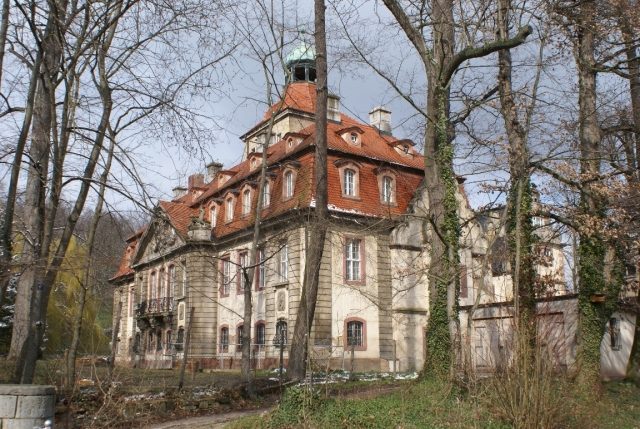
The moated castle Sankt Ulrich in Mücheln (Geiseltal) is a High Gothic to Neo-Baroque complex built around a tower that is still medieval at its core. It was owned by the von Helldorff family from 1770 to 1945.
In the 12th century, there was a moated castle at the site of the present castle, its moat fed by the Geisel, which was still very rich in water at that time. Construction of the castle began in the second half of the 15th century. It was a pile dwelling on oak stilts. The moat around the castle must still remain filled today so that the piles do not lose their stability due to drying out. The castle features High Gothic and Renaissance architectural elements around a tower that is still medieval at its core. In 1624, it was rebuilt again. Particularly noteworthy is a square Renaissance oriel window - next to the main entrance - with an onion dome. From 1528 to 1764, the castle and manor were owned by the von Breitenbauch family. Around 1720, the then owner, a Mr. von Breitenbauch, had a Baroque garden in the French style and an English landscape park laid out next to the castle and estate on the sunny southern slope of the Geisel. In 1770, Johann Heinrich von Helldorff, canon of the Merseburg collegiate church, bought the entire estate. The castle, manor, castle park, and terraced garden remained in the possession of the von Helldorff family until their uncompensated expropriation and expulsion by the communists in 1945. From 1921 to 1925, Karl Roderich von Helldorff had the moated castle rebuilt and beautified. Among other things, a Neo-Baroque superstructure was added to the western wing of the castle. The architect was Paul Salinger. After the Second World War, the castle became a youth workhouse and from 1948 to 1993 a children's home. In 2010, the building was in need of renovation, and the corresponding work is being carried out gradually.
The manor Sankt Ulrich consists of imposing and very solid buildings. During the GDR era, it was a state-owned farm (VEG). Slogans from the early GDR era can still be found on the walls: "The National Front fights for the defense of German culture" (all in capital letters and black, red, and gold on the sides). Elsewhere, one can see the painted emblems of the Young Pioneers, FDJ, and FDGB.
A "Herrenmühle" or "Gutsmühle" (manor mill), built in 1868 on the site of a former gunpowder mill, ceased actual milling operations in 1933 and, with its then overshot mill wheel, only transported water for the estate's needs. Today, an undershot mill wheel turns here with a sparse flow of water.
Not far from the castle stands the castle church or Luther church. It was built in 1790/95 in late Baroque style according to plans by the Merseburg collegiate architect J. W. Crysellius. The appealing interior decoration has been preserved. An interior renovation took place in the late 1980s, and the exterior renovation in the early 1990s.
Take Mobile History with you
You are reading this text for free. Premium adds what matters on the road: descriptions read aloud, sites found through your camera, whole regions taken offline.
- Every description, including the ~17,700 Premium sites
- Audio guide: have descriptions read to you on location
- AR finder: see sites through your camera, with distance and bearing
- Unlimited saved sites
14 days free, then from €2.99 a month. Cancel anytime.
Source: Wikipedia · Licence: CC BY-SA 4.0 · Image: Roland Neubert, Halle (Saale)
This description draws on the facts documented in the linked Wikipedia article; Wikipedia content is licensed under CC BY-SA 4.0. Wording and editing: Mobile History.
Location: 51.3007, 11.7970