To be privately owned
CastleNürnberg-Reichelsdorf
Waldstromer Castle
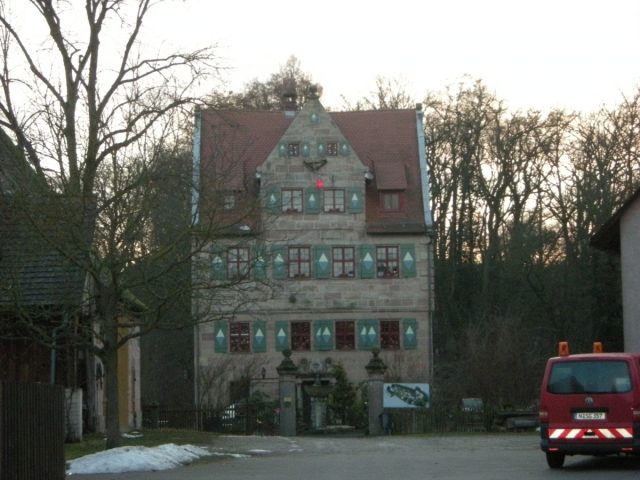
As early as Johannes Müllner's Annals of the Imperial City of Nuremberg from 1623, there are reports of a ministerial family from Reichelsdorf or Reichersdorf, who around 1300 resided on the imperial forest estate in Reichelsdorf and who were probably of the same lineage as the ministerials of Eibach. They presumably belonged to the retainers of the imperial ministerial family Rindsmaul, who are mentioned in 1391 as feudal lords of the "dwelling" in Reichelsdorf.
In July 1299, a Lord Sifrit von Reicholtsdorf and his son Rudger are attested in connection with a dispute over meadows, and in 1313, a Rüdiger, named after the place. In the 1330s, Rüdiger's heirs sold a large part of the property, most recently in 1336 the rights "to the forest in Reycherstorf" with the mill, forest rights, and appurtenances to Conrad Waldstromer. Emperor Ludwig the Bavarian confirmed to him in 1344 the possession of the forest estate in Reichelsdorf as well as half of the Eibach forest estate, which he had also acquired in the meantime. In 1382, the last shares were transferred to the Waldstromer family. From then on, the forest estate and also the manor house in Reichelsdorf, explicitly mentioned only in 1377, were in the hands of the Waldstromer family, a branch of the Schwabach-Nuremberg imperial ministerial family Stromair/Stromer, who had been enfeoffed with the dignity of Imperial Forest Master. In 1386, a chapel on the courtyard of the seat was mentioned for the first time.
When the Imperial Forest Master's office was sold to the Imperial City of Nuremberg in 1396, the Waldstromer family retained the forest estates of Reichelsdorf and Eibach. During the enfeoffment of the Waldstromer family by the later Emperor Frederick III in 1442, the imperial fiefdom "dwelling" with surrounding moats and two gardens is attested. An inventory from 1482 records "the castle site, where the castle stood, together with the large moat that surrounds it". The occasion on which the small castle was destroyed is not known - perhaps in the First Margrave War of 1449/50. In any case, the report on the land survey, which the imperial city council had ordered before the outbreak of the Landshut War of Succession in 1504, also shows no fortified seat in Reichelsdorf.
In 1519, a seat of the Waldstromer family is again attested. In 1539, Berthold Waldstromer von Reichelsdorf sold part of his assets to the Margrave. Therefore, the Imperial City, taking advantage of an inheritance dispute that broke out after Berthold's death in 1547, hastened to buy the manor house and the forest estate in 1548 and 1550 with the help of straw men, before they could also be acquired by Brandenburg-Ansbach. Shortly after this transaction, in the Second Margrave War, the Margravial troops burned down the seat, the hammer mill, the farmstead, and all associated taxable farms on May 11, 1552.
The seat, still lying in rubble and ashes in 1554, passed to the council consultant Dr. Johann Gemmel, who immediately granted the council the right of opening in times of war. By 1557, the city lawyer had the property rebuilt. The manor house was erected on its old site, surrounded by a moat, as a three-story tower house. Gemmel's widow sold the seat before 1565 to Michel and Simon Steinhauser. From the Steinhauser family, it passed in 1589 to a merchant Balthasar König, who in turn ceded the seat in 1599 to Stefan Kötzler; both opened the seat to the Imperial City of Nuremberg. In 1629, the buyer died and bequeathed it to his son of the same name. However, the young Kötzler had to accept in September 1632 that Wallenstein's army set fire to the manor house again upon their departure.
The renewed reconstruction of the manor house and the farm buildings was by no means, as Werner Sprung states, "vigorously tackled" in the period thereafter. On the contrary: Stefan Kötzler initially had only a residential house renewed in 1636/37 in the northern forecourt of the farmstead, so that he could again accommodate a bailiff and at least put the castle economy into operation. The manor house therefore fell into ruin in 1653 to Karl Kötzler, councilor to the Prince of Hohenlohe-Öhringen. The heir still complained in 1675 about his father's war damage, when he could finally prepare for the restoration and begin around 1679. Karl Kötzler, however, died in 1684 during the construction work, whereupon his brother Christoph Hieronymus took over the property. He will have completed the renovation of the castle by 1686, which has since presented itself as a three-story, solid rectangular building. Its appearance is characterized by a two-axis, volute-decorated dormer, rusticated corners of the second upper floor, and various gable attachments.
With the death of Christoph Hieronymus Kötzler, the old Nuremberg family died out in the male line on October 4, 1695. From the community of heirs, consisting of daughters and sons-in-law, the seat and the forest estate were sold to the Nuremberg citizen and cutler Georg Stepper, who had a new bailiff's house built in 1722 and undertook alterations to the manor house in 1731. Around 1750, Christoph Karl Joseph von Volckamer acquired the property. The rectangular moat, over which two bridges led north and south to the manor house with the inner courtyard once enclosed by a curtain wall, was converted into a meadow in the second half of the 18th century.
In 1818, Reichelsdorf Castle passed to Sigmund Friedrich Karl Wilhelm von Volckamer and his sister Maria Philippina Karolina, married to Dr. Emil von Furtenbach. In 1833, the sister took over the entire property. Around 1839, the couple undertook a renovation of the manor house, as indicated by a year on the eastern gable. The husband finally established a chemical factory in the castle complex, which was not operated for long, but according to Friedrich August Nagel's words "caused great damage to the buildings". In 1880, after Furtenbach's death, the property was sold to the Barons von Stromer, who, however, only kept it until 1891.
In the last years of the 19th century, the owner Johann Georg Kettlein, a farmer, used the manor house as a rental property. Kettlein's heirs sold the property in 1902 to Ferdinand Hirt, until in 1906 the post director Karl August Eßlinger from Leer in East Frisia bought it. He gave the residence its "ancient character" by having an old well with a water basin and various stone figures installed. He is also said to have broken up many old chests to panel the large room on the upper floor with the boards. A Renaissance paneling in a room on the second upper floor was translocated here from the so-called Tilly Room of the "Bayerischer Hof" hotel in Nuremberg. The open fireplace on the ground floor is a dummy from East Frisia. The ground floor hall, supported by an octagonal column and a beam, was created at that time by demolishing several, perhaps subsequently installed, interior walls. Eßlinger also published a short, unfortunately very deficient history of Reichelsdorf in 1922. In 1921, the manufacturer Hans Durban acquired the manor house with the large garden; his descendants were still owners in the late 20th century.
Take Mobile History with you
You are reading this text for free. Premium adds what matters on the road: descriptions read aloud, sites found through your camera, whole regions taken offline.
- Every description, including the ~17,700 Premium sites
- Audio guide: have descriptions read to you on location
- AR finder: see sites through your camera, with distance and bearing
- Unlimited saved sites
14 days free, then from €2.99 a month. Cancel anytime.
Source: Wikipedia · Licence: CC BY-SA 4.0 · Image: http://schloesserrundschau.de/bayern/schloesser01/nuernberg36.html
This description draws on the facts documented in the linked Wikipedia article; Wikipedia content is licensed under CC BY-SA 4.0. Wording and editing: Mobile History.
Location: 49.3759, 11.0286