The Castle can be visited
Museum
CastleWaldburg
Waldburg Castle
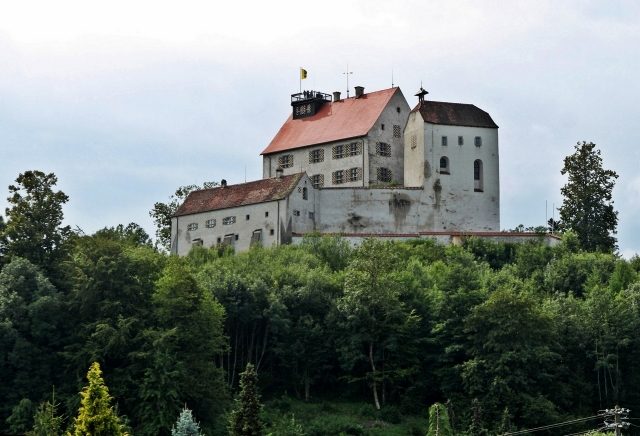
Waldburg Castle is the ancestral seat of the Truchsess and Imperial Princely House of Waldburg. It dates back to the 12th century and is located in the municipality of Waldburg in the Ravensburg district in Upper Swabia.
Waldburg Castle is situated on a natural elevation, a drumlin from the Würm Ice Age, at an altitude of 772m. Its elevated position with long-distance views (in suitable weather conditions) west to Hohentwiel near Singen, north to Ulm Minster, far into the Alpine foothills to the east, and far into the Swiss Alps to the south, made Waldburg Castle an important trigonometric survey point for land surveying in the early 19th century. The steep drumlin, with its very large slope angles, already offers almost ideal military protection for a castle complex, but also significantly complicated its construction and expansion over 7 centuries.
Until the 1980s, the hilltop castle was heavily forested. Through targeted clearing at the beginning of the 1990s for its reopening to the public in 1996, the view of the castle was restored to its old state. Both during the day and at night with illumination, the castle is a very prominent and important landmark in Upper Swabia.
The first foundation of the castle dates back to the 11th century. During this time, the Waldburg family received an official fief from the Welfs. In the first half of the 13th century, the castle was fundamentally rebuilt, and the palas was newly constructed up to the second floor.
Under Emperor Frederick II, the Imperial Regalia were kept in the castle from 1220 to at least 1240. The Holy Lance and the Imperial Orb are exhibited as replicas in the castle's rooms.
In 1327, St. Magnus Church was built. It houses in a niche of the sacristy the tomb of the blessed Habnit, who lived in the 16th century, was originally a village shepherd, and gained supra-regional fame as a healer of childhood diseases.
In the mid-16th century, under Truchsess Georg IV von Waldburg, the castle was expanded into a palace-like residential and administrative seat. From the 17th century onwards, the castle was only sporadically inhabited by the Waldburg family, and construction activity decreased.
Today, the castle houses a museum and is open for visits during the summer months. Many weddings take place at Waldburg Castle. For this purpose, parts of the museum and the vaults can be used. The castle chapel is still very often used for church weddings today.
Quotes+
- To the traveler coming from Franconia and Bavaria, we recommend a visit to Waldburg Castle, which is perfectly suited for a panoramic view. (Gustav Schwab)
Take Mobile History with you
You are reading this text for free. Premium adds what matters on the road: descriptions read aloud, sites found through your camera, whole regions taken offline.
- Every description, including the ~17,700 Premium sites
- Audio guide: have descriptions read to you on location
- AR finder: see sites through your camera, with distance and bearing
- Unlimited saved sites
14 days free, then from €2.99 a month. Cancel anytime.
Source: Wikipedia · Licence: CC BY-SA 4.0 · Image: Norbert Kaiser
This description draws on the facts documented in the linked Wikipedia article; Wikipedia content is licensed under CC BY-SA 4.0. Wording and editing: Mobile History.
Location: 47.7589, 9.7119