Official residence of the State Ministry of Baden-Württemberg and the acting Prime Minister
ResidenceStuttgart-Ost
Villa Reitzenstein
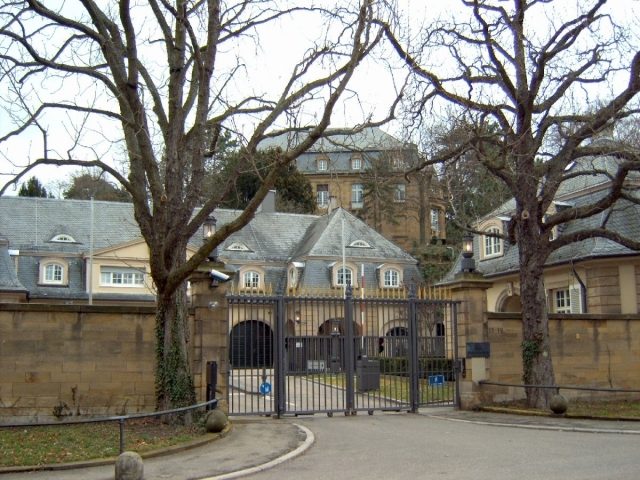
Villa Reitzenstein in Stuttgart is the official residence of the State Ministry of Baden-Württemberg and the incumbent Minister-President. It is located in the Stuttgart-Ost district, halfway up a hill on the slope of the Bopser, southeast above the Stuttgart valley basin.
Villa Reitzenstein was built between 1910 and 1913 for Baroness Helene von Reitzenstein. She was the second daughter of the Stuttgart publisher Eduard Hallberger.
The architects of the villa were Hugo Schlösser and Johann Weirether. The client sent both on a trip to France (Paris and Loire castles) and Italy prior to the work, to gather inspiration for the exterior and interior architecture of the villa. The building was constructed in the French Baroque style as a two-story, three-wing complex made of Maulbronn sandstone and topped with a mansard roof. It was already equipped with a central hot water heating system, which was not yet common at the time. Due to the professional background of the owner's family, particular emphasis was placed on the interior design of the villa's library. The total construction costs of the villa and its park amounted to 2.8 million Goldmark, which corresponds to approximately 14 million Euros.
The two-and-a-half-hectare garden of the villa was laid out in 1912 according to the designs of garden architect Carl Eitel, partly in the French formal style and partly in the English style, by gardener Georg Stirnweis, an employee of Carl Eitel's landscape gardening firm, and maintained for the following four decades. The garden consisted of solitary trees, a rosarium, several ponds, and a tempietto dedicated to Cupid. The enclosed complex includes various outbuildings. After the Second World War, a residential building for the American military and an administrative building were erected in the park, so that today only just under one hectare of the park remains.
Helene von Reitzenstein lived in her villa for only nine years. During the First World War, she left Stuttgart, and the building was temporarily used as a reserve hospital for officers. After the Baroness moved her residence to Darching in Bavaria, Johannes von Hieber, State President of the Free People's State of Württemberg, had the villa acquired by the state during the inflation period in 1922 for a favorable 5.5 million Papiermark (approx. 400,000 Goldmark). The government had intended to bring the Imperial Administrative Court to Stuttgart and house it there. However, this plan was not realized; the court was initially to be established in Karlsruhe but then only came into being in Berlin in 1941. The villa was converted and served as the seat of the Württemberg State President from 1925. State President Wilhelm Bazille was the first to reside there. He is the only head of government to date who not only had his official residence but also his private residence there. He was followed in 1928 by Eugen Bolz, who was deposed in March 1933 at the beginning of the National Socialist era in Württemberg and executed in 1945. Villa Reitzenstein was the seat of the Stuttgart NSDAP party leadership for twelve years under Gauleiter and later Reichsstatthalter Wilhelm Murr. From this period also dates a – now bricked-up – tunnel beneath the actual cellar of the villa, which was built for Murr. Prisoners and forced laborers were also used in its construction. The destruction of the villa, prepared by Murr according to the Nero Decree, was prevented after Murr's flight from Stuttgart on April 20, 1945, by a ministerial councilor named Karl Benz.
On April 22, the Lord Mayor handed the city over to French troops. They briefly took possession of the villa, and after the war, the US military governor, General Lucius D. Clay, had his seat there. The Länder Council (consisting of the Minister-Presidents of the US-occupied federal states) convened by Clay also met in the Gobelins Hall. From 1948, the villa was the official residence of the Minister-President of Württemberg-Baden, Reinhold Maier, and since 1952, it has been the official residence of the Minister-Presidents of Baden-Württemberg. On June 19, 1983, the Stuttgart Agreement, a solemn declaration within the framework of the Single European Act, was drafted in the so-called corner room of the house by the then German Foreign Minister Hans-Dietrich Genscher and his Italian counterpart Emilio Colombo. In this agreement, the states of the European Community commit to reviewing progress in the areas of inter-institutional relations, Community competencies, and political cooperation, and to incorporating them into a new treaty for the European Community if necessary.
In the summer of 2013, extensive work will begin on the ten buildings of the State Ministry located on the grounds of Villa Reitzenstein, for which costs of 27.8 million Euros are estimated. This includes the renovation and technical modernization of the villa, combined with the demolition of its extension built in the 1970s, which will be replaced by a new building. The return of the Minister-President to the villa is expected for the summer of 2015.
Naming+
The villa is named after the deceased husband of the client, Carl Friedrich Sigmund Felix Freiherr von Reitzenstein, from the Franconian noble family of Reitzenstein. He was chamberlain to Queen Charlotte of Württemberg and son of General Karl Bernhard Freiherr von Reitzenstein, who had led the Württemberg troops in the Franco-Prussian War of 1870/71. Baron von Reitzenstein was fond of gambling and died at the roulette table in Baden-Baden in 1897. The Deutsche Verlags-Anstalt (DVA) was formed in 1881 through a merger of the publishing house founded in 1848 by Eduard von Hallberger, the client's father, and the Hallberger'sche Verlagshandlung, founded in 1831 by his father Louis Hallberger. In 1920, the industrialist Robert Bosch acquired the majority stake in DVA.
Take Mobile History with you
You are reading this text for free. Premium adds what matters on the road: descriptions read aloud, sites found through your camera, whole regions taken offline.
- Every description, including the ~17,700 Premium sites
- Audio guide: have descriptions read to you on location
- AR finder: see sites through your camera, with distance and bearing
- Unlimited saved sites
14 days free, then from €2.99 a month. Cancel anytime.
Source: Wikipedia · Licence: CC BY-SA 4.0 · Image: http://schloesserrundschau.de/bawue/schloesser/stuttgart002.html
This description draws on the facts documented in the linked Wikipedia article; Wikipedia content is licensed under CC BY-SA 4.0. Wording and editing: Mobile History.
Location: 48.7714, 9.1928