Museum
Restaurant
CastleHering
Otzberg Castle (Hering)
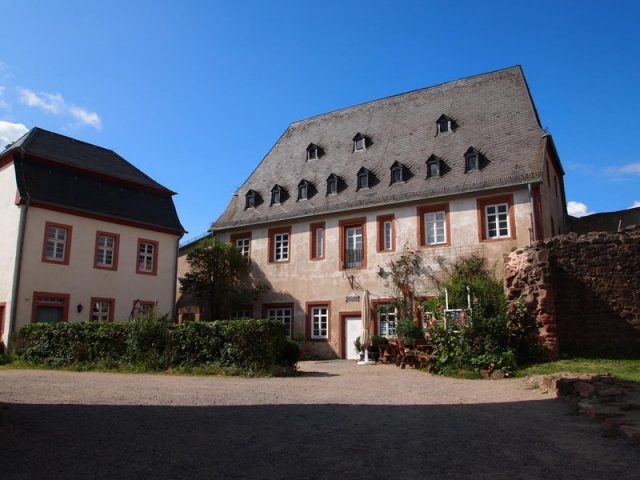
Veste Otzberg was built on the summit of the mountain of the same name in the Odenwald at 368 m above sea level. On its northern slope is the village of Hering, which emerged from the outer bailey or the settlement of the burgmannen. The history of the castle and the village is therefore closely linked.
The area around Otzberg probably belonged to the territory that King Pippin granted to Fulda Abbey in 766, along with Groß-Umstadt.
Veste Otzberg was probably built at the end of the 12th, beginning of the 13th century.
At this time, Abbot Marquard I of Fulda secured the monastery's possessions and erected widely visible castles as a sign of his influence.
He handed over the castle to Konrad the Staufer, the brother of Emperor Frederick Barbarossa, as Vogt. The Staufer was Count Palatine of the Rhine.
The castrum Othesberg was first mentioned in a document in 1231.
In this document, Archbishop Siegfried III of Mainz, also administrator of Fulda Abbey, guarantees Count Palatine Otto II the agreement made the previous year, the content of which is unknown.
In 1244, castellanos de odesbrech, burgmannen of Otzberg Castle, appeared for the first time. The defensive structure must have been completed to such an extent that five burgmannen, together with their servants, could occupy the complex. The burgmannen built farms, so-called burgmannen houses, in the village of Hering. Parts of the property of the Gans von Otzberg are still preserved from these.
At the beginning of the 14th century, Fulda Abbey ran out of funds, so Prince-Abbot Heinrich VI von Hohenberg pledged Veste Otzberg and the Fulda share of Umstadt for 4600 pounds Heller to Werner von Anevelt and Engelhard von Frankenstein in 1332, who had buildings erected on Veste Otzberg for 200 pounds.
Fulda redeemed the estate in 1374, but in the same year pledged Otsperg die burg, Heringes die stat darundir and half of Umstadt for 23,875 guilders to Ulrich von Hanau, who in turn carried out construction measures in the castle for 400 guilders.
In 1390, the monastery sold Otzberg and Hering, as well as half of Umstadt with the Hanau pledge, which had by then increased to 33,000 guilders, to Count Palatine Ruprecht II.
In 1504, the Bavarian Feud was partly fought at Otzberg. In the dispute over the Landshut inheritance, Emperor Maximilian declared the imperial ban against Count Palatine Philipp for breach of the public peace. Landgrave Wilhelm II of Hesse militarily occupied Veste Otzberg. After the Diet of Konstanz in 1507, the Electoral Palatinate reclaimed the Otzberg office and did not relinquish possession. However, weapon technology had changed, so the Veste could no longer be held by burgmannen alone. From 1511, a Zwinger was built, the inner wall ring was reinforced, and a new gatehouse was erected.
In the middle of the 16th century, a stone city wall was also built around the outer bailey (the village of Hering).
In 1621, during the Thirty Years' War, a Bavarian corps of 2000 men, as well as imperial and Spanish troops, quartered in the Otzberg-Umstadt area and besieged Veste Otzberg. A year later, in 1622, the castle's garrison capitulated.
The Veste and the Otzberg office, as well as half of Umstadt, returned to Hesse in 1623, which received them as compensation for war damages suffered.
In 1647, the French occupied the Veste. They settled in the castle and helped themselves to the remaining provisions. With the Peace of Westphalia in 1648, Otzberg returned to the Palatinate.
Although the entire Palatinate was in French hands during the French War, the two offices of Otzberg and Umstadt remained Electoral Palatinate. At that time, the Palatinate Archive was stored in Veste Otzberg, from which ownership claims for a new beginning could be proven.
With the stabilization of political conditions, Veste Otzberg had lost its military significance for the Palatinate. Gradually, from 1711, active soldiers were replaced by invalids, so that from 1720, Veste Otzberg presented itself as a pure invalid garrison guarding the prisoners held within.
In 1802, the Electoral Palatinate Oberamt Otzberg passed to Hesse-Darmstadt, which used it as a state prison from 1803.
In 1818, Veste Otzberg was abandoned as a location.
On July 25, 1826, a decree was issued by the Ministry of Finance in Darmstadt to preserve the tower of the Veste, the commandant's house with the small stables, the doctor's residence, the stable near the sutler's shop, the well house, and the New Barracks (Bandhaus). All other buildings were to be sold for demolition.
In 1921, the Bandhaus was converted into a youth hostel.
In the 1950s, a forestry office and a restaurant were located in the commandant's house. The commandant's house was used jointly as a forester's house and restaurant until the mid-sixties and then continued as a restaurant with changing tenants.
From 1985, the Museum Collection of Folklore in Hesse moved into the Bandhaus. In 1996, the Korporalshaus was rebuilt. Since then, it has been used as a museum building and registry office for the municipality of Otzberg.
Military+
The inhabitants were soldiers from the beginning; in the 14th century, six men lived there, around 1471, 14 people were mentioned. Specialized mercenary troops were added only in the 16th century, at the time when the property was expanded into a fortified fortress.
Architectural Description+
The shape of the fortress is characterized by the double ring walls, built in the 16th century, which describe an oval shape, and the keep, which is of Romanesque origin. The character is still that of a fortress from the period after the introduction of artillery; typical castle features such as tower landscapes are completely absent.
Keep
The keep, popularly known as the White Turnip, is the oldest building of Veste Otzberg. On clear days, from the 17-meter-high White Turnip, one can see across the entire Darmstadt-Dieburg district to Frankfurt am Main and the Taunus.
Well
The castle well from approx. 1320 at the passage is one of the deepest wells in Hesse. According to recent excavations, the depth of the well is estimated to be only about 50 meters. Next to it stands the treadwheel installed in 1788, which significantly facilitated water extraction at that time.
Commandant's House
The Commandant's House, which today houses the Burgschänke (castle tavern), was built in 1574 along with several other new buildings.
Palas
The Palas houses the Otzberg Museum – Collection of Folklore in Hesse.
Barracks/Kemenate
The former Kemenate was later used as barracks. Due to the Hessian demolition order of 1806, it was destroyed as one of the few buildings on Veste Otzberg. Today, only the foundations are visible.
Corporal's House
The Corporal's House, rebuilt in 1996, serves as the wedding room for the municipality of Otzberg.
Source text: Wikipedia
Take Mobile History with you
You are reading this text for free. Premium adds what matters on the road: descriptions read aloud, sites found through your camera, whole regions taken offline.
- Every description, including the ~17,700 Premium sites
- Audio guide: have descriptions read to you on location
- AR finder: see sites through your camera, with distance and bearing
- Unlimited saved sites
14 days free, then from €2.99 a month. Cancel anytime.
Source: Wikipedia · Licence: CC BY-SA 4.0
This description draws on the facts documented in the linked Wikipedia article; Wikipedia content is licensed under CC BY-SA 4.0. Wording and editing: Mobile History.
Location: 49.8199, 8.9109