Local Authorities
Cultural Events
CastleHohe Börde - Bebertal
Veltheimsburg Castle
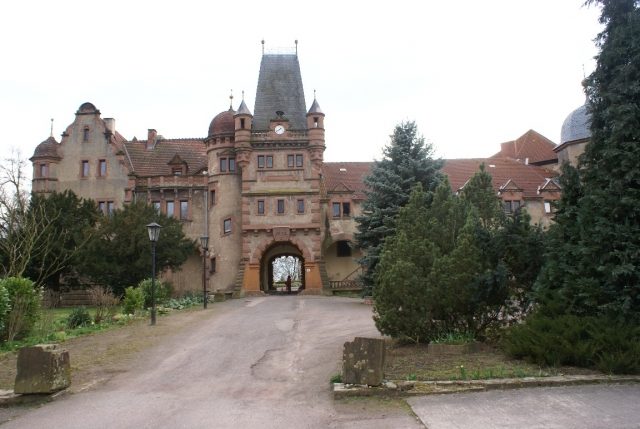
The former Alvensleben Castle, today: Veltheimsburg, is a former castle complex in the district of Bebertal, which belongs to the present-day municipality of Hohe Börde and was formed in 1950 from the merger of the municipalities of Alvensleben and Dönstedt.
The Archdeaconry of Alvensleben was one of the oldest settlements of the Bishopric of Halberstadt. To protect it, the bishops founded a castle on a rock massif above the Bever valley, in whose care a market town developed in the 10th century (first, albeit unconfirmed, documentary mention in 964). The episcopal ministerial family of Alvensleben, who held the office of castle bailiffs in the 12th and 13th centuries, named themselves after it. Nineteen municipalities belonged to its administrative district.
The name Alvensleben is derived from the personal name Albwin (Old High German: "alp" = elf, nature spirit, "wini" = friend, i.e., elf friend) or Alf (abbreviated form of Alfert = splendid elf) and from the ending -leben (= legacy, inheritance). The meaning of the place name is thus to be understood as "possession or inheritance of Albwin or Alf". It is probably to be dated to the pre-Carolingian period.
In the Middle Ages, Markt Alvensleben – enclosed by walls and gates – was a structure bristling with towers. The town's ring wall enclosed two churches and several tower houses of the knightly service. Silver mining was carried out in the surrounding area.
The adjacent map shows the site plan of the castle hill according to the separation map of 1833/35.
The town was dominated by two castles, the episcopal one, whose main tower is visible in the background in Anco Wigboldus' drawing (status 1937), and the Brandenburg margravial one in the foreground. The location of a third castle is unclear.
Bishop's Castle and Alvensleben Office+
The Bishop's Castle was in the possession of the Bishops of Halberstadt in 1180 (first documented mention), but is probably much older. It came into the possession of the Archbishops of Magdeburg at the beginning of the 14th century, who mostly mortgaged the castle, most recently from 1534 to 1598 to Gebhard XVII von Alvensleben and his sons Ludolf X and Joachim I, who restored the already heavily dilapidated buildings. Thereafter, the castle was administered as an office by state officials. In 1649, the economic operations, and in 1685, the seat of the bailiff, were moved to Markt Alvensleben. The castle fell into disrepair except for the tower. The castle grounds were acquired in 1837 during the course of the separation by District Administrator Otto August von Veltheim (1798-1848) and transformed into a landscape park.
Margrave's Castle, later Veltheimsburg+
The Margrave's Castle was built before 1245 by the Margraves of Brandenburg directly next to the Bishop's Castle, was part of the fortifications and was also referred to as the rear castle. In 1439, it came into the possession of the Lords of Veltheim as an archiepiscopal fief, who gave the castle the name Veltheimsburg after an expansion with a new manor house in the 18th century. In 1882 and 1910, it was expanded and supplemented in a romanticizing form. It remained in the possession of the von Veltheim family until its forced expropriation by the communists in 1945.
Knight's Castle or "Musikenburg"+
A third castle, the Knight's Castle or "Musikenburg", was built at the beginning of the 13th century by Gebhard I von Alvensleben (doc. 1190–1216), but sold by his son Johann II von Alvensleben (doc. 1232–1248) to the Bishop of Halberstadt. It is said to have been located on the hill on the right side of the picture. However, this has not yet been confirmed by archaeological investigations, so the location of this castle remains unclear. According to legend, it bore its name because "the sound of trumpets, horns and cymbals, with the clinking of cups and the whirl of dances, almost never ceased within it".
Current State+
Documents that would have allowed a reconstruction of the significant facilities do not exist. Except for the round keep and the visible remains of the Romanesque palas of the Margrave's Castle, all medieval buildings have been demolished. Also present are the manor house and a courtyard building of the Veltheimsburg. The associated park, under which a labyrinth of underground passages is said to extend, covers the grounds of the former Bishop's Castle and the surrounding sloping castle hill rock. After 1945, the buildings of the Veltheimsburg served, among other things, as a children's home. After the fall of the Berlin Wall in 1990, the Braunschweig entrepreneur Hans-Dieter Neddermeyer († 2012) acquired the entire castle complex and carried out extensive renovations. Part of the buildings are used as a registry office, a local history museum, and for gastronomy. Flea markets, garden festivals, and shooting festivals are held on the castle grounds.
Take Mobile History with you
You are reading this text for free. Premium adds what matters on the road: descriptions read aloud, sites found through your camera, whole regions taken offline.
- Every description, including the ~17,700 Premium sites
- Audio guide: have descriptions read to you on location
- AR finder: see sites through your camera, with distance and bearing
- Unlimited saved sites
14 days free, then from €2.99 a month. Cancel anytime.
Source: Wikipedia · Licence: CC BY-SA 4.0 · Image: Roland Neubert, Halle (Saale)
This description draws on the facts documented in the linked Wikipedia article; Wikipedia content is licensed under CC BY-SA 4.0. Wording and editing: Mobile History.
Location: 52.2405, 11.3307