Local Authorities
CastleSiegen
Unteres Castle (Siegen)
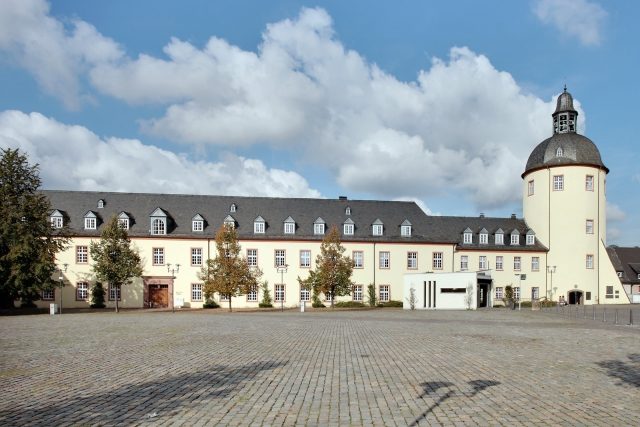
The Lower Castle, formerly also known as Nassauischer Hof, is located in the city center of Siegen. Originally a Franciscan monastery, the building became the residence of the Protestant line of the House of Nassau-Siegen in the 17th century. Today, it houses state authorities.
A Franciscan monastery existed on the site of the present castle since 1489. After its dissolution during the Reformation, the Hohe Schule, located in Herborn, was temporarily housed there from 1534. Following the division of the House of Siegen-Nassau into a Catholic and a Protestant line after 1623, the complex became the residence of the Protestant line. It was therefore also called Nassauischer Hof.
Already during the time of Johann Moritz von Nassau-Siegen, who was among other things Governor-General of Dutch Brazil, negotiations were held with the city for an extension of the building. During his lifetime, the princely crypt was created around 1668 by the Dutch master builder Maurits Post. A gallery wing was also built during this period. Parts of it can be found in today's north wing. Building activity continued under the subsequent princes. For example, a gatehouse was erected in 1690. Its portal was moved to the north wall of the chapel wing in the Upper Castle before its demolition in the 19th century.
The Lower Castle complex was largely destroyed by the great city fire of 1695, with the exception of the gate and the princely crypt. The master builder Peter Remboldt then rebuilt the north wing ("Courland Wing") and a series of outbuildings between 1698 and 1711. A new central wing ("Corps de Logis") incorporated the princely crypt. The facade of this part is characterized by an arcade formed by 21 pillars. Subsequently, the location of the princely crypt was visually emphasized in 1884 by the addition of a central risalit. Already outside the then city walls, Remboldt laid out the baroque castle garden ("Herrengarten"). This included an orangery in 1701. Construction of a south wing began in 1717. The master builder was now Philipp Ploennies. In 1721, the "Dicke Turm" (Thick Tower) was built as an archive tower in place of a medieval tower of the city wall. It was only connected to the Courland Wing by an intermediate building in 1802. On the northeast side of the castle square were the stables and a ball house. Both were not rebuilt after the Second World War.
After the end of the Protestant line of Nassau-Siegen in 1722, the castle served as a widow's residence until 1782 and also as an administrative building from 1742. After the Siegerland became part of Prussia in 1815, the castle served, among other things, as the official seat of the district administrator. In 1816, the Siegen Mining Office was founded in the Lower Castle, and in 1818, the "Royal Mining School Siegen" was opened in a room in the "Courland Wing". In 1822, Siegen's post office was housed in the Wittgenstein Wing of the castle. Between 1864 and 1976, the district and regional court were located in the castle.
Current Use+
Since 1930, a branch of the JVA Attendorn has been located there (until 2010). In addition, it is a state administrative building. It houses the Siegen Labor Court, the Bau- und Liegenschaftsbetrieb NRW, the external office of the Arnsberg District Government, and the Office for Occupational Safety. From 2013, the Department of Business Administration, Business Informatics, and Business Law of the University of Siegen is to use the building. The branch of the Attendorn Correctional Facility, the Labor and Social Court, and the other state authorities are to have moved out by then.
The castle square is also used today for large events, including the Siegen Open Air Cinema and for public viewing during the FIFA World Cups in 2006 and 2010 and the UEFA European Championship in 2008. Since 2007, the Siegen Christmas Market has also been held there in December.
Take Mobile History with you
You are reading this text for free. Premium adds what matters on the road: descriptions read aloud, sites found through your camera, whole regions taken offline.
- Every description, including the ~17,700 Premium sites
- Audio guide: have descriptions read to you on location
- AR finder: see sites through your camera, with distance and bearing
- Unlimited saved sites
14 days free, then from €2.99 a month. Cancel anytime.
Source: Wikipedia · Licence: CC BY-SA 4.0
This description draws on the facts documented in the linked Wikipedia article; Wikipedia content is licensed under CC BY-SA 4.0. Wording and editing: Mobile History.
Location: 50.8739, 8.0214