The remains of the Castle can be visited
CastleKyffhäuserland-Steinthaleben
Lower Castle Kyffhausen
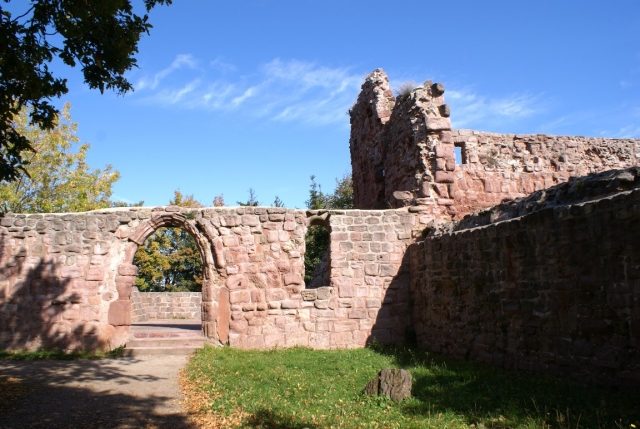
The Imperial Castle of Kyffhausen is a medieval castle ruin in the Kyffhäuser Mountains, located on the 439.7 m above sea level Kyffhäuserburgberg, in the municipality of Steinthaleben, near the town of Bad Frankenhausen in the Kyffhäuser district, Thuringia, close to the border with Saxony-Anhalt.
The Imperial Castle consists of three individual medieval fortifications, separated by defensive ditches. These castles are called the Upper, Middle, and Lower Castles. With a length of over 600 meters and a width of around 60 meters, they collectively form one of the largest castle complexes in Germany. Together with the castle museum and the Kyffhäuser Monument located within the castle grounds, the castle is one of the most visited tourist destinations in Germany, particularly well-known through the Barbarossa or Kyffhäuser legend.
The ruins of the Imperial Castle of Kyffhausen are located in the Kyffhäuser Mountains within the Kyffhäuser Nature Park – approximately 300 m south of the park's northern border. It is situated on the Kyffhäuserburgberg (439.7 m above sea level), an approximately 800 m long eastern spur of the mountains, about 3 km northeast of Rathsfeld, a district of Steinthaleben in the Thuringian Kyffhäuser district, and south of Sittendorf and southwest of Tilleda, which belong to the town of Kelbra (Mansfeld-Südharz district, Saxony-Anhalt) and lie in the Golden Aue (approx. 160 m above sea level), about 280 m lower.
The History of the Castles+
Settlement of the Mountain in Prehistoric and Early Historic Times
The settlement of the castle hill, which slopes steeply to the south, east, and north, possibly began as early as the Neolithic period, according to archaeological findings. However, the recovered stone tools, so-called shoe-last celts, could also have been brought here in medieval times as a means of protection against lightning. Ceramic and metal finds from the Bronze Age probably come from destroyed burial mounds on the widely visible mountain spur. In several excavation trenches in the Upper Castle in 1937/38, remains of a fortification from the older Iron Age (Hallstatt D–Latène A (B)/"Thuringian Culture" of the 6th/5th centuries BC) were encountered. A dry stone wall extended further down the valley than the medieval walls. According to the prehistoric settlement remains, the inhabited area stretched far down the slope. From the cultural layer, up to half a meter thick, with numerous ceramic finds, also comes the discovery of a layer of burnt grain. Such a find is usually interpreted as a remnant of cultic practices. However, this interpretation is not unequivocally confirmed.
The Beginnings of the Medieval Castle until its First Destruction in 1118
The beginnings of the castle are largely unclear, as written sources about the castle only appear late and are generally sparse. However, its construction is undoubtedly closely related to the administration and security of the extensive imperial estate in the southern Harz foreland and the Golden Aue, and the protection of the Tilleda Palatinate, located only two kilometers away.
For the year 1118, written sources already report the destruction of the castrum etiam Cuphese by the Saxon Duke Lothar of Supplinburg. This occurred during the conflicts with King Henry V, the so-called Saxon uprisings. This news is also the first written mention of the castle. Its construction must therefore have taken place in the 11th century, probably during the reign of the German King Henry IV, and in the area of the Upper Castle, according to findings, possibly even as early as the late 10th century.
Kyffhausen as a Staufer Imperial Castle
After the destruction in 1118, which was also evident in a layer of fire found in several places in the Lower Castle during excavations, a rapid and extensive reconstruction took place, probably already during the reign of King Lothar of Supplinburg, and was completed under Frederick I Barbarossa. Whether Barbarossa stayed at the Imperial Castle of Kyffhausen during his visits to the Tilleda Palatinate, such as in 1174, can only be assumed. In the 12th and 13th centuries, the three successive castles experienced the peak of their importance. This is documented, on the one hand, by the number and quality of the buildings erected during this period, and on the other hand, by the numerous and high-quality metal finds, such as partially gilded bronze and copper objects from the Upper Castle, which apparently served as the core or main castle. However, no imperial stays are attested for this period. The sources only mention imperial ministerials, such as the later Lords of Mildenstein, who administered the castle and the royal estate, for the mid-12th century to the first half of the 13th century.
The walls, which already appeared pale red due to the use of the conglomerate-layered Kyffhäuser sandstone, had received additional red-colored plaster washes at least twice during the Staufer period. After such thin plasters had already been observed during investigations in the 1930s on the ring walls of the Upper and Lower Castles, they were again detected in 1995, and now also on other buildings in the castle area, particularly on the castle chapel of the Lower Castle. The color red, which also characterized other imperial castles and buildings of Emperor Frederick I Barbarossa, such as the Augustinian Canons' Monastery in Altenburg, the so-called "Red Spires," had a special symbolic meaning. It was intended to signal the imperial builder and must have enormously increased the visual impact of the castle on the unwooded, cleared mountain ridge.
The Castle in the Late Middle Ages
Already at the end of the 13th century, the castle lost its strategic importance for the monarchy and subsequently experienced multiple changes of ownership. After the Counts of Rothenburg, as holders of the burgraviate, died out, King Rudolf of Habsburg transferred the office of royal burgrave to Count Friedrich V of Beichlingen. In 1375, the Counts of Beichlingen had to take Kyffhausen Castle as a fief from the Thuringian Landgraves of the House of Wettin. But already in 1378, the Landgrave of Thuringia pledged the castles of Rothenburg and Kyffhausen for 970 marks to the Counts of Schwarzburg. Despite the agreed right of repurchase, both castles never returned to the possession of the Landgraves of Thuringia. In 1407, the Counts of Schwarzburg-Rudolstadt received the fief over the castle, thus replacing the Counts of Beichlingen.
In the Thuringian Chronicle of Johannes Rothe († 1434), Kyffhausen is referred to as a "wustes sloz" (ruined castle). Only in the Lower Castle was the chapel restored once more and consecrated in 1433 as the pilgrimage chapel "Zum heiligen Kreuz" (To the Holy Cross). This is evidenced not only by the building itself but also by several burials and the discovery of pilgrim badges. At the latest with the Reformation, this regional pilgrimage center also lost its importance, and the mountain was only used by a quarry, which had been in operation since the 15th century, until the construction of the Kyffhäuser Monument.
The Use of the Site in Modern Times
In connection with the further spread of the Barbarossa legend, e.g., in a popular booklet published in 1519, there were several appearances of so-called "false Fredericks." The most famous is the appearance of a tailor from Langensalza in 1546, who pretended to be Emperor Frederick and "resided" in the ruins of the castle.
Already in the Age of Classicism, but even more so in Romanticism, the ruin developed into a tourist attraction. In 1776, Johann Wolfgang von Goethe and Grand Duke Carl August of Saxe-Weimar hiked on the Kyffhäuser. In the early 19th century, the Kyffhäuser also became a symbol for the aspirations for freedom and the creation of a German national state. In 1817, Friedrich Rückert published his poem "Der alte Barbarossa," which became common school knowledge and further increased the fame of the Kyffhäuser. Between 1846 and 1848, student fraternity meetings took place at the castle ruins. The construction of the Kyffhäuser Monument from 1890–1898 on the Upper Castle largely destroyed its remains.
Until the November Revolution of 1918 in Germany, the Imperial Castle of Kyffhausen belonged to the Principality of Schwarzburg-Rudolstadt, and thereafter to the Free State of Thuringia.
The Archaeological Excavations 1934–1938
In 1934, the German Imperial War Veterans' Association (Kyffhäuserbund), as owner of the site, began to uncover and conserve the parts of the medieval Imperial Castle of Kyffhausen that had remained undamaged during the construction of the Kyffhäuser Monument, in order to make them accessible to the public. In this context, archaeological excavations in the Lower (1934–36) and Upper Castles (1937–38) became necessary, which were carried out under the direction of the State Trustee for Prehistoric and Early Historic Soil Monuments of Thuringia, Prof. Dr. Gotthard Neumann, and his assistants from the Germanic Museum of the University of Jena. The excavation work, completed in 1938, was carried out with the involvement of the Reich Labor Service and numerous volunteers and was performed under great time pressure. Compromises in the scientific quality of the excavations were therefore unavoidable, but these excavations nevertheless yielded essential insights into the construction development and furnishings of the castles in the Middle Ages.
During the excavations, significant differences arose with representatives of the Reichskriegerbund regarding the interpretation of the discovered prehistoric fortification and settlement remains. Furthermore, Heinrich Himmler and the "Forschungsgemeinschaft Deutsches Ahnenerbe e. V." (German Ancestral Heritage Research Society), founded by him in 1935, increasingly tried to influence the investigations. While the prehistoric and early historic finds and findings were presented in detail by the excavators in 1940, the archaeological processing of the medieval building history and the presentation of the numerous and partly outstanding medieval finds are still pending today.
The Castle in the Second Half of the 20th Century to Today
After the excavations in the 1930s, the ruins were secured and partially rebuilt. At the end of World War II, there were allegedly plans to blow up the monument, which would have severely damaged the castle ruins as well. In connection with the renewed increase in tourist use, continuous preservation work on the ruins and the monument also took place during the GDR era, which could be intensified again since 1990. In this context, smaller excavations and emergency recoveries, as well as building research, particularly on the Barbarossa Tower, have been carried out again in recent years.
The scientific processing of the castles' building history was in the hands of the renowned castle researcher Herrmann Wäscher until 1961. To what extent his considerations on the construction process, calculations of the construction scope and performance, and reconstruction attempts are still valid can only be decided after a detailed presentation of the archaeological finds and findings, including more recent archaeological and building-historical investigations.
Description of the Castle Complex+
The entire complex is divided into three individual, formerly self-contained castles. They are referred to as the Upper, Middle, and Lower Castles.
The Upper Castle
The Upper Castle is – contrary to Hermann Wäscher's assumption – the oldest of the three complexes. According to an evaluation of ceramic finds by Wolfgang Timpel, it originated in the first half of the 11th century, possibly even as early as the 10th century. During the construction of the Kyffhäuser Monument, over two-thirds of it were destroyed. Several outstanding medieval buildings in the west remained. Particularly noteworthy is the square keep, the so-called Barbarossa Tower. The tower, with its 3-meter-thick masonry outer shell featuring bossed ashlar, is still preserved today at a height of 17 meters; originally, it is said to have been 30 meters high. As with almost all keeps, it is often assumed that it served as the last refuge for the castle lords. However, this is a cherished myth of older castle research. Its actual significance, in addition to its defensive capability, was its function as a symbol of dominion and power. Additionally, a residential function is added here, evidenced by two residential floors with fireplaces and latrine bay windows. Around the keep, several foundation lines and walls could be excavated and preserved, suggesting, among other things, a three-part main residential building (palas) on the south side and a kitchen building on the northwest side. Remains of the ring wall and the so-called Erfurt Gate, a simple Romanesque chamber gate without additional defensive structures from the last third of the 12th century, which is well comparable to similar gate systems at Runneburg near Weißensee or Eckartsburg, have also been preserved.
During the work on the Kyffhäuser Monument, the buried castle well was also rediscovered. It is driven 176 m deep into the rock and is one of the deepest wells in medieval castle complexes in Central Europe. The well shaft has a diameter of just over 2 m. It is fed by seepage water and not, as is sometimes still read, by groundwater. The outflow through a rock fissure keeps the water level constant at 9 m. It was cleaned of rubble and debris during the archaeological excavations from 1934 to 1938. When the well was built cannot be determined with certainty, but it is assumed to have originated only in the last phase of the castle's expansion. However, a construction period from 1140 to 1180 is sometimes assumed, which is justified by the castle's importance at that time, but remains without comparison so far and therefore seems rather unlikely.
The well is illuminated today. In the past, to demonstrate the enormous depth, a cup mounted at the top, slowly filled with water, would tip over every minute and pour into the well. About 20 seconds later, the impact of the water on the water surface in the depth could be observed by the changing light reflections. Now, previously acquired stones from the locally available sandstone can be thrown in. A basket below the water level catches the stones and allows them to be retrieved back to daylight.
The Middle Castle
Only remnants of the former masonry of the Middle Castle, which was already destroyed in the late Middle Ages and early modern period by a quarry for millstones, remain. These include parts of a rectangular and a round tower. Statements about its age, construction process, and function are therefore hardly possible. Today, it presents itself as a romantic, wildly rugged rock gorge that already fascinated Goethe in 1776. Inclusions of silicified (petrified) wood were also exposed by the quarry. Some of these 300-million-year-old trunk pieces can also be found in front of the castle museum.
The Lower Castle
The best preserved is the Lower Castle, which was only uncovered again in the 1930s and partially rebuilt, with an almost closed ring wall preserved up to a height of 10 m and another simple chamber gate with well-preserved gate cheeks. In the Lower Castle, wall and foundation remains of residential and economic buildings from various construction phases of the castle have been uncovered. In the western part, separated by a transverse wall, stands the stump of the keep with an 11 m diameter. In the rear part, next to the chapel, which was renewed in the 15th century, a second tower (residential tower?) rose. Since a massive fire horizon, which was encountered in almost the entire Lower Castle during the excavations, is to be associated with the destructions in 1118, it must have already existed at that time. However, it should not have been founded significantly before the 12th century.
Take Mobile History with you
You are reading this text for free. Premium adds what matters on the road: descriptions read aloud, sites found through your camera, whole regions taken offline.
- Every description, including the ~17,700 Premium sites
- Audio guide: have descriptions read to you on location
- AR finder: see sites through your camera, with distance and bearing
- Unlimited saved sites
14 days free, then from €2.99 a month. Cancel anytime.
Source: Wikipedia · Licence: CC BY-SA 4.0 · Image: Roland Neubert, Halle (Saale)
This description draws on the facts documented in the linked Wikipedia article; Wikipedia content is licensed under CC BY-SA 4.0. Wording and editing: Mobile History.
Location: 51.4126, 11.1121