Museum
CastleNürnberg
Tucher Castle
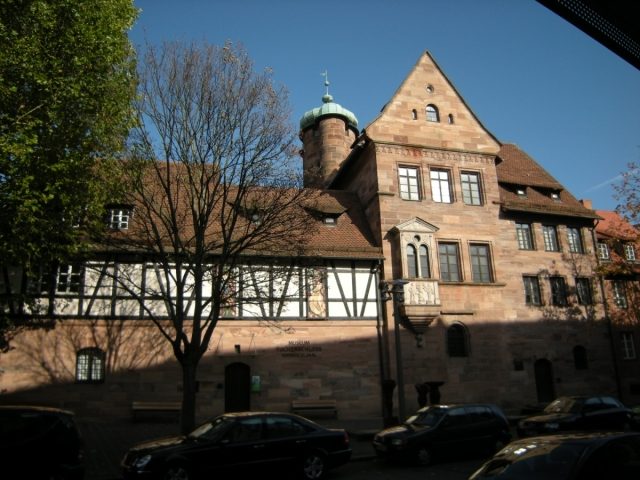
The Tucherschloss is a museum located at Hirschelgasse 9/11 in the St. Sebald district of Nuremberg's Old Town. The Tucherschloss was built as the city residence of the Nuremberg patrician family Tucher.
The castle was built under Lorenz (II.) Tucher between 1533 and 1544. The building plan probably goes back to Paulus Beheim, who designed it in the style of French Renaissance castles. The building is a three-story structure made of sandstone ashlar with a closed front facing the alley. On the first floor, facing the alley, there is a small oriel with a sandstone balustrade, on which a relief of the Fall of Man is attached. The entrance from the courtyard side features two arches with a Tuscan column in the middle. On the ground floor, there is a hall with a late Gothic net-ribbed vault.
During World War II, the complex was severely damaged in 1945. Of the main building, only the western courtyard facade up to the second upper floor with large parts of the stair tower, the street facade with the sandstone oriel, and the ground floor vaults remained largely intact. In contrast, the outbuildings were almost completely destroyed. Reconstruction took place from 1967-69, with the outbuildings being rebuilt in a slightly altered form.
Tucherschloss Museum with Hirsvogelsaal+
The Tucherschloss is now a museum, but it still belongs to a Nuremberg branch of the baronial Tucher von Simmelsdorf family. The museum is managed equally by the Free State of Bavaria and the City of Nuremberg. Exhibits on the history of the Tucher family are displayed.
In addition to valuable furniture and tapestries, the museum showcases the famous Tucher pouring set, specially enameled in Limoges, and a silver double goblet by Wenzel Jamnitzer, as well as a portrait of Hans VI. Tucher, painted by Albrecht Dürer's teacher Michael Wolgemut.
The administrative headquarters of the Nuremberg City Museums are housed in the outbuildings.
Hirsvogelsaal
In the garden of the Tucherschloss, the Hirsvogelsaal, which was destroyed in World War II, was rebuilt by the year 2000. The interior design was created by Peter Flötner with his Renaissance elements of Italian origin, which were unusual for Nuremberg at the time. The large ceiling painting depicting the "Fall of Phaeton" was painted by Dürer's pupil Georg Pencz on 20 canvases.
Take Mobile History with you
You are reading this text for free. Premium adds what matters on the road: descriptions read aloud, sites found through your camera, whole regions taken offline.
- Every description, including the ~17,700 Premium sites
- Audio guide: have descriptions read to you on location
- AR finder: see sites through your camera, with distance and bearing
- Unlimited saved sites
14 days free, then from €2.99 a month. Cancel anytime.
Source: Wikipedia · Licence: CC BY-SA 4.0 · Image: http://schloesserrundschau.de/bayern/schloesser01/nuernberg08.html
This description draws on the facts documented in the linked Wikipedia article; Wikipedia content is licensed under CC BY-SA 4.0. Wording and editing: Mobile History.
Location: 49.4575, 11.0842