Local Archives
CastleHeidelberg
Tiefburg Castle
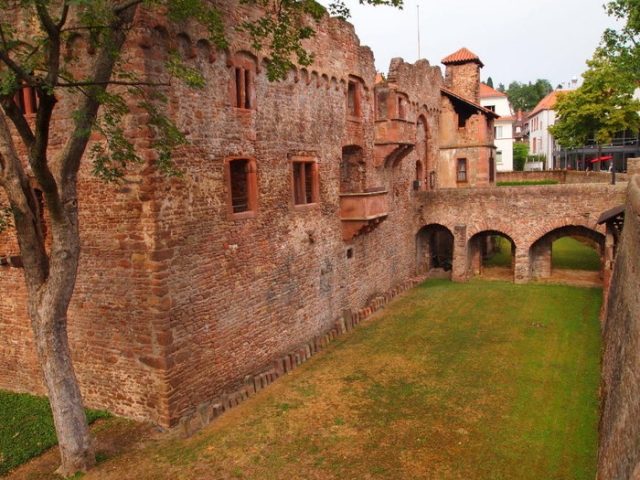
The Tiefburg, also known as Handschuhsheim Castle, is the ruin of a medieval moated castle in Heidelberg-Handschuhsheim in northwestern Baden-Württemberg.
The castle is located as a low-lying castle within the village, northwest of the former village center of Handschuhsheim. The castle was once surrounded by a moat fed by the Mühlenbach stream. At the northeast corner of the complex, the walled-up inflow to the moat is still visible. After its drainage, the connecting channel was used as access to the neighboring manor. The surrounding wall of the entire complex has been fragmentarily preserved in the surrounding properties.
The oldest noble residence in Handschuhsheim was probably located on a western spur of the Heiligenberg in the Bürgel district. According to old traditions, vaults and walls of a castle were once located there. Whether this castle ever existed and when it was abandoned is as unknown as the origin of the Tiefburg. The latter, however, existed at the latest in the 13th century. From traditions of the 13th and 14th centuries, it appears that it was a moated castle, surrounded by a 12-meter-wide moat, fed by the Mühlenbach.
The quadrangle of the defensive walls and the barrel vaults of the cellars still date from the High Middle Ages, while the rest of the complex shows features of the Renaissance, suggesting a major renovation of the castle between 1500 and 1600. The coats of arms visible on the balcony parapets of the outer walls from 1544 date this renovation more precisely.
The castle was the ancestral seat of the Lords of Handschuhsheim. After they died out in the male line in 1600, the castle passed to the Lords of Helmstatt in 1624, in whose possession the castle remained for more than three centuries.
From the Thirty Years' War to the War of the Palatine Succession, the castle suffered from the wars of the 17th century. In 1642, the castle was set on fire several times, and in 1674 it was destroyed and uninhabitable. Georg Adam Christoph von Helmstatt (1676–1741) had the free noble manor built around 1700 next to the ruin, on the site of the dilapidated manor house of the former local lords. The manor had once been part of the entire castle complex and was subsequently maintained, while the ruinous core castle was only barely kept up.
From 1911 to 1913, the Tiefburg was renovated by its owner, Raban Graf von Helmstatt (1844–1932), and the residential building was made usable again. It was rented for some time to various Handschuhsheim citizens before a youth hostel was established there in 1921. In 1950, Raban's son Bleickard von Helmstatt (1871–1952) sold the castle to the city of Heidelberg, which handed over the property to the Handschuhsheim district association. The youth hostel operation ended in 1951, and since then the castle has been used for events.
The Walled-in Knight+
In 1770, the then owner of the Tiefburg, Johann Ferdinand Joseph Freiherr von Helmstatt, discovered a walled-in skeleton in medieval armor in a cavity behind a wall. Several legends surround this "walled-in knight." One of them states that the walled-in man was said to have had an affair with a resident of Hirschhorn Castle and was walled in alive as punishment for this.
The armor is said to have been given as a gift to the Palatine General von Rothenhausen and later came via Elector Carl Theodor to the royal antiquity collection in Munich. The armor has since disappeared. Since 1977, the discovery site has been adorned with a replica donated by the district association.
Complex+
Even today, one enters the castle via a bridge that spans a twelve-meter-wide filled-in moat. Of the core castle, only the foundations, the vaults of the residential tower, and the defensive walls remain today. Around 1700, a new manor house with stables and barns was built. It was only between 1911 and 1913 that the then owner, Count Raban von Helmstatt, had the residential building "Ritterhaus" in the inner courtyard rebuilt and extended.
Current Use+
In addition to event rooms for local associations, the restored residential building also houses the local historical archive of the Handschuhsheim district association. Numerous local events take place in the castle courtyard.
Literary Impact+
The castle is the focus of Walter Laufenberg's historical novel "Ritter, Tod und Teufel" (Knight, Death and Devil), which was published in 1992 by Langen Müller in Munich.
Take Mobile History with you
You are reading this text for free. Premium adds what matters on the road: descriptions read aloud, sites found through your camera, whole regions taken offline.
- Every description, including the ~17,700 Premium sites
- Audio guide: have descriptions read to you on location
- AR finder: see sites through your camera, with distance and bearing
- Unlimited saved sites
14 days free, then from €2.99 a month. Cancel anytime.
Source: Wikipedia · Licence: CC BY-SA 4.0 · Image: http://www.wehrbauten.de/thread.php?threadid=976
This description draws on the facts documented in the linked Wikipedia article; Wikipedia content is licensed under CC BY-SA 4.0. Wording and editing: Mobile History.
Location: 49.4282, 8.6861