Museum
CastleMödling
Thonet Castle
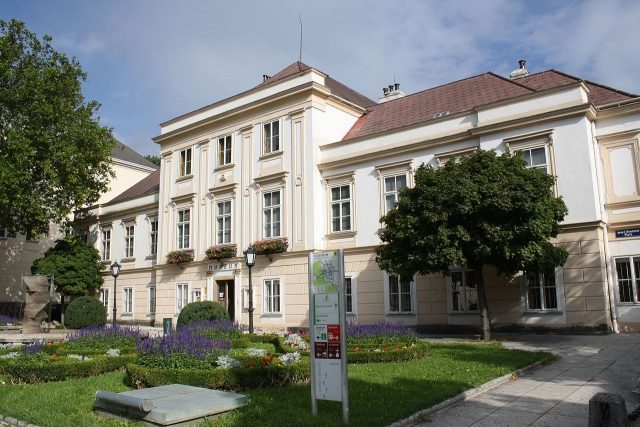
The Thonetschlössl currently houses the District Museum in the city of Mödling.
Johann Baptist Verda von Verdenberg founded a Capuchin monastery in 1631. The monastery was destroyed in the Turkish War in 1683 and rebuilt in 1684. The monastery was secularized in 1785 under Joseph II and acquired in 1786 by Giacomo Caliano and used for the production of silk and fabrics. Around 1806, the building was used as a chemical bleachery, and around 1821 as a theater. In 1833, the entomologist Ernst Heeger acquired it through an auction, and it was subsequently used as a silk factory. The next owner from 1845, Altgräfin Elise von Salm, born Liechtenstein, had the building converted into a castle-like structure. In 1889, the Thonet family acquired the building. In 1931, it was acquired by the Sparkasse der Stadt Mödling, and the District Museum, which had existed since 1904, was housed there. From 1945 to 1955, the building served as a police station. In 1958, the building was acquired by the city of Mödling and from 1965 onwards was again used as the District Museum.
The Building+
The symmetrical building with a raised three-story central section and two-story side wings under hip roofs features a strict historicist facade on the square side with a rusticated plinth zone and pilaster strips, and on the garden side, a portal-balcony-window group on the central risalit and the alliance coat of arms of Salm/Liechtenstein from the mid-19th century in the stepped gable. The core Baroque nave of the monastery is preserved in the central risalit. The former barrel-vaulted church vaults are preserved in the upper floor in the ballroom. The vaults were decorated with Neo-Baroque stucco in the third quarter of the 19th century.
Museum Park+
The equally listed Museum Park was opened in 1957 and includes a Baroque fountain basin, a Pietà group on a pedestal from 1756, a dog figure from the Romanesque temple built in 1827 on the Hundskogel in Hinterbrühl, three inscribed tombstones from the 16th and 17th centuries, a Protestant stone with Wolfgangus and Zezilia Reitperger, Protestant councilor and market judge from 1581, a fragment of a Gothic column damaged in 1529 and 1683 from the St. Stephen's Cathedral workshop.
The Museum+
The museum documents the formation of the Mödling landscape, displays rocks and fossils; prehistory, and also features one of Austria's first Avar collections. Historical events, such as Mödling's fate in the Turkish Wars, are documented, as are the biographies of famous residents of the city, such as Mitsuko Coudenhove-Kalergi or the anatomist Josef Hyrtl.
Parts of the museum come from the private paleontological collection of local historian Oskar Spiegel. It was acquired for the museum with the support of the federal government, the state of Lower Austria, and the city of Mödling.
Another large part is made up of Joseph Hyrtl's library, including editions by Paracelsus or Johannes Wesling. These have been digitized and made available to a wide public on the internet.
Since 2008, the Museum Association has published a semi-annual cultural magazine called medilihha.
Take Mobile History with you
You are reading this text for free. Premium adds what matters on the road: descriptions read aloud, sites found through your camera, whole regions taken offline.
- Every description, including the ~17,700 Premium sites
- Audio guide: have descriptions read to you on location
- AR finder: see sites through your camera, with distance and bearing
- Unlimited saved sites
14 days free, then from €2.99 a month. Cancel anytime.
Source: Wikipedia · Licence: CC BY-SA 4.0 · Image: https://commons.wikimedia.org/wiki/File:M%C3%B6dling_5628.jpg
This description draws on the facts documented in the linked Wikipedia article; Wikipedia content is licensed under CC BY-SA 4.0. Wording and editing: Mobile History.
Location: 48.0866, 16.2880