The remains of the ancient town can be visited
Ancient BuildingRoma
Tempio di Vespasiano
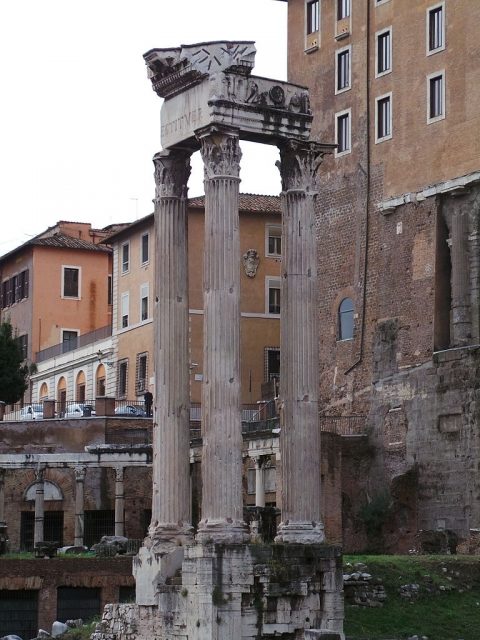
The Temple of Vespasian and Titus (Latin: Templum divi Vespasiani, Italian: Tempio di Vespasiano) is located in Rome at the western end of the Roman Forum between the Temple of Concordia and the Temple of Saturn. It is dedicated to the deified Vespasian and his son, the deified Titus. It was begun by Titus in 79 after Vespasian's death and Titus's succession. Titus’ brother, Domitian, completed and dedicated the temple to Titus and Vespasian in approximately 87.
Importance+
Throughout Roman history, there was an emphasis on increasing the fame and glory of a family name, often through monuments commemorating the deceased. Therefore, the temple was constructed to honor the Flavian Dynasty, which comprised the emperors Vespasian (69-79), Titus (79-81), and Domitian (81-96). Historians question whether or not Titus and Domitian had a good relationship; however, Domitian ensured the deification of his brother into the imperial cult in order to exalt the prominence of the Flavian name. Titus and Vespasian were each deified through the ceremony of apotheosis. In doing so, tradition guaranteed that Roman citizens and subjects would honor Vespasian and Titus (or at least honor their genius) as Roman deities. This imperial cult worship was as much a sign of allegiance to the emperor of Rome, or as a political and diplomatic gesture, as it was a formal religion.
Structure+
The Temple of Vespasian was in the Corinthian order, hexastyle (i.e. with a portico six columns wide), and prostyle (i.e. with free standing columns that are widely spaced apart in a row). It was particularly narrow due to the limited space, measuring 33 meters long and 22 wide. In a constricted space between the temple and the Concord, a small, two story vaulted room made of brick and concrete, and lined with marble, was built against the wall of the Tabularium, and apparently was dedicated to Titus.
Construction and renovation
Titus began construction and presumably finished the foundations, made of tufa concrete, and the core of the podium, made of white marble. Domitian, however, completed the interior work after Titus’ death. The cella (inner) walls were in travertine, lined with marbles imported at great expense from the eastern provinces. The interior is highly ornate and the frieze depicts sacred objects that would have been used as the symbols, or badges, of the various priestly collegia in Rome. Around 200 to 205, Emperors Septimius Severus and his son, Caracalla, conducted renovations on the temple.
Medieval and modern history
The temple suffered significant damage during mediaeval times, particularly c. 1300 (under Pope Boniface VIII), and in Pope Nicholas V's remodelling of the Forum (which involved the demolition of both angles of the temple on the Forum side and the reconstruction of its front as a fortress with corner towers). All that survives today is the podium's core (with some of its peperino lining), parts of the cella (two fragments of its travertine wall and part of the pedestal at its back for the cult statues), and three Corinthian columns at pronaos's south-east corner.
Take Mobile History with you
You are reading this text for free. Premium adds what matters on the road: descriptions read aloud, sites found through your camera, whole regions taken offline.
- Every description, including the ~17,700 Premium sites
- Audio guide: have descriptions read to you on location
- AR finder: see sites through your camera, with distance and bearing
- Unlimited saved sites
14 days free, then from €2.99 a month. Cancel anytime.
Source: Wikipedia · Licence: CC BY-SA 4.0 · Image: http://de.wikipedia.org/wiki/Datei:TempelVespasianTitus.jpg
This description draws on the facts documented in the linked Wikipedia article; Wikipedia content is licensed under CC BY-SA 4.0. Wording and editing: Mobile History.
Location: 41.8928, 12.4841