The remains of the ancient town can be visited
Ancient BuildingRoma
Tempio di Marte Ultore
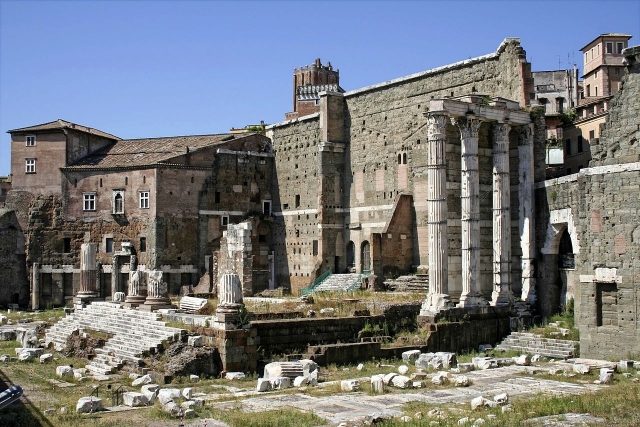
In 2 BC, the Forum of Augustus with its associated Temple of Mars Ultor was inaugurated by Emperor Augustus in Rome. The center of the Forum of Augustus is the Temple of Mars Ultor, the avenging Mars. This forum was the second of the four Imperial Fora in Rome. It was an extension of the Roman Forum.
The complex with forum and temple was planned by Augustus as early as 42 BC, but it took another 40 years until its inauguration. Originally conceived to demonstrate Octavian's succession and to commemorate the Battle of Philippi (42 BC), upon completion it served as a symbol of the Principate ideology and the reconciliation of the emperor with the Senate.
Architecture and Location+
The temple interior was magnificently furnished. The building consisted of Carrara marble, and eight Corinthian columns lined the front and sides of the building. (→ Augustan Classicism) In the center of the temple (pediment or large apse) was a statue of Mars, depicted as a peacemaker and not, as usual, as a god of war - but, with one foot on the globe, still as a sign of Roman world domination. To his right stood Venus and Rome, to his left Fortuna and Romulus. Capitoline and Tiber were represented by allegorical figures.
In the colonnades and exedrae stood statues and busts of victorious generals, deserving officials, kings, mythological figures, and poets. Sixty caryatids, as well as female entablature bearers, embodied the subjugation of foreign peoples. In front of the temple, with great probability, stood a quadriga - a four-horse chariot - showing Augustus in triumph. The plinth inscription read "pater patriae" - father of the fatherland. The ruins of the Forum of Augustus were used for palaces from 1200 onwards. The complex was located in the center of Rome, northeast of the Circus Maximus. It directly adjoined the Forum of Caesar.
Function and Significance+
The temple area was deliberately built directly in the residential settlements to present Augustus as a ruler who sought communication with his people. It served to store Caesar's sword, as well as the military standards recovered from the Parthians in 20 BC. Furthermore, the laurel wreaths of the triumphators were laid here. Governors who were sent to the provinces were also bid farewell here, and the Senate made decisions about wars and triumphs. In addition, the donning of the "toga virilis" took place here.
Through the Forum of Augustus, the emperor was to be presented as part of Roman history. He was equated here with the great personalities of Roman history and mythology. It also served for the religious representation of Augustus, who had taken on more and more priestly offices since 41 BC.
Take Mobile History with you
You are reading this text for free. Premium adds what matters on the road: descriptions read aloud, sites found through your camera, whole regions taken offline.
- Every description, including the ~17,700 Premium sites
- Audio guide: have descriptions read to you on location
- AR finder: see sites through your camera, with distance and bearing
- Unlimited saved sites
14 days free, then from €2.99 a month. Cancel anytime.
Location: 41.8943, 12.4871