The remains of the ancient town can be visited
Ancient BuildingRoma
Tempio di Antonino e Faustina
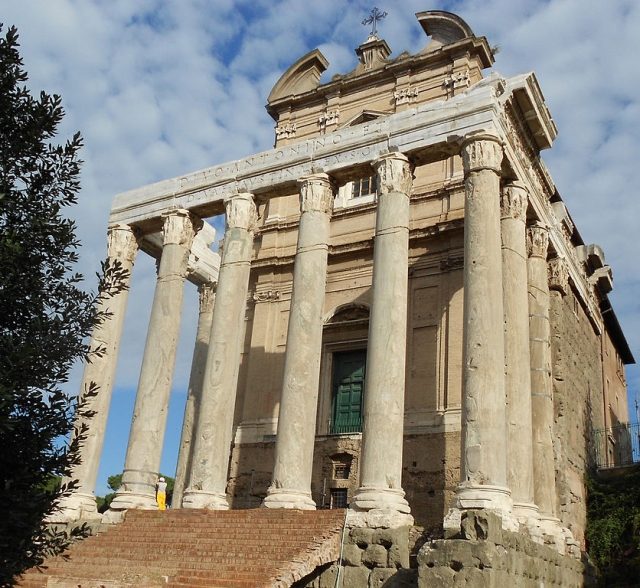
The Temple of Antoninus and Faustina is an ancient Roman temple in Rome, adapted to the church of San Lorenzo in Miranda. It stands in the Forum Romanum, on the Via Sacra, opposite the Regia.
The temple+
The temple was begun in 141 AD by the Emperor Antoninus Pius and was initially dedicated to his deceased and deified wife, Faustina the Elder. When Antoninus Pius was deified after his death in 161 AD, the temple was re-dedicated jointly to Antoninus and Faustina at the instigation of his successor, Marcus Aurelius.
The building stands on a high platform of large peperino blocks. The later of two dedicatory inscriptions says, "Divo Antonino et Divae Faustinae Ex S.C." meaning, “To the divine Antoninus and to the divine Faustina by decree of the Senate.”
The ten monolithic Corinthian columns of its pronaos are 17 m. tall. The rich bas-reliefs of the frieze under the cornice, of garlanded griffons and candelabri, were often copied from the sixteenth through the nineteenth centuries.
The church+
The temple was converted to a Roman Catholic church, known as San Lorenzo in Miranda, perhaps as early as the seventh century, but it is only attested from the eleventh century Mirabilia Urbis Romae. "Miranda" may derive from the name of a benefactress. It was then thought that this was where St Lawrence had been sentenced to death.
The deep grooves in the temple's columns are said to date to a medieval attempt to dismantle the pillared portico, either for spolia or to destroy what was then still seen as a pagan temple. Also in the Middle Ages, a staircase was built on the Forum side, but it is now impossible to enter from that side, as there is a gap of about six metres between the foot of the steps and the green bronze door. Before the archeological excavations, ground level was at this door. Excavations in front of the temple were undertaken in 1546, again in 1810, and at intervals from 1876.
In 1429/30, Pope Martin V gave the church to the Collegio degli Speziali (College of Chemists and Herbalists), at the time officially known as the Universitas Aromatorium. (They still use their adjoining guildhall, which contains a small museum that holds a medicine-receipt signed by Raphael). Side chapels were built after this date.
The church was partially demolished, and the side chapels removed, in 1536, in order to restore the ancient temple for the Roman visit of Emperor Charles V. The church, now constrained within the cella of the temple, was remodeled in 1602 by Orazio Torriani, creating a single nave and three new side chapels. The main altar has a canvas by Pietro da Cortona of the Martyrdom of St. Lawrence (1646), while the first chapel on the left has a Madonna and Child with Saints (1626) by Domenichino.
Christianization has accounted for the survival of the cella and portico of the temple, though the marble cladding of the cella has been scavenged. Indeed, the church lacks the usual east-end apse: one was never added, to retain the temple's structural integrity.
The church is normally closed to the public, but may be visited 10.00-12.00 on most Thursdays.
Take Mobile History with you
You are reading this text for free. Premium adds what matters on the road: descriptions read aloud, sites found through your camera, whole regions taken offline.
- Every description, including the ~17,700 Premium sites
- Audio guide: have descriptions read to you on location
- AR finder: see sites through your camera, with distance and bearing
- Unlimited saved sites
14 days free, then from €2.99 a month. Cancel anytime.
Source: Wikipedia · Licence: CC BY-SA 4.0 · Image: http://de.wikipedia.org/wiki/Datei:TempelAntoniusFaustina2.JPG
This description draws on the facts documented in the linked Wikipedia article; Wikipedia content is licensed under CC BY-SA 4.0. Wording and editing: Mobile History.
Location: 41.8922, 12.4868