Parish church
CathedralWaldsassen
Stiftsbasilika Waldsassen
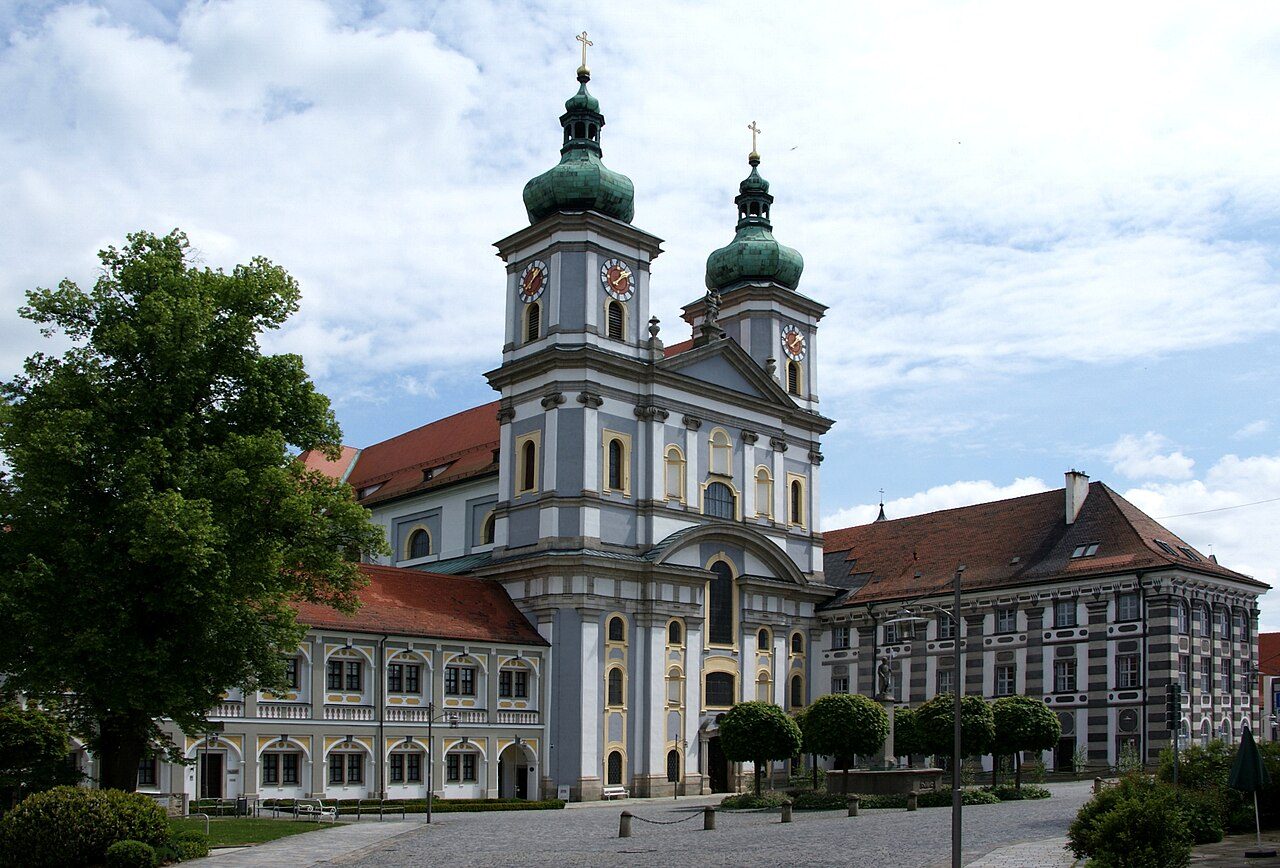
The Collegiate Basilica of Waldsassen, an outstanding Baroque church in Bavaria, is located in Tirschenreuth, Upper Palatinate. Today, it serves as a parish church and is dedicated to the Assumption of Mary and Saint John the Evangelist. As the former monastic church of the Cistercian Abbey of Waldsassen, it is considered one of the most significant sacred buildings of Southern German Baroque.
History+
The origins of the Cistercian monastery of Waldsassen date back to 1132/1133. An initial three-nave basilica without a tower, reflecting the Cistercian architectural style, was consecrated in 1179. In the course of the Reformation and the spread of the Protestant faith in the Palatinate territories, the monastery was dissolved in 1556. Following the re-Catholicization under the Bavarian Elector Maximilian I, Cistercians from Fürstenfeld returned in 1661. The Baroque reconstruction of the monastery and its church began in 1681. The foundation stone for the current church was laid in 1685, with actual construction commencing four years later. Under the direction of renowned master builders such as Georg Dientzenhofer and Abraham Leuthner, an impressive pillar basilica was created. The interior decoration was crafted by artists from across Europe. The church was consecrated in 1704 by Auxiliary Bishop Franz Ferdinand von Rummel. During the secularization in 1803, the monastic church was handed over to the Catholic community as a parish church. In 1863, the monastery was re-established as a priory for Cistercian nuns and repopulated by sisters from Seligenthal. Pope Paul VI elevated the collegiate church to a Basilica minor in 1969.
Location+
The Collegiate Basilica of Waldsassen is situated in the town of Waldsassen in the district of Tirschenreuth, within the Bavarian administrative region of Upper Palatinate.
On site+
The Collegiate Basilica impresses with an overall length of 82 meters. Its main nave is equipped with chapels and galleries, with Prague architecture and Passau Cathedral serving as models. The interior is richly adorned with stucco work by Giovanni Battista Carlone. Ceiling frescoes by Johann Jakob Steinfels depict scenes of the monastery's founding, from the life of Jesus, and an image of Mary spreading her mantle. The high altar of black marble, created by Giovanni Battista Carlone, dominates the choir area and features a crucifixion painting by Jean Claude Monot. A rare spherical tabernacle made of Salzburg marble, a work by the young sculptor Karl Stilp, is located in the altar wall. The choir stalls in the nuns' choir were crafted by Martin Hirsch. A crypt extends beneath the nave. The floor of the main nave is laid with Solnhofen limestone and features a circular motif with a compass rose in front of the choir area. The basilica also houses the world's largest collection of twelve richly adorned full-body relics of so-called catacomb saints, which were decorated between 1707 and 1765 by Adalbert Eder.
Nearby+
- Waldsassen Abbey (sacred building, approx. 52 m away)
- Fockenfeld Monastery (sacred building, approx. 5137 m away)
- Hrozňatov Castle (Kinsberg) (castle, approx. 6240 m away)
- Hardeck Castle (castle, approx. 7996 m away)
Take Mobile History with you
You are reading this text for free. Premium adds what matters on the road: descriptions read aloud, sites found through your camera, whole regions taken offline.
- Every description, including the ~17,700 Premium sites
- Audio guide: have descriptions read to you on location
- AR finder: see sites through your camera, with distance and bearing
- Unlimited saved sites
14 days free, then from €2.99 a month. Cancel anytime.
Source: Wikipedia · Licence: CC BY-SA 4.0 · Image: Aconcagua (talk) / CC BY-SA 3.0 via Wikimedia Commons
This description draws on the facts documented in the linked Wikipedia article; Wikipedia content is licensed under CC BY-SA 4.0. Wording and editing: Mobile History.
Location: 50.0042, 12.3092