Church
MonasterySalzgitter - Thiede
Steterburg Abbey
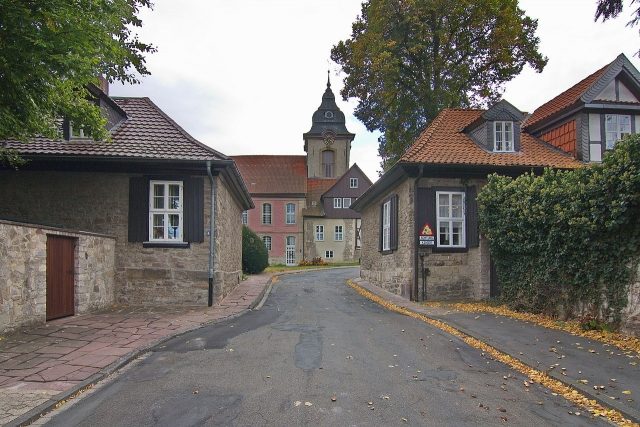
Steterburg Abbey is a former canonesses' foundation, later an Augustinian canonesses' foundation, and former Evangelical-Lutheran women's foundation in Salzgitter-Thiede, Lower Saxony.
Around the year 1000, Frederunda von Oelsburg († March 16, 1020), daughter of Count Altmann von Oelsburg († 1000/03), built Steterburg Abbey on the grounds of the "Stederburg", a ruined castle complex from the early 10th century. Count Altmann had remained without a male heir and decreed that a "virgins' foundation" should be established on the castle grounds. Saint Christopher was chosen as the patron saint.
Frederunda endowed the foundation with her inheritance and herself entered the foundation as its first abbess. The property included about 36 villages, including Dannenbüttel, Eickhorst, Harxbüttel, Küblingen, Meine, Melverode, Nortenhof, Rötgesbüttel, Rühme, Salzdahlum, Salzgitter-Thiede, Stiddien Klein Stöckheim and Waggum. Otto III granted the foundation a letter of protection before 1002. The no longer extant founding charter of Steterburg was confirmed by King Henry II on January 21 or 24, 1007.
The canonesses initially did not live in enclosure. The women wore no religious habit and dressed in secular clothing. Private property was allowed, and returning to secular life and marriage was possible.
In the 12th century, the foundation was converted into an Augustinian canonesses' foundation. A provost was appointed to lead the monastery, subordinate to the abbess. Provosts Gerhard von Riechenberg († 1150), provost since 1142, and Gerhard von Steterburg († 1209), who was installed in his office in 1164 by Bishop Hermann of Hildesheim, enforced the rules of the Augustinian Order. Enclosure was introduced and personal property abolished.
Gerhard was the author of the Steterburg Annals, a history of the properties of Steterburg Abbey. As a diplomat, Gerhard was probably part of the delegation that Henry the Lion sent to Henry VI in 1191.
During the 14th and 15th centuries, the convent was predominantly composed of bourgeois women, many of whom came from patrician families in the city of Braunschweig. In 1519, Nikolaus Decius (* around 1485; † after 1546), hymn writer and later reformer in Prussia, was appointed provost of the foundation.
Reformation
The conversion of the monastery into an evangelical women's foundation took place in 1568. The vow of celibacy was again renounced. Catholic books and cult objects were removed, and services were held in German. The communion and baptismal vessels, candlesticks, and trimmings remained in use. During the Thirty Years' War, a large part of the church treasury was lost.
At the end of 1627, the abbey's facilities were destroyed by imperial troops under General Gottfried Heinrich Graf zu Pappenheim during the battle for Wolfenbüttel. The canonesses fled to Braunschweig. In 1641, Steterburg was again a scene of war during fighting between imperial troops and Swedes. Only in the mid-17th century did the reconstruction of the monastery buildings begin, which were again inhabited by women from 1667.
As late as 1676, bourgeois canonesses were still in the monastery. Later, only nobles were admitted. In 1691, Dukes Rudolf August and Anton Ulrich elevated the foundation to a noble women's foundation.
At the end of the 18th century, the chapter of the foundation consisted of an abbess, the provost, and eleven canonesses, who, as an admission criterion, had to prove eight noble ancestors. The provost was elected by the chapter by a majority of votes and proposed to the Braunschweig sovereign for confirmation. The position of abbess could be filled by the duchess at will with one of the canonesses or a princess from the ruling house. Until the 19th century, no commoner was left in the convent.
Dissolution of the Foundation
After 1918, Steterburg Abbey was merely an institution for the provision of unmarried women from the lower landed gentry. In 1938, the Steterburg virgins' foundation was dissolved, and the buildings were used by the Reichswerke Hermann Göring.
Current Use
In 1955, parts of the buildings were handed over by Salzgitter AG, successor to the Reichswerke, to the Evangelical-Lutheran Church of Braunschweig. The abbey church now serves as the parish church of the Evangelical community of Steterburg.
There is no historical connection to the Redemptorist monastery of Steterburg, built from 1954 in Salzgitter-Thiede at a different location.
Buildings+
- Abbey Church: The first church was completed and consecrated in 1070. Already around 1160, it had to be demolished due to dilapidation. The construction of the second church began in 1165 under Provost Gerhard in the Romanesque style. After the destructions of the Thirty Years' War, the present Baroque church was built only from 1751 to 1758 by Duke Karl I (1735-1780), according to designs by the Braunschweig colonel and architect Anton Ulrich von Blum. The abbey church is today one of the most important sacred buildings in Salzgitter.
- Abbess's Residence: The house was built in 1691. A barrel-vaulted corridor connects the abbess's house with the church and the convent buildings.
Take Mobile History with you
You are reading this text for free. Premium adds what matters on the road: descriptions read aloud, sites found through your camera, whole regions taken offline.
- Every description, including the ~17,700 Premium sites
- Audio guide: have descriptions read to you on location
- AR finder: see sites through your camera, with distance and bearing
- Unlimited saved sites
14 days free, then from €2.99 a month. Cancel anytime.
Source: Wikipedia · Licence: CC BY-SA 4.0 · Image: https://de.wikipedia.org/wiki/Datei:Stift_Steterburg_in_Thiede_%28Salzgitter%29_IMG_2704.jpg
This description draws on the facts documented in the linked Wikipedia article; Wikipedia content is licensed under CC BY-SA 4.0. Wording and editing: Mobile History.
Location: 52.1934, 10.4736