Abbey
MonasterySchlägl
Schlägl Abbey
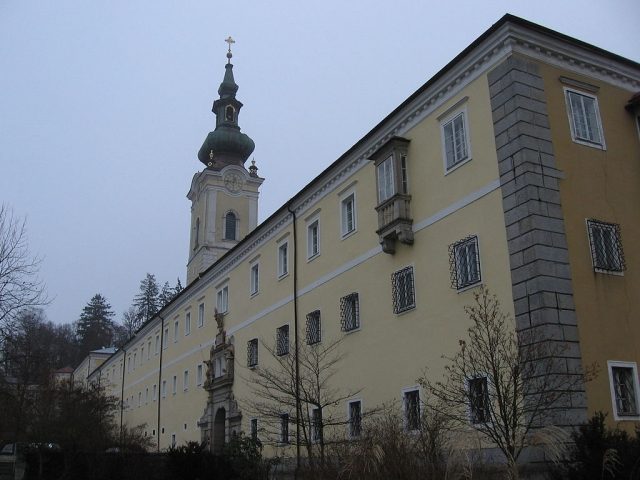
Schlägl Abbey, a significant Premonstratensian sacred building, stands at approximately 546 meters above sea level in Schlägl, a municipality in the Rohrbach district of Upper Austria, Austria. It is a living monastery that continues to play a central role in the region and is known for its long history.
History+
The origins of Schlägl Abbey date back to the early 13th century when it was initially founded as a Cistercian monastery, presumably around 1202/03 by Bishop Wolfger von Erla of Passau. It was settled by monks from the Franconian monastery of Langheim. However, this early monastery lasted only a few years, ceasing to exist around 1209/10 or 1210/11, possibly due to unfavorable climatic conditions and insufficient resources. Bishop Wolfger's successors sought to revive it at a more favorable location and enlisted the Premonstratensians. On June 20, 1218, the Cistercians of Langheim renounced their claims, and on July 9, 1218, Kalhoch von Falkenstein transferred his foundation to the Premonstratensians. The exact origin of the first canons is debated, with both Osterhofen Abbey and the Bohemian monastery of Mühlhausen being considered. Over the centuries, the abbey received numerous donations and privileges, including from the Lords of Krumau and Rosenberg. It was repeatedly damaged by wars and fires, such as during the Hussite Wars in the 15th century and the Peasant War in 1626, but was always rebuilt. In 1657, it was elevated from a provostry to an abbey. After a devastating fire in 1850, extensive reconstruction took place under Abbot Dominik Lebschy. The abbey also survived its dissolution by the National Socialists in 1941 and was restored after World War II under Abbot Cajetan Lang.
Location+
Schlägl Abbey is located in the village of Schlägl in the Rohrbach district, nestled in the picturesque landscape of Upper Austria, Austria. It stands at an elevation of approximately 546 meters above sea level.
On site+
Today, Schlägl Abbey is an active Premonstratensian monastic community. It serves as the spiritual, pastoral, and economic center of the upper Mühlviertel and oversees numerous parishes. Visitors can explore the historic complex, which includes a Romanesque crypt and parts of the nave of the abbey church dating from the 13th century.
Nearby+
- Morau Castle Ruin (Castle), approx. 5.8 km away
- Peilstein Castle (Castle), approx. 5.9 km away
- Zarghof Castle (Castle), approx. 6.7 km away
- Lichtenau Castle (Castle), approx. 7.2 km away
Take Mobile History with you
You are reading this text for free. Premium adds what matters on the road: descriptions read aloud, sites found through your camera, whole regions taken offline.
- Every description, including the ~17,700 Premium sites
- Audio guide: have descriptions read to you on location
- AR finder: see sites through your camera, with distance and bearing
- Unlimited saved sites
14 days free, then from €2.99 a month. Cancel anytime.
Source: Wikipedia · Licence: CC BY-SA 4.0 · Image: http://commons.wikimedia.org/wiki/File:Schlagl3.JPG
This description draws on the facts documented in the linked Wikipedia article; Wikipedia content is licensed under CC BY-SA 4.0. Wording and editing: Mobile History.
Location: 48.6360, 13.9679