The Abbey can be visited
MonasteryRanshofen
Ranshofen Abbey
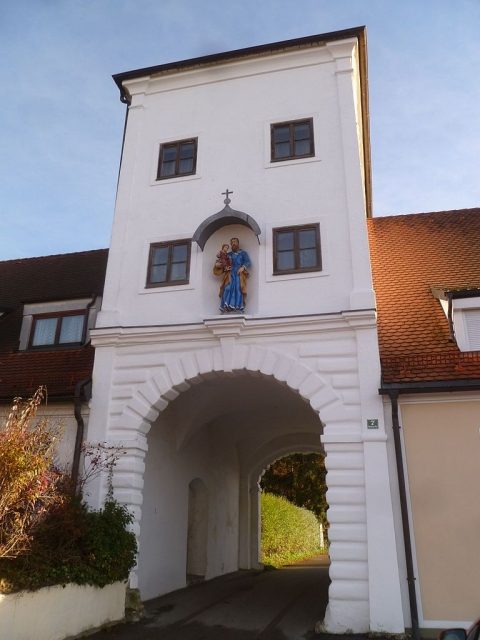
Ranshofen Abbey is a former monastery of the Augustinian Canons Regular (CanReg) in Ranshofen near Braunau am Inn in Austria.
Ranshofen was first mentioned in a document in 788 as the ducal court "Rantesdorf" of the Agilolfings. At that time, the Agilolfing Duke Tassilo III still ruled in Bavaria, and the ducal court was taken over by the Carolingians as imperial property after Tassilo's deposition. Under Charlemagne, Ranshofen was elevated to an imperial palace. Kings Louis the German and his son Carloman stayed several times at this royal court (curtis regia) or palace (Palatium). The last Carolingian Emperor Arnulf of Carinthia had a palace chapel dedicated to St. Pancras built here between 896 and 898. This was transferred to the priest Ellimbrecht as a fief and then to him as free property. From 900, a seat of an association of secular priests is mentioned here for the first time. In 1120, Ranshofen was a ducal seat of the Welfs.
Ranshofen Monastery
Even before 1040, Emperor Henry II established the parish of Ranshofen, had a separate parish church built, and Emperor Conrad II confirmed this parish in 1040. A community of secular priests formed at the old palace chapel of St. Pancras, from which an Augustinian Canons Regular monastery emerged in 1125 under the Bavarian Duke Henry IX. The royal palace became a monastery and was settled by canons by Archbishop Konrad of Salzburg and presumably consecrated in 1135. The right to free election of the provost was guaranteed to the monastery in the great charter of protection by Pope Eugene III in 1147. Already at this time, a number of filial churches were subordinate to the monastery (Braunau am Inn, Geretsberg, Gilgenberg, Handenberg, Hochburg, Neukirchen an der Enknach, Parish Church of St. Michael in Ranshofen); the Ranshofen parish church of St. Michael is also attested since 1147. Ranshofen was able to free itself from the supervisory rights of the Mattsee Archdeaconry, which was subordinate to the Bishop of Passau, around 1200 (exemption of the churches united in the collegiate association). In 1212, Bishop Manegold of Passau also renounced jurisdiction over the monastery's subjects. In 1345, the monastery was granted lower jurisdiction by Emperor Louis the Bavarian.
Throughout history, the monastery was repeatedly affected or devastated by warlike events. In 1233, the Babenberg Duke Frederick the Quarrelsome plundered the filial church belonging to the monastery in Neukirchen an der Enknach during battles with Duke Otto II of Bavaria. In 1242, followers of the Bishop of Passau, coming from Obernberg Castle, attacked the monastery and burned down both churches there along with the palace. In 1266, Ranshofen was again burned down during battles between King Ottokar of Bohemia and Duke Henry of Lower Bavaria. Under Provost Konrad I (1276-1311), the reconstruction of the collegiate church was completed in 1283 and consecrated by Bishop Henry II of Rotteneck of Regensburg. During the Landshut War of Succession (1504/05), the church and monastery were again severely damaged. Under Provost Kaspar Türndl (1504-1529), the Gothic reconstruction of the collegiate church began in 1508, and a new monastery wing and a large farmstead were also built. In the 16th century, the Reformation also began to spread in Ranshofen. Under Provost Adam Gensleuthner (1560-1587), the Counter-Reformation was very quickly enforced.
After 1620, a glorious period began for Ranshofen despite the threat of the Thirty Years' War. The monastery complex was rebuilt in Baroque style under Provost Philipp Vetterl (1620-1634), and the church tower, which had collapsed in 1621, was also rebuilt. This tower was considerably higher than the present one and was topped by a half-dome with a lantern. The current tower was built in a reduced form after the fire of 1859. The collegiate church received a new high altar, the massive banded side portal, and a new organ. The provost received the pontificalia from Pope Urban VIII. Around this time, several confraternities were established in the monastery, such as the Corporis Christi Confraternity, the Good Death Confraternity, and the Rosary Confraternity. For these, the Marian chapel was redesigned and equipped with a new altar in 1632. In 1634, the Bavarian Elector Maximilian I and his family also found refuge from the Swedish troops. Provost Benno Meier (1665-1687) had a theological study institution built in Neukirchen Castle.
On the occasion of the 800th anniversary of the old palace chapel, the church and monastery were renewed again in 1698 under Provost Ivo Kurzbauer (1687-1715). The Baroque high altar is a work by Sebastian Hagenauer. The altarpiece is by Johann Kaspar Sing and depicts the beheading of the patron saint, while the altar predella shows the Holy Trinity. In 1770, the prelates' wing was decorated with Rococo stucco by Johann Baptist Modler. In 1805, a pompous festive cantata took place on the occasion of the second mass of Provost Kierl.
Only a few years after the incorporation of the Innviertel into Austria in 1779, the then Ranshofen parish church of St. Michael was closed. This parish church was located in front of the monastery, was baroqueized in 1712, but was secularized in 1785 and demolished in 1799. The stones were used to repair the huge fortress of Braunau.
During the Napoleonic Wars, the economic decline of the monastery began. In 1811, the monastery was dissolved by the Bavarian government.
Ranshofen Castle
After the Peace of Teschen, Ranshofen came to Austria in 1779. During the Napoleonic Wars, there were several plunderings, and the abbey was used as a hospital first by one side and then by the other. The last provost elected in 1784, Johann Nepomuk Kierl, was considered weak and wasteful, so that the monastic community also disintegrated internally. After his death in 1809, there was no new election of a provost. In 1810, the Innviertel returned to Bavaria, and just one year later, Ranshofen Monastery was dissolved on October 28, 1811, by order of Minister Montgelas, and the monastery building was secularized into a castle. The monastery church became a parish church, and the canons became secular priests and ministered to the formerly affiliated parishes. The archives, considered valuable, went to the Main State Archives in Munich, and the larger part of the library went to the present Bavarian State Library.
In 1816, the Innviertel finally came to Austria. In 1812, Count Frohberg Montjoie acquired the property. In 1839, the castle came into the possession of the Munich court councilor Ludwig Bernhart. After further changes of ownership, Ferdinand Wertheimer acquired the castle in 1851, whose family owned the large complex with its extensive properties until 1938. In 1939, Ranshofen was acquired by the Aluminum Works in Tögling. In 1945, the castle came into the possession of the municipality of Braunau, which established a prisoner and refugee camp here.
Ranshofen Castle Today+
In 2007, the 16th Braunau Contemporary History Days focused on the grandson of Friedrich Wertheimer, the Austrian-American diplomat and journalist Egon Ranshofen-Wertheimer. On May 3, 2008, the Egon Ranshofen-Wertheimer Prize was awarded for the second time.
From April 27 to November 4, 2012, Ranshofen Abbey, along with Mattighofen Castle and Burghausen Castle, was one of the venues for the Upper Austrian-Bavarian State Exhibition "Allied, Antagonistic, Intermarried."
To secure funding for the 2012 State Exhibition, a concrete proposal for the subsequent use of Ranshofen Abbey was required. In this context, considerations were made for establishing a branch of the Braunau State Music School.
From November 16 to 18, 2012, the Christ the King Festival of the Loretto Community took place at the Abbey.
Take Mobile History with you
You are reading this text for free. Premium adds what matters on the road: descriptions read aloud, sites found through your camera, whole regions taken offline.
- Every description, including the ~17,700 Premium sites
- Audio guide: have descriptions read to you on location
- AR finder: see sites through your camera, with distance and bearing
- Unlimited saved sites
14 days free, then from €2.99 a month. Cancel anytime.
Source: Wikipedia · Licence: CC BY-SA 4.0 · Image: http://commons.wikimedia.org/wiki/File:Ranshofen-3.JPG
This description draws on the facts documented in the linked Wikipedia article; Wikipedia content is licensed under CC BY-SA 4.0. Wording and editing: Mobile History.
Location: 48.2316, 13.0190