Church
MonasteryHessisch Oldendorf - Fischbeck
Fischbeck Abbey
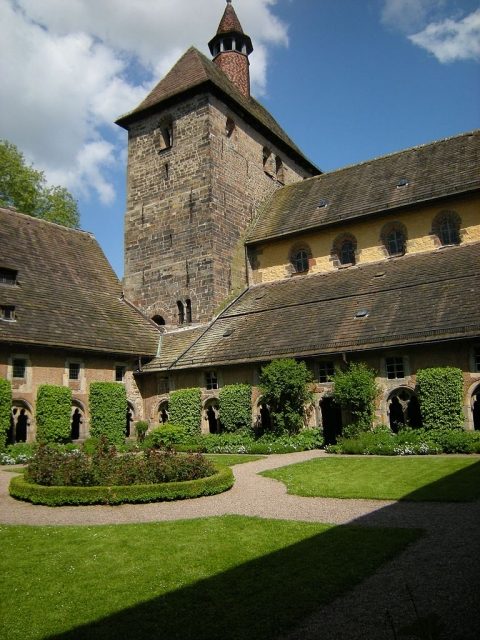
Fischbeck Abbey is an abbey in the Fischbeck district of Hessisch Oldendorf in Lower Saxony.
Fischbeck Abbey was founded in 955 by the noble Helmburgis, who was related to the Ecbertiners. The land on which the abbey stands was given to her by King Otto I, who placed the abbey under his protection as an independent protective monastery. In 1147, the Roman-German King Conrad III donated the abbeys of Fischbeck and Kemnade to the Benedictine abbey of Corvey, but Fischbeck was able to maintain its independence with the support of Henry the Lion.
In 1559, the Reformation was introduced in the monastery, but the monastery remained a noble convent for ladies, retained its old institutions and continued to invoke its imperial immediacy. After severe damage to the building during the Thirty Years' War, it was not rebuilt until the 18th century.
In 1810, under King Jerome of Westphalia, the abbey was dissolved, but was restored as early as 1814. German Emperor Wilhelm II visited the abbey in 1904 for the handover of the abbess's staff to Abbess Frau v. Butlar. In 1955, the abbey celebrated its millennium. Fischbeck Abbey is still a women's convent today. The abbey belongs to the Klosterkammer in Hanover.
Collegiate Church+
In the collegiate church hangs a tapestry from 1583, which depicts the founding story of the abbey in six pictures. This tapestry inspired the author Manfred Hausmann to write his legendary play Der Fischbecker Wandteppich (The Fischbeck Tapestry) (1955), which was performed several times in the collegiate church in Fischbeck.
Triumphal Cross
The triumphal cross of the Fischbeck collegiate church is 235 cm high and 165 cm wide, the corpus measures 210 cm and has an arm span of 165 cm. The crossbeams are original, but probably shortened at all ends. The triumphal beam, on which the cross has been mounted since a renovation of the collegiate church in 1904, was probably mounted higher than the original during this renovation; the original triumphal beam has not been preserved. It is not known whether the cross was part of a triumphal cross group. The corpus is well preserved. The toes show abrasions. Some curls are broken off the hair. The two crowns are carved onto the head. The arms of the crucifix are carved separately and doweled. There is an opening in the skullcap, possibly a reliquary deposit, which was already empty during a restoration of the figure in 1965.
The cross comes from the Lower Saxon art circle. Particularly striking are the recourse to traditional forms, such as the double crown and the open eyes. Similarities can be found with a triumphal cross in Deckbergen and with the triumphal cross of Osnabrück Cathedral, so that the Fischbeck cross can be dated to the middle of the 13th century. Since the Fischbeck collegiate church was damaged by fire in 1234 and re-consecrated in 1254, the cross can be associated with this re-consecration.
Organ
The organ of the Fischbeck collegiate church was built in 1736 by the organ builder Johann Adam Berner (Osnabrück). The instrument had 27 stops on two manuals and pedal. Over time, the instrument was partially renewed, overhauled and supplemented. The current organ work was built in 2007 by the organ builder Martin Hillebrand (Isernhagen), based on the disposition and style of the organ builder Berner, whereby the disposition was expanded to 32 stops.
Take Mobile History with you
You are reading this text for free. Premium adds what matters on the road: descriptions read aloud, sites found through your camera, whole regions taken offline.
- Every description, including the ~17,700 Premium sites
- Audio guide: have descriptions read to you on location
- AR finder: see sites through your camera, with distance and bearing
- Unlimited saved sites
14 days free, then from €2.99 a month. Cancel anytime.
Source: Wikipedia · Licence: CC BY-SA 4.0 · Image: http://de.wikipedia.org/wiki/Datei:Hessisch_Oldendorf_-_Stift_Fischbeck_Kirche_Innenhof.jpg
This description draws on the facts documented in the linked Wikipedia article; Wikipedia content is licensed under CC BY-SA 4.0. Wording and editing: Mobile History.
Location: 52.1421, 9.2974