The church can be visited
ChurchKonstanz
St. Stephan Church
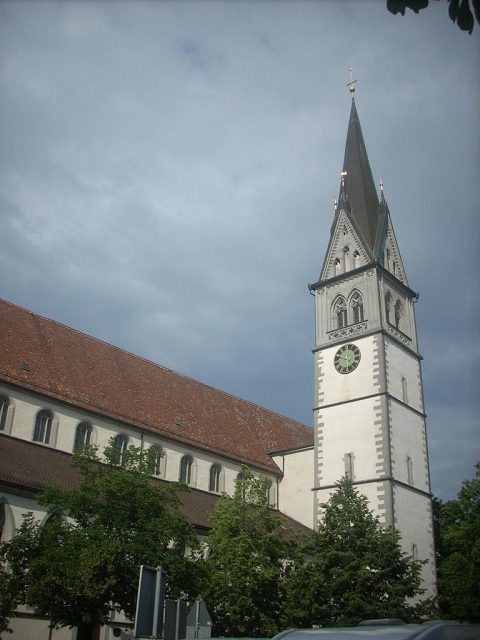
St. Stephan, also known as St. Stephen's Church, is a former collegiate and parish church in the old town of Konstanz. Today it belongs to the Catholic pastoral care unit Konstanz-Altstadt. St. Stephen's Church is considered the oldest church foundation in Konstanz.
Roman Period
The origins of St. Stephan date back to the late Roman period. The site is located south outside the first settlement and later cathedral district. The earliest building is presumed to have been either a profane market and court hall or a cemetery church. The house of worship, dedicated to St. Stephen, was already present at the founding of the Diocese of Konstanz at the end of the 6th century. It may have been a wooden structure.
Early Middle Ages
The oldest documented mention of St. Stephen's Church dates from 680 (Gallus-Vita). From about 900, a regulated community of clerics (collegiate church) was established at St. Stephan. The pre-Romanesque church was damaged or destroyed during the Hungarian invasion in 926 and probably restored under Bishop Noting. At this time, a market already existed near the church, which was still located outside the walled city.
High Middle Ages (Romanesque)
From the 11th century, the market and artisan settlement around St. Stephan grew strongly and was incorporated into the city. The collegiate church now also served as the parish church of Konstanz's largest parish. Around 1130, the transformation of the old church into a Romanesque basilica reflected this development. It had its portal on the main street on the east side; the square choir with the main altar was in the west. The nave corresponded approximately to its current size; the side aisles were half as wide.
Late Middle Ages (Gothic)
From the 13th century, St. Stephan, in contrast to the episcopal cathedral area, was a civic and market church and thus a symbol of patrician self-confidence. The canons now largely came from the city's bourgeois families, who also buried their leading members here.
During the Council of Konstanz (1414–1418), the Roman Rota met in St. Stephan.
In 1428, extensive expansion work on the building began, which lasted over three-quarters of a century and gave the exterior its current form. The side aisles were doubled in width. The nave was extended by three meters, and the church was now oriented to the east. A polygonal choir was added on the east side. The clerestory windows received Gothic tracery. In 1483, the construction of the tower added to the south was begun. However, all these works reflect chronic lack of funds. The Gothicization was limited to a minimum and kept in simple early Gothic forms.
Reformation Period
The Reformation found early entry into Konstanz from Zurich and, in the Free Imperial City, combined with opposition to episcopal influence. From 1527, St. Stephan was Zwinglian. The canons were expelled. The entire furnishings – paintings and statues, liturgical books and vessels – fell victim to the iconoclasm. Ulrich Zwingli himself preached in St. Stephan in December 1529.
After the defeat of the Schmalkaldic League in 1548, Konstanz was re-Catholicized under Habsburg rule. From 1550, St. Stephan was again Catholic, and the canons returned. However, the diminished importance of the city and the Thirty Years' War prevented a significant artistic re-furnishing.
Baroque
From the mid-17th to the mid-18th century, only the most necessary maintenance work was carried out on St. Stephan. A new impetus was given in 1763 by the donation of Nicholas and Stephen relics by Weingarten Abbey; Nicholas of Myra, patron saint of merchants, had been considered a secondary patron of St. Stephan since about the 15th century. From 1770, a thorough renovation of the church began, which was accompanied by a partial Baroque transformation. Especially the choir received a completely new spatial effect with a bright stucco ceiling and a colorful ceiling painting by Franz Ludwig Herrmann.
19th and 20th Century
In 1807, the St. Stephen's Collegiate Church was dissolved. The church remained a Catholic parish church. The structural changes since then have been minor and primarily served to secure the building. The 19th century supplemented the interior furnishings in the spirit of Neo-Gothic. At the beginning of the 20th century, a new larch wood ceiling was installed, decorated with wood reliefs by the Freiburg sculptor Joseph Dettlinger.
Furnishings+
Most of the pre-Reformation furnishings of St. Stephan were lost during the Reformation turmoil. The current furnishings were only partially created for St. Stephan. Many pieces come from elsewhere.
The choir stalls and eight oil paintings of saints mounted above them date from the early 15th century (partially from the Minster). The stained glass windows with depictions of saints, which have been inserted flanking the historicist central window in the choir since 1863, were probably created by Claus Nithard around the middle of the 15th century.
Among the contributions of the 16th century, the tabernacle stands out, created by Hans Morinck in 1594. With its rich and lively figural program, it is one of the significant examples of its kind. Several epitaphs in the choir are by the same sculptor. Slightly older is the cycle of apostle paintings with Creed texts on the nave pillars, which was uncovered during the most recent restoration.
From the Baroque furnishings, the following are preserved:
- St. John of Nepomuk figure on the exterior of the choir apse (1710)
- St. Stephen figure above it (around 1770)
- Inside, to the left and right of the choir arch, Nicholas and Stephen (around 1770)
- Twelve apostle figures on the choir walls (18th century)
- Parts of the organ case
- Pulpit (1773)
The main witness to Historicism is the Neo-Gothic high altar from 1863, which shows in full plastic representation in the central shrine the Crucifixion of Christ with Mary and John and the kneeling Mary Magdalene, and in the outer shrines the church patrons Stephen and Nicholas. The central choir window depicting the Holy Trinity was created in 1862 (Eggert, Munich).
Between 1910 and 1917, Carl Philipp Schilling and his nephew Franz Schilling decorated the clerestory walls with twelve rectangular narrative paintings depicting scenes from the Gospel, as well as with depictions of important saints and church teachers in the interspaces and spandrels. This painting is only partially preserved, especially on the north wall.
Organ+
The organ was built in 1997 by the organ building company Georges Heintz (Schiltach) within the existing organ case. Behind the central part of the case are the Great Organ and the Positive Organ, above the Great Organ is the Swell Organ, which takes on the function of a Rückpositiv. To the right and left of the Great Organ are the stops of the Swell Organ, and in the outer case parts and on the back wall are the pedal stops. The instrument has 58 stops on 4 manuals and pedal, with the depth of the organ being 1.20 m.
Bells+
In the tower there is a four-part bronze carillon with the nominals D-flat1, E-flat1, F1 and A-flat1.
Take Mobile History with you
You are reading this text for free. Premium adds what matters on the road: descriptions read aloud, sites found through your camera, whole regions taken offline.
- Every description, including the ~17,700 Premium sites
- Audio guide: have descriptions read to you on location
- AR finder: see sites through your camera, with distance and bearing
- Unlimited saved sites
14 days free, then from €2.99 a month. Cancel anytime.
Source: Wikipedia · Licence: CC BY-SA 4.0 · Image: https://commons.wikimedia.org/wiki/File:Konstanz_St._Stephan_SW.jpg
This description draws on the facts documented in the linked Wikipedia article; Wikipedia content is licensed under CC BY-SA 4.0. Wording and editing: Mobile History.
Location: 47.6625, 9.1745