The Gate can be visited
Town FortificationOber-Ingelheim
Town Fortification Ober-Ingelheim-Uffhub Gate
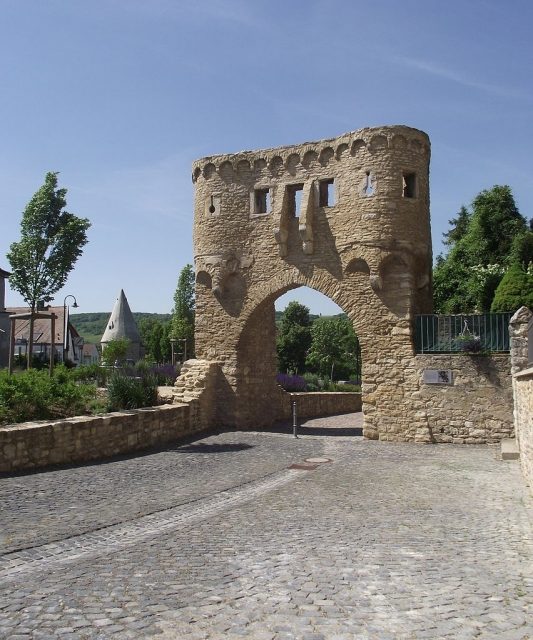
The Ober-Ingelheim local fortification enclosed Ober-Ingelheim since the beginning of the 15th century, until it finally lost its importance in the course of the 19th century. The complex dates from the 14th to 15th century, the defensive system at the Burgkirche dates from the 12th century. The local fortification became necessary to protect the property of the noble families in Ober-Ingelheim. Different masonry techniques and different stone materials indicate several construction phases. According to the town plans, the complex was still largely preserved around 1800. This changed with the breakthroughs of the Neuweg in 1830 to the south, as well as with the northern breakthrough of Bahnhofstraße in 1876. With this, the local fortification lost more and more importance, fell into disrepair or was used as a quarry. Since the 1990s, the city of Ingelheim has been striving to preserve the remaining building fabric.
Town Wall+
The tower-fortified ring wall consisted of limestone rubble and fieldstones and was six to eight meters high. It had 16 towers and seven gates, some of which were inhabited. In addition, it was fronted by a palisade, as well as a rampart and moat. Since the Selz river west of the town was very marshy at that time, no fortification was necessary there. The best-preserved part today is the section around the Burgkirche and the northern section in front of the Burgkirche, where the former moat is still visible.
Gates+
The Uffhubtor is the youngest and at the same time best-preserved city gate. It led in the direction of Wackernheim and Mainz. The western Ohrenbrücker Tor led over the then marshy Selz in the direction of Westerberg. In the 1960s, the archway was reconstructed based on the model of the Uffhubtor. To the southwest lies the Stiegelgässer Tor; it could also be passed at night when the main gates were closed. At the Stiegelgässer Tor, one first crossed a footbridge, hence the current name Stieg, to enter the town. The Altengässer Tor was the gate towards Gau-Algesheim. It was located at the western end of today's Altengasse and is no longer preserved. To the north was the Rinderbacher Tor, which connected the two towns of Nieder- and Ober-Ingelheim. It was already demolished in the 19th century and replaced by a residential building, until it was completely removed in the 1970s. The Hammergässer Tor, which is no longer preserved today, was the connection between Sporkenheim and Ober-Ingelheim. Today, a new development area is located on the site. It can be assumed that all city gates, except for the Uffhubtor, had a similar architectural style. The gates were always opened at 4 am and closed again at 8 pm. All gate systems were inhabited by a gatekeeper.
Towers+
A number of conical spired towers have been preserved, some of which are inhabited today. The Malakoffturm is the most striking part of the defensive system in the area of the Burgkirche. It is a two-story round tower with a domed vault on the upper floor and an intact high entrance. In addition, a dungeon with a groin vault is still present.
The Uffhubtor+
The Uffhubtor is one of the best-preserved city gates of the former local fortification of Ober-Ingelheim. The gate stands on the southwestern city limits of Ober-Ingelheim near the Burgkirche. In the immediate vicinity is the second Ober-Ingelheim power station (today called Altes E-Werk). In 2008, a green area was created next to the gate.
Name+
Uffhub is dialectically derived from Aufhof. The street below the Uffhubtor bears the official name Aufhof. In the Middle Ages, it led to the noble farmsteads in Stiegelgasse.
From Construction to Auction
The gate was built in the 14th century for access from the direction of Mainz, making it the youngest of the city fortifications. With the city fortifications, the gate also lost importance and fell into disrepair over the centuries, leaving only the masonry as a ruin. Around 1900, the gate was auctioned off by an Ingelheim citizen to preserve it. In the 20th century, the gate again came into the possession of the city of Ingelheim. Today, the building is a protected monument.
21st Century, Redesign and Renovation
Until 2007, traffic passed through the gate; since the construction of a bypass road, it has been closed to car traffic. In 2009, it was extensively renovated.
Architecture+
The gate, designed as a shell tower, originally had pointed turrets; only remnants of the wooden gable remain. It has a Gothic archway and is decorated with a round arch frieze. In addition, the typical machicolation found in city gates is present. The battlement floor and the pivot holes of the gate wings are still preserved.
In the Middle Ages, the city wall led directly from the gate to the Burgkirche; since the construction of the power station (1905), the city wall is no longer visible or has been demolished.
Take Mobile History with you
You are reading this text for free. Premium adds what matters on the road: descriptions read aloud, sites found through your camera, whole regions taken offline.
- Every description, including the ~17,700 Premium sites
- Audio guide: have descriptions read to you on location
- AR finder: see sites through your camera, with distance and bearing
- Unlimited saved sites
14 days free, then from €2.99 a month. Cancel anytime.
Source: Wikipedia · Licence: CC BY-SA 4.0 · Image: https://commons.wikimedia.org/wiki/File:Ober-Ingelheim-Uffhubtor.JPG
This description draws on the facts documented in the linked Wikipedia article; Wikipedia content is licensed under CC BY-SA 4.0. Wording and editing: Mobile History.
Location: 49.9617, 8.0642