The Gate can be visited
Town FortificationFreistadt
Town Fortification Freistadt-Linzertor
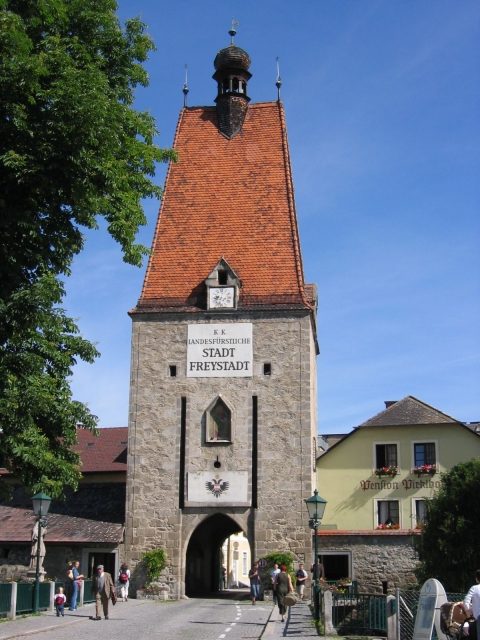
The listed Linzertor is a medieval city gate in Freistadt, Upper Austria. The name comes from the next largest city to the south – Linz. At 28 m high, the Linzertor is one of the most powerful gate towers in Central Europe and is considered the landmark of the city. The Linzertor has been adapted to the current architectural style several times over time.
It was built in the 13th century at the southern access to the city (the Böhmertor is in the north) and is thus one of the oldest towers of the city fortifications. Around 1485, the Freistadt master builder Mathes Klayndl rebuilt the Linzertor in the late Gothic style. During this time, a bastion was also erected in front of it, which is still recognizable today by the property boundaries. In the Baroque period, a Baroque onion dome was placed on top of the gable of the steep wedge roof of the Linzertor.
The outside of the city gate protrudes only a small distance from the course of the outer city wall. The old trade route from Enns to Bohemia, the later Reichsstraße (Linz – Prague) and then Bundesstraße 125 ran through the gate, before a bypass road was built in the 1960s. In the Middle Ages, the gate was equipped with a drawbridge, as evidenced by the long wall slots (for the swing beams). In peacetime, the drawbridge remained on the ground, only the city gate was closed and locked at dusk. The watchman handed the key to the mayor overnight, and the gate was reopened at dawn.
In 1964 and 1971, two safe passages for pedestrians were created to the right and left of the gate (through the outer city wall). This was necessary to provide pedestrians with safe access to the old town, as traffic through the gate was constantly increasing.
Current Appearance+
Above the passage is an image of the city's patron saint – Saint Catherine of Alexandria. The designation "k.k. = kaiserlich-königliche landesfürstliche Stadt Freystadt" (imperial-royal princely city of Freystadt) indicates that Freistadt belonged to the sovereign (Babenbergs, since 1282 Habsburgs), like seven other cities in Upper Austria. The southern and northern of the four roof dormers bear a stopped clock.
From the western pedestrian passage, a path leads into the Zwinger and further to the Bürgerkorpsturm. The Zwinger is the space between the outer and inner city walls and is very well preserved in this area. In the past, the Zwinger was not allowed to be built on for security reasons. The only exception was that the city built a butcher's stall here and at the Böhmertor around 1570. After that, no more cattle were allowed to be slaughtered within the inner city wall; this was a sanitary measure and was intended to help prevent diseases.
Take Mobile History with you
You are reading this text for free. Premium adds what matters on the road: descriptions read aloud, sites found through your camera, whole regions taken offline.
- Every description, including the ~17,700 Premium sites
- Audio guide: have descriptions read to you on location
- AR finder: see sites through your camera, with distance and bearing
- Unlimited saved sites
14 days free, then from €2.99 a month. Cancel anytime.
Source: Wikipedia · Licence: CC BY-SA 4.0 · Image: http://commons.wikimedia.org/wiki/File:Linzertor3.JPG
This description draws on the facts documented in the linked Wikipedia article; Wikipedia content is licensed under CC BY-SA 4.0. Wording and editing: Mobile History.
Location: 48.5129, 14.5055