The Gate can be visited
Town FortificationFamagusta (Αμμόχωστος, Mağusa)
Famagusta City Wall-Sea Gate
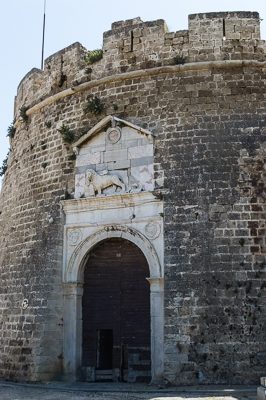
The walls of Famagusta are about two miles in length, totally surrounding the old city, and are remarkably well preserved. Probably the best view of them is from the moat, itself running for over a mile along the three landward sides. Don't believe some maps that tell you part is inaccessible because of military occupation. This has not been the case for several years now. Although meant to be a foot and cycle path, it is possible to drive round the moat, although you get a much better view on foot.
When the Venetians took over Cyprus in 1489, they inherited a city that already had defensive walls, built by the Lusignans. These walls were tall and thin for defence against the siege engines and bows and arrows of the day. However, by 1489, warfare had changed. The invention of gunpowder meant that cities now had to be defended against cannon attack, and Famagusta's walls were no longer suitable defence against the Ottomans, who were seen as the major threat, (Correctly as was seen just 80 years later).
The Venetians immediately started to renovate and update the walls, bringing in specialists from Venice to oversee the work. The walls and bastions were strengthened, redundant arrow slits and openings being closed up. In their place, openings were made in the walls to house cannons and other modern artillery.
The Sea Gate
When the Venetians took over Famagusta in 1489, they immediately started to strengthen the walls. The Sea Gate, or Porta del Mare, was one of the earliest to be completed, in 1496. It was built by Niccolo Prioli in order to protect the entrance to the walled city from the Port of Famagusta. It was built at an angle, so that it was the first thing that mariners would see as they approached the city.
Unfortunately, the most interesting part of the Sea Gate is on the port side of the wall, and inside the customs area. Consequently, it is normally inaccessible. A good view can be had, however, from the Othello Tower.
Dominating the entrance, above the gate, is a large marble sculpture of the winged lion of St Mark, who was the patron saint of Venice. The lion holds a book in one paw, on it inscribed in Latin, "Peace to you Mark, my evangelist". It is thought that the marble for this sculpture was brought from Salamis. The wooden gate and portcullis, is a little later, dating from Ottoman times.
On the land side, to the right of the Sea Gate, you will see a large statue of a lion. Local legend states that one night the lion will open its mouth. The person who catches this moment and puts their hand into the lion's mouth will obtain an enormous fortune.
The Sea Gate is currently undergoing renovation.
Take Mobile History with you
You are reading this text for free. Premium adds what matters on the road: descriptions read aloud, sites found through your camera, whole regions taken offline.
- Every description, including the ~17,700 Premium sites
- Audio guide: have descriptions read to you on location
- AR finder: see sites through your camera, with distance and bearing
- Unlimited saved sites
14 days free, then from €2.99 a month. Cancel anytime.
Source: Wikipedia · Licence: CC BY-SA 4.0 · Image: http://www.schwarzaufweiss.de/Nordzypern/famagusta-seetor.htm
This description draws on the facts documented in the linked Wikipedia article; Wikipedia content is licensed under CC BY-SA 4.0. Wording and editing: Mobile History.
Location: 35.1260, 33.9445