The City Wall can be visited
Town FortificationBonn
Town Fortification Bonn-Sterntor
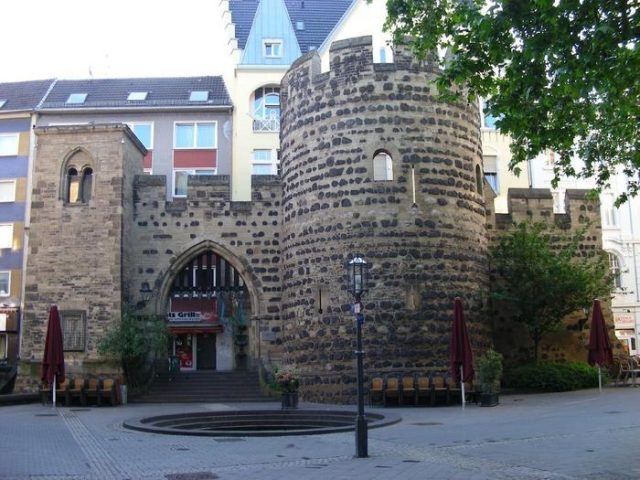
The city fortifications of Bonn protected the city of Bonn for a longer period of its history. A medieval wall ring from the 13th century was supplemented in the 17th century by baroque fortifications. The most famous remnants are the Alter Zoll and the Sterntor. Remains have also been preserved in some other parts of the city.
Middle Ages
The city wall was erected after the granting of city rights by the Archbishop of Cologne, Konrad von Hochstaden, on March 18, 1244. Today's Kasernenstraße and Theaterstraße mark the northwestern and northern course of the city wall. It had four main gates: The Stockentor (Stocken pfort) to the south (since the 18th century also Koblenzer Tor), the Sterntor ((Pi)sternen pfort) to the west (Eifel) at the end of Sternstraße (in the Middle Ages Pisternenstraße - Baker's Street, from Latin pistrina - bakery), the Kölntor (Cölnisch pfort) as the northern main gate to Cologne (today's intersection of Kölnstraße/Kasernenstraße) and the Rheinpforte towards the Rhine bank as the eastern main gate. Further harbor gates were the Giertor (Gier pfort) and the Krantor (Gran pfort) above the customs, near which a tread crane stood for loading. In addition to the main gates, which were expanded into gate castles modeled on Cologne during the Middle Ages, there was also the Mülheimer Pförtchen (Mülmer Thörlen, today's Mülheimer Platz) slightly south of the Sterntor to the southwest and the Wenzelpforte (Wentzel pfort) to the north between Kölntor and the Rhine (at today's intersection of Welschnonnenstraße/Theaterstraße) at the end of the former Wenstergasse (Wanstmachergasse, today Wenzelgasse), which led from the market north to the northern city wall. As in Cologne, on a smaller scale, the Rhine side was heavily fortified. A square defensive tower (Neuer Turm) with battlements stood as a northern bulwark to secure access to the Rhine bank, and at the southern end of the Rhine wall, under Archbishop Salentin von Isenburg after 1576, the new customs (later called Alter Zoll) was erected.
Modern Era
Among the reasons for the reinforcement of the 300-year-old medieval city wall may be the threat from the Rheinschanze Pfaffenmütze at the mouth of the Sieg and the course of the Thirty Years' War, especially in the years 1642–44. Advances in the production of cannons at that time forced many cities to build fortifications with reduced target areas through appropriately inclined masonry.
A leading master builder for the baroque fortification is not known; recognizable influence came from Munich's construction industry in the environment of Elector Ferdinand's relatives and the contemporary fortress construction by Sébastien Le Prestre de Vauban. Most of the participating engineer officers came from the Italian or French school. In 1688, Ing. Thomas de Choisy, Governor of Saarlouis, was named the "First Man after Vauban". In 1701, Elector Joseph Clemens held formal leadership.
In 1622/23, construction of the bastion fortification at the Stockentor began. From 163 to 1642, the Zollbastion was built in the area of the former Renaissance customs building from the time of the earlier Cologne Elector Salentin von Isenburg. The first confirmed mention of the Alter Zoll in the original plan of the fortress dates from 1644.
During the occupations of Bonn in 1673, 1689, 1703, and 1811, there were partial destructions of the complex, the most severe in 1689, and subsequent repairs. In the 18th century, the Alter Zoll was popular as a "castle terrace".
Preserved Sections+
Medieval City Wall
The Sterntor, rebuilt in 1900 two years after the demolition of the original gate castle at Bottlerplatz, also contains parts of the city wall and a half-tower. Since 1987/88, a part of the counter-wall to the medieval fortification (Contrescarpe) on Friedensplatz has served as a low wall in the pedestrian zone.
Since 2006, there has been a bronze plaque and markings in the pavement on Gangolfstraße. An idea of the shape of the half-tower is conveyed by the architectural hint in the shop window of house no. 11, continuing the ground marking. Not directly visible, but to be guessed, is the course of the city wall in the cityscape along Theaterstraße in the area of the Beethovenhalle towards the Rhine bank. The Beethovenhalle, as one of the subsequent superstructures, marks the northern bastion of the city wall.
Baroque City Fortification
The Alter Zoll is a former bastion of the complex on the Rhine bank and is today a popular excursion destination in the city center. Other smaller remains are, in order of rediscovery or installation:
- In 1972, during construction work, the Maximilian Bastion, also called Botterweck and built in 1642–48, became recognizable. Its southeast corner (curtain angle) was later left visible in a gallery shop in the Cassiusbastei (Maximilianstraße).
- 1989: Bastion fountain with a bronze floor plan near the curtain of the Maximilian and Heinrich bastions in Windeckstraße.
- In the course of Bonn's defortification, the Sterntorbrücke, now a protected monument, 35 meters long, also disappeared from the cityscape. Its seven barrel vaults, rhythmically structured towards the center and built of bricks, span the partly filled fortress moat and connected the newer Outer Sterntor from 1662, demolished in 1858, with the bank of the western fortress foreland. In the pedestrian zone Sterntorbrücke, since 1993, paved areas refer to the original bridge, which was widened to over 10 meters in the mid-19th century in a southerly direction and decorated with circular ornaments as architectural embellishment.
- Since 1996, the northern and southern faces of the Sterntor / St. Maria Bastion, built 1658–64, have been located at Annagraben near the new courthouse buildings. Another part of the wall was visibly incorporated into the Oxfordstraße / Wilhelmstraße underground car park.
- In 1999, a part of the curtain between the Heinrich and Sterntor / St. Maria bastions, built 1658–64, was uncovered in the new "Mälzerei" in the basement of a brewery restaurant (Sterntorbrücke).
- The curtain between the Ferdinand and Cassius bastions from 1642 has been in the Kaiserpassage since 2000.
- A bronze plate and ground stone markings have commemorated the course of the southwestern face of the Cassius Bastion from 1642 in Gangolfstraße since 2006.
- Well-preserved wall remains in the line of the northern flank of the Heinrich Bastion were uncovered in 2011 at the construction site at Friedensplatz 1 and documented using 3D methods. This 3D computer reconstruction was also shown in the special exhibition of the StadtMuseum. At two places in the new underground car park of Sparkasse KölnBonn, wall sections have been left visible. Thus, near the entrance to the underground car park, as the only known find site, the internal structure of the fortress wall can be observed in a cross-section framed with a concrete frame on the wall (fired bricks and interlayers with horizontal basalt columns). The other, concrete-walled, free-standing piece of the bastion wall in the parking area with a recognizable small room still puzzles experts.
Not directly visible, but to be guessed as a topographical trace, is the course of the bastion system in the cityscape from Wilhelmstraße to Wachsbleiche in the area of the Beethovenhalle. The hall itself stands as one of the subsequent buildings on the remains of the bastion that protected Bonn on the Rhine bank to the north.
Further Fortifications in Bonn+
Further fortifications in the Bonn city area are the Beueler Schanze, which existed from 1583 to 1713, and the Schänzchen, located in the immediate vicinity of the former ancient Roman camp Castra Bonnensia. Other structures in the Bonn city area not related to the medieval or baroque fortifications were or are various castles and knight's seats in the later incorporated villages of the surroundings, such as Burg Endenich and Dransdorfer Burg, with concrete plans to structurally integrate the Godesburg into the overall baroque concept.
Sterntor+
The original Sterntor in Bonn was built around 1244 at the end of Sternstraße and was part of the medieval city fortifications. It is a protected architectural monument, and the 17th-century barrel vault is designated as an archaeological monument.
In 1898, the gate, which remained as the last gate castle of the former city fortifications, was demolished despite intervention by Emperor Wilhelm II to better manage traffic flow. Only two years later – in 1900 – a replacement structure under the same name was created a few meters away on the north side of Bottlerplatz. It consists only partially of remnants of the former Sterntor, otherwise of remnants of the city wall and an old half-tower. The corner turret and the surrounding battlement crown classify it as historicist.
Two effigies are inserted into the outer archway: the Crucified with Mary and John, and the "Mother of God with Seven Sorrows" from 1650.
In 2002, the "Lichtblicke" (Glimpses of Light) installation by light artists Regine Vogel/Johannes Dinnebier from the Center for International Light Art took place at the Sterntor.
Take Mobile History with you
You are reading this text for free. Premium adds what matters on the road: descriptions read aloud, sites found through your camera, whole regions taken offline.
- Every description, including the ~17,700 Premium sites
- Audio guide: have descriptions read to you on location
- AR finder: see sites through your camera, with distance and bearing
- Unlimited saved sites
14 days free, then from €2.99 a month. Cancel anytime.
Location: 50.7352, 7.0986