The City Wall can be visited
Town FortificationAvignon
Town Fortification Avignon
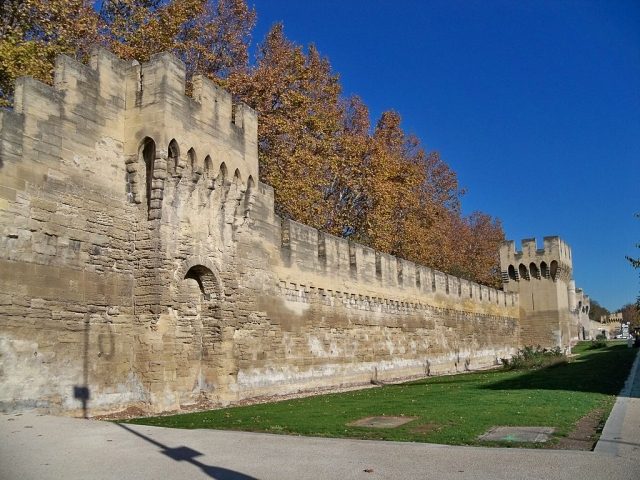
The city wall of Avignon is a 4330-meter long ring wall that surrounds the historic old town of Avignon. It is flanked by 39 towers and seven main gates and is considered one of the best-preserved structures of its kind in Europe. The city wall has been classified as a Monument historique since February 23, 1902.
The city wall runs elliptically around the city center within Avignon's boulevard ring. It is almost completely closed and is only interrupted by the Rocher des Doms rock, which itself serves as a natural protective barrier.
The wall was built with "molasse burdigalienne" limestone, which formed in the Burdigalian age in the Carpentras-Avignon-Camargue sedimentary basin and is abundant in the Avignon area.
Construction History+
A first ring wall was built together with the St. Bénézet Bridge in the twelfth century, when Avignon rose to become a self-governing city-republic modeled on Italian cities. During the siege of Avignon in 1226 by Louis VIII, this fortress was destroyed. After the city was attacked several times by troops of the Grandes Compagnies, Pope Clement VI decided in 1348 to erect a new circumvallation on the ruins of the old wall. Furthermore, the population was to be protected from impending floods of the Rhône. As part of an extensive defense plan, the city wall was to be equipped with numerous troops and protected by additional moats. The completion of the new defensive wall only took place in 1376, when the popes decided to leave the city and return to Rome.
In 1856, a part of the city wall was destroyed by floods. Eugène Viollet-le-Duc, who was commissioned with the restoration four years later, reinforced the wall for protection against floods and equipped the new city gate, Porte de la République, established at the train station, with two towers. Additionally, further gates were opened alongside the existing seven city gates to facilitate road traffic. The former moats were filled in during the 19th century and later converted into parking lots.
Take Mobile History with you
You are reading this text for free. Premium adds what matters on the road: descriptions read aloud, sites found through your camera, whole regions taken offline.
- Every description, including the ~17,700 Premium sites
- Audio guide: have descriptions read to you on location
- AR finder: see sites through your camera, with distance and bearing
- Unlimited saved sites
14 days free, then from €2.99 a month. Cancel anytime.
Source: Wikipedia · Licence: CC BY-SA 4.0 · Image: http://de.wikipedia.org/wiki/Datei:Remparts_%C3%A0_Avignon.JPG
This description draws on the facts documented in the linked Wikipedia article; Wikipedia content is licensed under CC BY-SA 4.0. Wording and editing: Mobile History.
Location: 43.9515, 4.8034