The Tower can be visited
Town FortificationAachen
City Wall Aachen-Marienturm
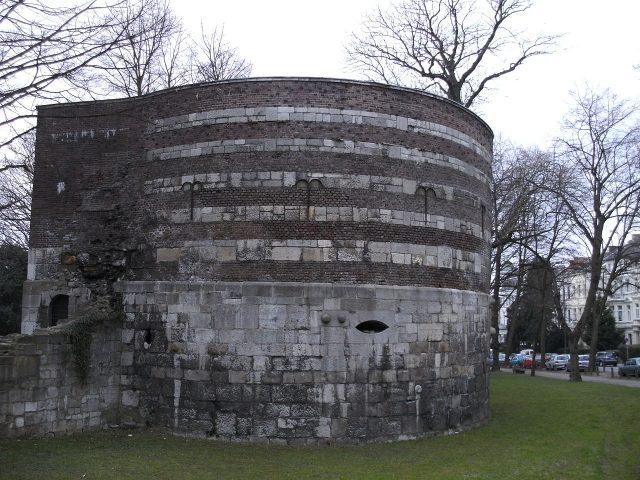
The Marienturm (also called Marienburg) was a defensive tower of the outer city wall of Aachen, built between approximately 1300 and 1350. It is one of the few remaining towers of the former city fortifications and is among the listed buildings of the city of Aachen.
The name Marienturm or Marienburg results from the date of the laying of the foundation stone. This took place on August 14, 1512, the day before the Assumption of Mary.
The Marienturm is located in the north of Aachen. Within the city wall, it is the direct neighbor of the still existing city gate Ponttor and the no longer preserved Bergtor.
The Marienturm was built in 1512. This means that it was constructed long after the completion of the outer city wall, which was built between 1257 and 1357. Until then, a large watchtower had stood here. Its height was hardly different from the Langer Turm and the Sandkaultor. It bore the name "Breuerturm", "Brewersturm" or "Brauersthorm". The location of this building required a considerable height for a tower in the 13th century, as this was the only way to repel attackers from the neighboring Lousberg. This changed with the advent of cannons in the military. To use these as artillery on a tower, a lower, more stable construction was significantly better suited. The citizens of Aachen decided to demolish the Breuerturm and replace it with the Marienturm. Due to its four-meter-thick walls, it resisted cannon attacks better than tall, thin-walled towers.
Impact holes from stone cannonballs in the exterior wall of the building still bear witness to the battle against the Spanish General de Grana in 1638.
In 1908, a garden with a pond, the Ludwigsplatz (today Veltmannsplatz), was laid out below the Marienturm. It was part of the redesign of the outer moat ring into a closed green belt including water features by the landscape architect Maximilian Friedrich Weyhe, the court gardener of Düsseldorf. A hornbeam (1900), a cornelian cherry (1900), and a horse chestnut (1850) are particularly prominent in the green area around the Marienburg.
On August 6, 1933, a memorial for the victims of the First World War was established on the ground floor by the then Lord Mayor of Aachen.
The Marienturm was severely damaged during the Second World War and restored to its original state between 1950 and 1955. Today, the building is one of the sights of Aachen visited by numerous tourists.
Architecture+
The tower has four-meter-thick walls. Its moat floor has two narrow firing slits, while the upper floor is equipped with five firing shafts. Deviating from the other towers of the city fortifications and resulting from modern warfare technology, every second shaft of the upper floor was specially prepared for the use of cannons, while the others were intended for defense with rifles.
The round part of the tower has a diameter of 14.70 meters, and the square forepart facing the city has a width of 13.40 meters. On both sides of the tower, remnants of the otherwise hardly existing city wall are present.
Inscriptions+
Numerous inscriptions and memorial plaques are located on the tower. Their texts read:
- O sint Salvatoir du heiland Marieburg bin ich Genat.
- 1914-1918 1939-1945 THIS BULWARK, ERECTED IN THE YEAR 1512 TO STRENGTHEN THE OUTER CITY WALL, CALLED MARIENBURG, WAS CONVERTED INTO A MEMORIAL IN 1932. SEVERELY DAMAGED IN THE WAR YEAR 1944, RESTORED 1950-1955.
- 1933-1945. Paths against forgetting. Aachen According to plans still made in the Weimar Republic, the National Socialist Lord Mayor of Aachen dedicated this "memorial" for the German fallen of World War I on August 6, 1933. The military spirit of those years characterizes this building to the present day.
Memorial for the War Victims of Both World Wars+
The population of Aachen decided to erect this memorial during the Weimar Republic. Through the attached inscription, they explicitly point out that although the Marienturm was consecrated by a National Socialist Lord Mayor, the decision for this was made without National Socialist influence.
Inside the memorial is a stone sarcophagus of a war. This was created by the artist Mathias C. Korr in 1933.
Take Mobile History with you
You are reading this text for free. Premium adds what matters on the road: descriptions read aloud, sites found through your camera, whole regions taken offline.
- Every description, including the ~17,700 Premium sites
- Audio guide: have descriptions read to you on location
- AR finder: see sites through your camera, with distance and bearing
- Unlimited saved sites
14 days free, then from €2.99 a month. Cancel anytime.
Source: Wikipedia · Licence: CC BY-SA 4.0 · Image: http://de.wikipedia.org/wiki/Datei:Marienturm-Aachen6.JPG
This description draws on the facts documented in the linked Wikipedia article; Wikipedia content is licensed under CC BY-SA 4.0. Wording and editing: Mobile History.
Location: 50.7824, 6.0822