The church can be visited
ChurchNördlingen
St. Georgs Church
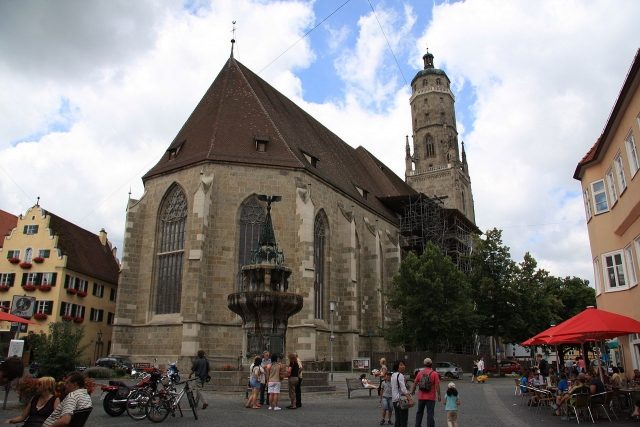
The late Gothic church of St. Georg, built between 1427 and 1505, is the landmark of the city of Nördlingen in Bavaria. It is the Evangelical Lutheran parish church of the city.
The city council of Nördlingen decided to build St. George's Church on October 17, 1427. The choir of the hall church was completed in 1451, and the construction of the tower began in 1454. The high altar by Friedrich Herlin was completed in 1462, and the tower in 1490. With the completion of the vault in 1505, the construction, which largely consists of suevite, was finished. Because Nördlingen joined the Reformation under Kaspar Kantz, St. Georg became the Evangelical city church in the years 1523/1525.
The first restoration of the church took place between 1877 and 1887. On March 30, 1945, at 9:25 PM, an aerial bomb destroyed the Steinmeyer organ, which had been installed in 1889. On February 2, 1974, a fire destroyed the old Baroque organ from 1610. The church was last restored between 1971 and 1977.
Tower+
Visible from afar is the 90-meter-high church tower, called the Daniel, which is considered Nördlingen's landmark; it dominates the cityscape and the landscape of the Ries crater. This name goes back to a quote in the biblical book of Daniel: "And the king promoted Daniel and [...] made him ruler over the whole province" (2:48).
The provisional low dome helmet could not be replaced due to lack of funds. 350 steps lead to the tower room. The viewing gallery offers a panoramic view over the roofs of the old town, the city wall, and the surrounding villages up to the Ries rim. According to the city of Nördlingen (information board on site), 99 church towers can be seen from this gallery. Halfway up there is a late medieval treadmill. Prisoners once had to move it with their body weight to transport loads up the tower.
The tower room is constantly occupied by a tower keeper: a profession that only exists in Münster and Krakow in Europe. From 10 PM to midnight, the tower keeper calls out the saying "So G'sell So!" every half hour from the tower, the origin of which is associated with a legend:
In 1440, Count Hans von Oettingen-Wallerstein tried to conquer Nördlingen due to financial problems. To enter the city unnoticed, he bribed several gatekeepers not to lock the Löpsinger Gate on Epiphany Eve. When the wife of the cloth weaver Dauser went out at night to get beer from a tavern, she discovered the open gate, as an escaped sow was rubbing against it. She then cried out the words "So G'sell So!", which not only drove away the sow but also alerted the guards and can thus be understood as a threat against the treacherous gatekeepers; these were later apprehended while gambling and drinking wine and then quartered. The core of the legend is that a sow saved the city.
Historically, the watchman's call probably had a more practical background: the saying, called out hourly by all tower keepers simultaneously in the dark, was intended to ensure that all guards were at their posts and not sleeping.
Nave+
The 93-meter-long and over 20-meter-high nave makes St. Georg one of the largest hall churches in southern Germany. The building consists of a three-aisled choir and a three-aisled, twelve-bay hall with twelve central columns.
The Baroque high altar is adorned with late Gothic wooden sculptures by the Dutchman Niclas Gerhaert van Leyden. It is a crucifixion group with Mary and John and two grieving angels, flanked by Saint George with the defeated dragon at his feet and Mary Magdalene with the anointing vessel in her hand. These figures were originally in a wooden shrine painted by Friedrich Herlin with movable wings, created around the same time, which can now be seen in the Nördlingen City Museum. The altar received its Baroque form in 1683 by Johann Michael Ehinger. The casing of the late Gothic wooden shrine was only discovered under the Baroque cladding during the restoration in 1971–73; it now stands on the north wall with the painted back (eight Passion scenes of Christ and the Last Judgment) facing forward. Although the casing is signed by Herlin (dated 1462), it is assumed that the panels of the back, given their lower quality compared to the winged altar panels, are not by the master.
Carved animal and human heads as well as mythical creatures are attached to the choir stalls from the late Middle Ages (attributed to the local cabinetmaker Hans Tauberschmid, who was active around 1500). The baptismal font dates from 1492.
Also noteworthy are the sacrament house in the northeast corner of the choir, made by the stonemason Ulrich Creycz according to a design by the church master Stephan Weyrer, as well as the gallery balustrade depicting the Twelve Apostles and the late Gothic pulpit with reliefs of the four Evangelists with their symbols (Augsburg 1499) under a Baroque sounding board, on which Christ is enthroned with the globe (Johann Michael Ehinger, 1681).
A special feature of St. George's Church are the numerous epitaphs and funeral shields on the side walls. They bear witness to Nördlingen's past as a wealthy city of citizens and merchants.
Organs+
St. George's Church has three organs: the main organ on the west gallery, the side organ in a Renaissance prospectus (above the sacristy), and a small positive organ.
Main Organ
The main organ was built in 1977 by the organ building company Peter and restructured by the organ building company Rensch in 2005. The instrument now has 56 stops on four manuals. The fourth manual makes the stops of the side organ playable from the main organ. The key actions are mechanical, the stop actions are electric.
Side Organ
The side organ was built in 1976 by the Peter company behind the Renaissance prospectus from 1544 with 10 stops on two manuals and pedal.
Bells+
Of the four bells, the Osanna is the oldest. It was cast in 1496 by Peter Gereis from Augsburg.
The Great Bell or Apostle Bell (formerly also called Mary Bell or Snake Bell) originally hung in St. Mary's Church in Stargard and came to Nördlingen in 1952 as a so-called loan bell after the Second World War (cf. St. Lukas in Munich). Its rich decoration includes, in addition to generous friezes, a depiction of the twelve apostles with names under neo-Gothic aedicules placed around the flank. The bell also bears the inscription CALL OUT BOLDLY, DO NOT SPARE, RAISE YOUR VOICE. The two old bells from 1496 and 1862 were restored by welding in the Nördlingen company Lachenmeyer.
In 1960, the Rincker bell and art foundry added two bells. The larger one bears the inscription CHRIST SAYS: I LIVE AND YOU SHALL ALSO LIVE and the smaller one ONE LORD, ONE FAITH, ONE BAPTISM.
According to the ringing order, the evening bell is rung at 6, 12, and 7 PM, or 6 PM in the winter half-year, with the Osanna. On Saturday, all four bells ring in Sunday at 4 PM.
In the tower lantern, there are two bell bowls from 1831 for the clock strike and the storm bell from 1536.
Take Mobile History with you
You are reading this text for free. Premium adds what matters on the road: descriptions read aloud, sites found through your camera, whole regions taken offline.
- Every description, including the ~17,700 Premium sites
- Audio guide: have descriptions read to you on location
- AR finder: see sites through your camera, with distance and bearing
- Unlimited saved sites
14 days free, then from €2.99 a month. Cancel anytime.
Source: Wikipedia · Licence: CC BY-SA 4.0 · Image: https://commons.wikimedia.org/wiki/File:Noerdlingen_sankt_georg.jpg
This description draws on the facts documented in the linked Wikipedia article; Wikipedia content is licensed under CC BY-SA 4.0. Wording and editing: Mobile History.
Location: 48.8506, 10.4884