The remains of the Castle can be visited
RuinElgin
Spynie Palace
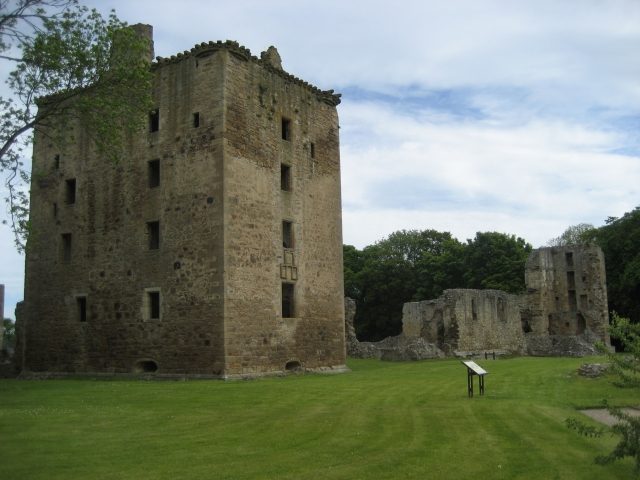
Spynie Palace, an imposing ruin in the Scottish region of Moray, was once a significant country residence for the Bishops of Moray. Situated on the south shore of Spynie Loch, the complex still bears witness to its former splendor and its role as one of Scotland's largest surviving medieval episcopal seats.
History+
The history of Spynie Palace dates back to the early 12th century, when the Diocese of Moray was founded. Towards the end of the same century, the Church of the Holy Trinity in Spynie was elevated to a cathedral, and it is presumed that an episcopal seat already existed at that time. Excavations confirm that a wooden castle stood on the same site before the current stone ruin. Under Bishop Bricius de Douglas, Spynie Palace was officially designated as the seat of the diocese in 1207/1208, increasing its importance as a residence. Despite the cathedral's relocation to Elgin in 1224, the palace remained a vital country estate. In the 14th century, following an act of revenge by the Wolf of Badenoch, Alexander Stuart, who burned down Elgin, the complex was expanded into its first stone castle. The 15th century saw further expansion, continuing into the early 16th century, making the palace one of Scotland's most magnificent structures. The imposing David's Tower, begun by Bishop David Stewart in the 1470s, subsequently dominated the site. In the 16th century, the last Roman Catholic Bishop Patrick Hepburn strengthened the defenses. After the episcopal constitution was replaced by the Presbyterian constitution in 1690 and the last Protestant Bishop William Hay was removed from office, Spynie Palace was gradually plundered and fell into ruin.
Location+
The ruin of Spynie Palace is located approximately 3 km north of Elgin in the Moray district of Scotland, United Kingdom, at an elevation of about 12 meters above sea level.
On site+
The ruin of Spynie Palace is now accessible to visitors and can be explored. It is state-owned and managed by Historic Scotland.
Nearby+
- Elgin Cathedral (sacred building), approx. 3.0 km away
- Gordon Castle (castle), approx. 13.5 km away
- Brodie Castle (castle), approx. 26.4 km away
- Balvenie Castle (ruin), approx. 26.7 km away
Take Mobile History with you
You are reading this text for free. Premium adds what matters on the road: descriptions read aloud, sites found through your camera, whole regions taken offline.
- Every description, including the ~17,700 Premium sites
- Audio guide: have descriptions read to you on location
- AR finder: see sites through your camera, with distance and bearing
- Unlimited saved sites
14 days free, then from €2.99 a month. Cancel anytime.
Source: Wikipedia · Licence: CC BY-SA 4.0
This description draws on the facts documented in the linked Wikipedia article; Wikipedia content is licensed under CC BY-SA 4.0. Wording and editing: Mobile History.
Location: 57.6760, -3.2912