To be privately owned
CastleNürnberg-Schniegling
Serzsches Castle
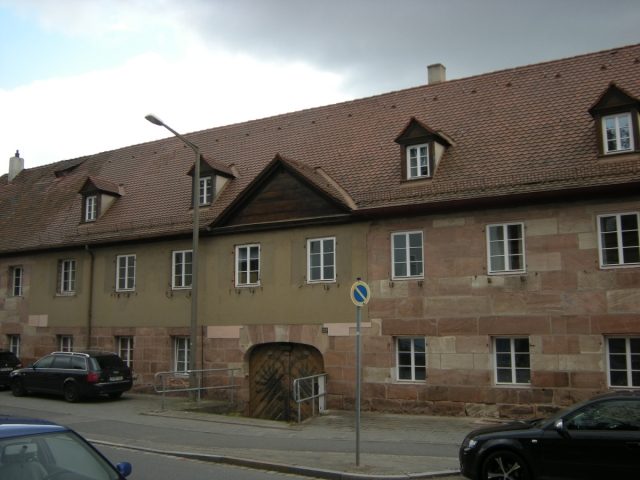
The core of the manor house consists of the summer house of the Nuremberg merchant Daniel Besserer from 1669. Besserer had acquired the garden with the ruins of two garden houses destroyed in 1632 from his father-in-law, the wine merchant Pankraz Pilgram. Before the Thirty Years' War, the garden property, possibly an offshoot of the large Sitzinger Hammer Mill, had been in the hands of Andreas Grünschneider and then came to Pilgram via the Lanzinger family.
Via the Hilling family and the merchant Johann Anton Ballador, the summer house came into the possession of the merchant and market adjutant Heinrich Krochmann in 1724, who began an extension in the same year. In 1732, a second major renovation took place, creating the current cubature. In 1737, Krochmann founded a snuff factory on his estate, which was partly established in the rooms of the castle. In 1739/41, production on the garden grounds was significantly expanded. The establishment of a tobacco factory, agreed with the Hofkammer in Munich for the central supply of the Electoral Bavarian tobacco monopoly, provoked resistance from the Principality of Brandenburg-Ansbach in 1741 (which claimed sovereignty in Schniegling), which even led to an occupation and willful damage to the property by a margravial commando.
Heinrich Krochmann had founded a family foundation during his lifetime, which was to be managed by the eldest male descendant after his death. Accordingly, his son Johann Jakob Krochmann became administrator shortly before 1750. Since the son died in 1750, the estate fell to the younger brother Johann Christoph, who also did not live long. Thereupon, a bitterly fought inheritance dispute erupted between the widows. Only a settlement by the city court in 1769 awarded the inheritance to Anna Susanna, daughter of Johann Christoph Krochmann. The heiress married Johann Albrecht Edlen von Serz, whereupon the name Serz's Castle became common.
The von Serz family was extremely wealthy and operated an iron and steel factory, among other businesses in Austria. After Anna Susanna's death in 1777, the dispute broke out again, ending with the transfer of ownership to her son Nicolaus Christoph Albrecht von Serz, who, however, died around 1795 on a journey to the East Indies. The family foundation was then dissolved and the property was handed over to the siblings jointly. One sister had married the merchant Heinrich Paul Wolfgang Günther, who appears as a co-owner in the early 19th century.
Heinrich Krochmann's grandson Johann Wolfgang Albert von Serz died at a great age in 1855 as the last of the ownership community. His heirs sold the family property in 1856 to Louis Vetter and the Dooser mill master Johann Adam Förster. After the estate was broken up, Vetter, who came from Ansbach, kept the manor house for himself and founded the well-known Schniegling metal capsule factory there. The Krochmann tobacco factory and the very representative Serz garden grounds fell victim to the continuously expanding capsule factory in the course of the late 19th and early 20th centuries. The company founded by Louis Vetter developed into an internationally renowned manufacturer of bottle capsules, tubes, sleeves, and shaped lids. The manor house was occupied by offices and rental apartments until the factory ceased operations in the 1990s. In 1913, the roof structure of the manor house was destroyed by a fire and replaced with a new, simpler construction. The clock tower and the Serz family crest in the triangular gable were not restored.
The manor house is a more than 42-meter-long, two-story building made of sandstone ashlar, covered with a hip roof. In the eastern upper floor, a hall with a very high-quality painted stucco ceiling has been preserved. The ceiling is also designed as a barrel vault (plank-lamella vault), which fortunately survived the fire disaster of 1913. The building also features baroque interior walls made of half-timbering and plank ceilings. Dendrochronological analyses confirmed the construction measures from around 1669 and 1732.
Take Mobile History with you
You are reading this text for free. Premium adds what matters on the road: descriptions read aloud, sites found through your camera, whole regions taken offline.
- Every description, including the ~17,700 Premium sites
- Audio guide: have descriptions read to you on location
- AR finder: see sites through your camera, with distance and bearing
- Unlimited saved sites
14 days free, then from €2.99 a month. Cancel anytime.
Source: Wikipedia · Licence: CC BY-SA 4.0 · Image: http://schloesserrundschau.de/bayern/schloesser01/nuernberg40.html
This description draws on the facts documented in the linked Wikipedia article; Wikipedia content is licensed under CC BY-SA 4.0. Wording and editing: Mobile History.
Location: 49.4674, 11.0292