Town and monastery archives
ResidenceAschaffenburg
Schönbornhof Palace
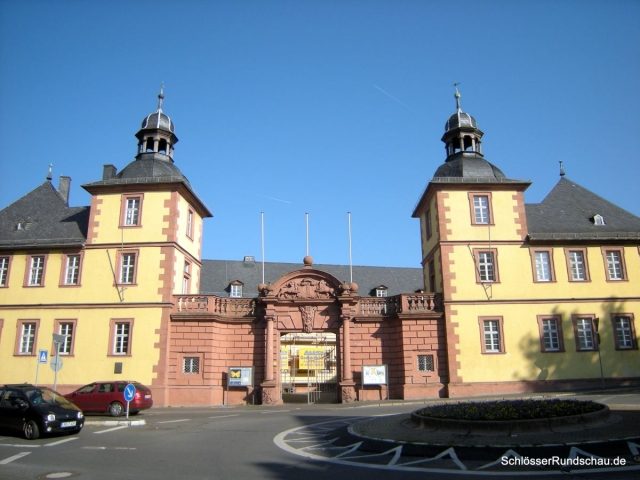
The Schönborner Hof in Aschaffenburg, a baroque building from the 17th century, today houses the Natural Science Museum Aschaffenburg with permanent exhibitions and an extensive collection of insects, as well as a representative display of the mineralogy and geology of the Spessart, and the City and Collegiate Archive Aschaffenburg.
The Schönborner Hof is centrally located in the city at the upper end of Im Löhergraben street, near the Freihofsplatz stop at Wermbachstraße 15.
The 30-meter long and six-meter wide building, a city palace, was the residence of the Schönborn family from 1676 to 1832. It was built from 1673 to 1681 according to the designs of the Mainz Capuchin friar Mathias von Saarburg. The Hof was conceived as a city palace for the Mainz Chief Court Marshal and Vicedom Melchior Freiherr von Schönborn and his wife Sophia Maria Anna, daughter of Johann Christian von Boyneburg.
The city of Aschaffenburg bought the Schönborner Hof in 1832 for 22,000 guilders. Initially, it served as a court and administrative building for the Court of Appeal for the Untermainkreis. When this moved to Würzburg, students of the Royal Female Educational Institution, together with a teacher training college, moved in for more than 30 years from 1875 to 1906. Subsequently, several other institutions were located in the Schönborner Hof.
- 1913 to 1926 the Municipal Savings Bank
- 1915-1918 Military Hospital and Milk Kitchen
- 1929 to 1951 City Post Office and Elementary School.
During the Second World War, the baroque complex was severely damaged. After reconstruction, the Hof housed the Commercial Vocational School for years. In the school year 1967/68, the 8th and 9th grades of the State Realschule Aschaffenburg, founded in 1965, and later parts of the Friedrich-Dessauer-Gymnasium Aschaffenburg were accommodated in the building, before the latter moved to the Leiderer district in 1968. Since 1980, the City and Collegiate Archive has also been located there.
Description+
The baroque noble palace consists of three two-story wings, hipped at the gables, which enclose an inner courtyard facing Wermbachstraße. Here, two three-story towers with a dome (hood and lantern) are attached to the side wings, connected by a main portal featuring two Ionic, mask-decorated columns supporting a segmental pediment with the Schönborn-Boineburg marital coat of arms held by two lions, and a courtyard wall adorned with balustrades on either side. The building's windows have profiled frames with ears. Ground and upper floors are separated by string courses.
In the courtyard to the left is the entrance to the Natural Science Museum, to the right the entrance to the City and Collegiate Archive. The ground floor is used for permanent exhibitions, ranging from historical and regional documentation to vernissages by local artists. On the first floor are administrative offices, the regional library with over 60,000 volumes, a reading room, the City and Collegiate Archive, a photo and graphics collection, as well as the press archive and the office of the Aschaffenburg History and Art Association. Publications of the house are offered in the secretariat. Furthermore, the building also houses a Graslitz Memorial and Information Room set up by the associations of displaced persons.
Schönborn House Chapel+
On the ground floor of the right tower is a small, approximately 12 m² former house chapel of the Schönborn family. The entrance portal is made of sandstone, with two flanking columns, above which is a large semicircular window as a light source. The simple barrel vault is divided into five medallions, with the Holy Spirit in the center and the four Evangelists (as busts) in the corners. On the left side is a baroque stucco frame.
The baroque wooden altar from 1681 is painted white, two pilasters support a round arch, behind which is a window with slightly colored leaded glass. In front of the pilasters are angels with the instruments of the Passion. In the center is a Pietà (Vesper group) with two weeping putti. In front of the altar table (mensa) is an antependium of embroidered silk, on the table four gilded bronze candlesticks, a similar crucifix and three silver-plated canon tables. On the altar table there is also a white chasuble (mass vestment) with stole and maniple and a missal with leather binding and brass fittings. To the left and right of the altar are two credence tables, one with two cruets, the other with a cup and a pewter plate as a lavabo. A covered priest's kneeler and four simple kneelers. On the wall in the stucco frame is an oil painting, 1.90 m long and 1.00 m wide, depicting shipwrecked people, labeled "Storm on the Sea of Galilee" (votive painting).
The valuable inventory has since been removed and transferred to the museum.
Stork's Nest+
Older is the house "Zum Storchennest" (To the Stork's Nest), later integrated into the complex, which was built around 1600 for Faust von Stromberg and his wife, born von Hettersdorf. In 1699, the highly princely Würzburg court and consistorial councilor Philipp Christoph Reibold sold his "peculiar, rear dwelling,... called Storcks Nest... on Erbensgasse" to Sophia Freifrau von Schönborn. The Storchennest is a two-story stone building, its gable decorated with dolphin bodies. The gable top is adorned with a male half-figure. In the 19th century, the building was used as an orphanage for girls and a crèche. A new connecting building to the Schönborner Hof was created around 1840. The basement today houses an event room, which is used specifically for lectures, readings, and cabaret events. The Aschaffenburg History and Art Association e.V. and the Working Group for Personal and Family Research also hold their meetings here. In the courtyard on Erbsengasse, there is a mineralogical exhibition of typical rock formations.
Take Mobile History with you
You are reading this text for free. Premium adds what matters on the road: descriptions read aloud, sites found through your camera, whole regions taken offline.
- Every description, including the ~17,700 Premium sites
- Audio guide: have descriptions read to you on location
- AR finder: see sites through your camera, with distance and bearing
- Unlimited saved sites
14 days free, then from €2.99 a month. Cancel anytime.
Source: Wikipedia · Licence: CC BY-SA 4.0 · Image: http://schloesserrundschau.de/bayern/schloesser02/aschaffenburg004.html
This description draws on the facts documented in the linked Wikipedia article; Wikipedia content is licensed under CC BY-SA 4.0. Wording and editing: Mobile History.
Location: 49.9739, 9.1479