The remains of the Castle can be visited
RuinPlauen
Plauen Castle
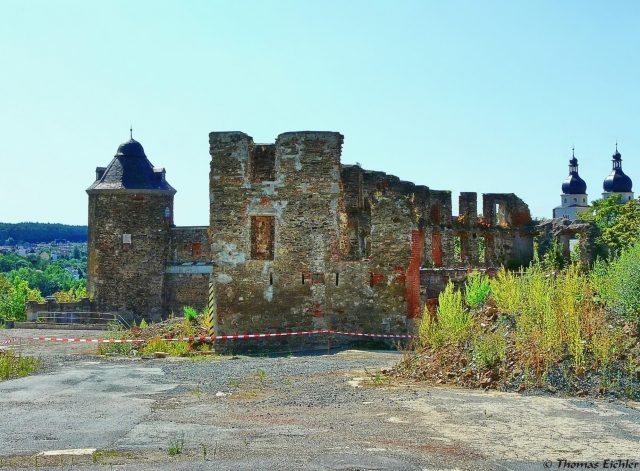
Plauen is the metropolis of Vogtland and was the main seat of powerful Vögte (bailiffs). The fact that the Vögte could evolve from their original function as administrative officials to territorial lords was a peculiarity and, until then, unique in history. Plauen entered documented history in 1122 with the founding of St. John's Church by Adalbert von Everstein and Bishop Dietrich von Naumburg. In the second half of the 12th century, Konrad III and Frederick I Barbarossa strengthened the presence of the Empire in Vogtland and continued the development of the territory. Plauen gained political and economic importance at the beginning of the 13th century due to its strategically favorable location.
To secure their power, the rulers established fortified complexes early on, culminating in the "Citadel of Plauen," as the Vögte's castle was called due to its exposed location. Even though nothing remains of the original complex due to 19th-century construction work and a bombing raid during World War II, the sheer size of the castle grounds already indicates the importance this castle once had.
It is assumed that a first castle of the Eversteiners - named after the noble family of the same name - already existed in the 12th century. Around 1200, the rule over the castle and the land passed to the Vögte of Weida. With the separation of the Vogt lines in 1238, the line of the Plauen Vögte began with Heinrich I von Plauen, who from then on named themselves after the city. Heinrich also had his main castle moved to the other side of the Syra river, to a mountain plateau in the east, between 1244-63, with the expansion of Plauen to include the new town. Only conjectures can be made about the original form of this castle. The disfiguring overbuilding and destructive changes in past centuries were too strong. However, it can be assumed that the castle already had the triangular shape still visible today. At the northern tip was the former core castle, in front of which a bailey was situated towards the new town. Both were separated by a moat that could be crossed via a drawbridge. The bailey covered the core castle on the attack side and had strong defensive towers there. The western one, the "Red Tower," is still visible today.
The Vögte resided in their castle until 1466. Then they had to cede their rule to the Wettins. With a brief interruption from 1547 to 1569, when Vögte of Plauen again served as city lords, Vogtland remained in Wettin possession. Over the centuries, Plauen was repeatedly involved in conflicts: in the Vogtland War, the Schmalkaldic War, and the Thirty Years' War. In 1430, destruction by the Hussites, during which the castle was stormed, and the great city fire of 1548 severely affected the castle. After the city fire, the castle initially remained a ruin. It was not rebuilt until 1670-75. However, later construction measures blurred many late medieval building achievements. The bombing raid in 1945 finally meant the definitive end for the crown of Plauen. Today, the renovated "Red Tower," the bastion, and parts of the surrounding wall are still preserved.
Take Mobile History with you
You are reading this text for free. Premium adds what matters on the road: descriptions read aloud, sites found through your camera, whole regions taken offline.
- Every description, including the ~17,700 Premium sites
- Audio guide: have descriptions read to you on location
- AR finder: see sites through your camera, with distance and bearing
- Unlimited saved sites
14 days free, then from €2.99 a month. Cancel anytime.
Location: 50.4947, 12.1399