Decaying
CastleKönnern-Haus Zeitz
Haus Zeitz Castle
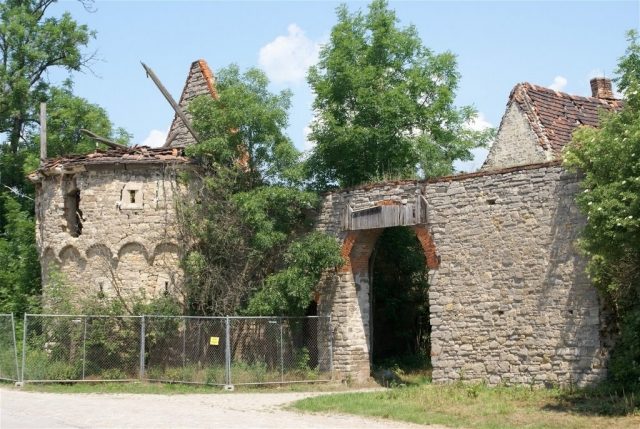
Haus Zeitz, a small settlement in the southern part of the Salzland district, now belongs to the municipality of Belleben. The origin of this settlement very likely dates back to the time of the Slavic settlement of the area west of the Saale. The name Zeitz is reminiscent of the Slavic words zitci or ciza, which stand for granary or goddess of nursing. Later mentions of the settlement's name make its Slavic origin comprehensible.
After the conquest of the Slavic territory west of the Saale by Otto I in the tenth century AD, the settlement became royal property. His son, Otto II, gifted the royal estate with other possessions south of Bernburg to his sister Mathilde, who was abbess of Quedlinburg. Through the convent led by Mathilde, the Counts of Barby came into possession of the estate as a sub-fief.
A noble family in the settlement of Zeitz can be traced back to the year 1128. In that year, a monk Conradus de Cize lived in the monastery on mons serenus, Petersberg near Halle. Only sparse information has been handed down about the descendants of that Conradus, although representatives of the family repeatedly appear in contemporary documents. A Johann von Zeitz was mentioned in a document in the 15th century as presumably the last representative of the family. After that, the von Dieskau family came into possession of the Zeitz estate, though only for a short time. In 1446, Hermann von Trotha was enfeoffed with the estates and all their rights and revenues. In 1497, Hans von Trotha acquired the plot of land on which the present castle ruin stands. The name Haus Zeitz goes back to this Hans von Trotha. The word Haus (house) at that time stood for a noble seat or even a castle. Hans von Trotha chose the settlement of Zeitz as his residence and had a castle (or house) built. In 1561, Haus Zeitz came to the von Krosigk family, who were connected to the von Trothas through marriage. However, the von Krosigk family soon ran into financial difficulties, so Haus Zeitz was sold to the von Lochau family in 1612.
After the extinction of the von Lochau family in 1684, the Elector of Saxony – under whose feudal suzerainty Haus Zeitz stood – sought an interested party for the castle. Johann II of Anhalt-Dessau was awarded the contract in 1685. However, he soon sold the castle to one of his relatives, Duke Victor Amadeus of Anhalt-Bernburg. Victor Amadeus had the castle extensively rebuilt and expanded between 1688 and 1692. Haus Zeitz had probably suffered greatly during the Thirty Years' War. The Anhalt-Bernburg line died out on the male side with Duke Alexander Carl, who is said to have been mentally incapacitated. Haus Zeitz then belonged half to Alexander Carl's widow, Friederike Caroline Juliane, and half to his sister, Wilhelmine Juliane. However, the castle was only inhabited by Duchess Friederike Caroline Juliane.
With the death of Duke Alexander Carl of Anhalt-Bernburg, Anhalt, which had been divided until then, was reunited under Duke Leopold Friedrich of Anhalt-Dessau. Leopold Friedrich, who was married to Friederike Louise Wilhelmine Amalie of Prussia, adopted the official title Duke of Anhalt for himself and his successors. For an understanding of the events surrounding Haus Zeitz in the 19th century, it is important that in 1815, with the Congress of Vienna, Saxony lost large territories to Prussia. This led to the creation of the large province of Saxony, which was under Prussian administration. Saxony as an independent state continued to exist, only much smaller. Haus Zeitz thus fell under the supreme feudal suzerainty of Prussia. The old castle must have been a large and richly furnished building, as historical illustrations also suggest.
Nevertheless, signs of decline already appeared towards the end of the 19th century. Professor Hermann Grössler, a renowned local historian of the Mansfeld region, wrote in 1895: "As an inscription indicates, the present (very old-fashioned) castle was built in the shape of a right angle in 1688." And further: "The interior rooms are rarely used and then, it seems, as granaries. They are therefore dilapidated and worn out. The chapel is merely to be called a larger room."
With the November Revolution of 1918, the monarchy in Germany was abolished and a parliamentary state was proclaimed. The Duchy of Anhalt became a Free State. The Anhalt family was compensated with a sum of 6.5 million Reichsmark. Haus Zeitz remained a ducal-Anhalt domain. In 1922, the castle's facade was re-plastered. However, Haus Zeitz had definitively lost its significance: agricultural workers from Poland and the then German eastern territories were accommodated in the castle. The Prince's Hall served as a grain chute, and the ducal family was rarely seen. Nevertheless, roof renovation work took place in 1938.
The area up to the Elbe was occupied by American troops in April 1945. They compensated themselves for the years at the front by plundering historical objects. Haus Zeitz was also affected in this way. According to the resolutions of the Yalta Conference, the Soviet Army soon took over the administration of the region. On March 14, 1946, the Anhalt family was dispossessed as part of the land reform in the Soviet occupation zone. The agricultural land was divided into small plots and distributed to new farmers. The castle served to accommodate some of the countless displaced persons. Joachim Ernst von Anhalt suffered a tragic fate. Already sentenced to forced labor in 1939 for slandering the Third Reich, he was interned in Dachau concentration camp in 1944. There he survived until the invasion of the US Army. In February 1947, he was arrested again under the Soviet occupation power and deported to the NKVD camp, the former Buchenwald concentration camp near Weimar. He died there on February 18, 1947.
The Prince's Hall later served the Agricultural Production Cooperative NEUES DEUTSCHLAND HAUS ZEITZ. In the years of the GDR, which saw its tradition exclusively in the workers' movement, at least in its early years, the castle was abandoned to unstoppable decay. The mummified dead in the crypt were treated particularly macabrely. In 1953, the then chairman of the LPG had the mummies buried within the crypt. The oak coffins were to be used to make feeding troughs.
Not much is left of Haus Zeitz Castle today. Still worth seeing are the ruins of the main building, completely overgrown with weeds, and the gate tower, preserved as a stump, with its teardrop-shaped loopholes. The gate tower strongly resembles that of the Templar Court in Mücheln near Wettin. A visit to the ruins of Haus Zeitz is nevertheless highly recommended, because if the decay of the building fabric continues at such a rapid pace, nothing at all will be left of the former castle in a few years. The preservation of the existing parts of the building is out of the question.
Take Mobile History with you
You are reading this text for free. Premium adds what matters on the road: descriptions read aloud, sites found through your camera, whole regions taken offline.
- Every description, including the ~17,700 Premium sites
- Audio guide: have descriptions read to you on location
- AR finder: see sites through your camera, with distance and bearing
- Unlimited saved sites
14 days free, then from €2.99 a month. Cancel anytime.
Source: Wikipedia · Licence: CC BY-SA 4.0 · Image: Roland Neubert, Halle (Saale)
This description draws on the facts documented in the linked Wikipedia article; Wikipedia content is licensed under CC BY-SA 4.0. Wording and editing: Mobile History.
Location: 51.6950, 11.6436