The remains of the Castle can be visited
CastleDortmund - Brünninghausen
Brünninghausen Castle
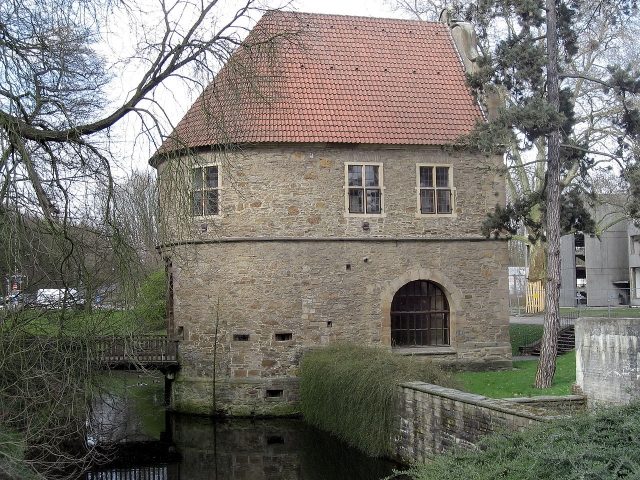
Brünninghausen Castle was a moated castle in Dortmund. In the 13th century, the property belonged to the lords "von Brünninghausen" and "von Stark".
The Nordkerke family had a moated castle built in 1300. From 1483, the von Romberg family lived here. In addition to the actual castle, numerous cottages and farms in Barop, Hacheney, Wellinghofen, Kleinholthausen and Lücklemberg belonged to the property. Extensive forest property on the northern slopes of the Ardey Mountains also belonged to Brünninghausen Castle.
In 1681, Conrad Philipp von Romberg had the castle renovated and the gatehouse built. The castle includes a castle park designed in the style of an English landscape garden, today's Rombergpark.
In the 19th century, the Rombergs owned many mines in the Ruhr area.
Brünninghausen Castle became known as the residence of the bon vivant Baron Gisbert II von Romberg (1839–1897), who is considered the model for the novel character of the "Toller Bomberg". He was sued by family members for drunkenness and extravagance. During the Franco-Prussian War of 1870/71, a military hospital for war wounded was set up in Brünninghausen.
Clemens von Romberg-Brünninghausen (1863–1923) moved to Buldern Castle in Westphalian Buldern in 1904. Subsequently, the house stood empty and for sale. The city of Dortmund acquired the complex in 1927 from Gisbert III von Romberg (1888–1952). During the Second World War, the castle was destroyed in a bombing raid on the Hoesch site in 1945. The moat was filled with rubble, while stones from the castle walls were used in the zoo.
Structural Findings+
The gatehouse of the moated castle, built in 1861 and now called Torhaus Rombergpark, was severely damaged in the Second World War and restored from 1957 to 1959 under the direction of engineers Bernhard von Glisczynski and F. H. Sonnenschein. Since 1968, it has been used as a municipal art gallery with changing exhibitions and concert events. So-called ambience weddings are also possible there. It is located at the northern entrance of the Rombergpark. The Brünninghausen Gatehouse is registered as a monument in the list of monuments of the city of Dortmund.
Further preserved evidence of the castle are parts of the castle moat and the now dilapidated ice cellar, which served to cool wine and food.
Until 2002, the Rombergpark Hotel was located on the grounds of the former castle. Adjacent was the wihoga business school for the hotel and catering industry, which moved into a new domicile in an opposite new building in 2007. The prefabricated buildings of the Rombergpark Hotel and the wihoga were demolished in 2008. A final decision on the subsequent use of the site, which also includes the former farmstead of Brünninghausen Castle, has not yet been made; most recently there were plans for a medical facility. At the end of 2012, construction work will begin on a pedestrian bridge to the nearby Phoenix-West development area.
A citizens' initiative is campaigning for the preservation of the farmstead. The approximately 200-year-old buildings built by Romberg are not listed as monuments and can only be preserved if an investor is found. The farmstead – also called Gut Brünninghausen – housed, among other things, a brewery where beer was brewed for the Rombergs' own consumption.
On March 4, 2011, a vacant farm building, presumably the last original preserved part of the former manor house apart from the gatehouse, burned down.
During work to redesign the Schondelle stream in October 2011, walls of a structure with a floor plan of 6 m x 6 m were discovered behind the gatehouse, presumably those of a castle tower from the 16th or 14th century and a shield wall adjoining to the west, which can be seen in old depictions, such as an illustration from 1894, and suggest the remains of an even older castle complex in this area. Since December 15, 2011, the walls have been uncovered. A final assessment of whether the find is worth preserving is still pending. If it is to be preserved, the plans for the renaturation of the Schondelle must be amended, as the planned stream bed runs through the excavation area.
Take Mobile History with you
You are reading this text for free. Premium adds what matters on the road: descriptions read aloud, sites found through your camera, whole regions taken offline.
- Every description, including the ~17,700 Premium sites
- Audio guide: have descriptions read to you on location
- AR finder: see sites through your camera, with distance and bearing
- Unlimited saved sites
14 days free, then from €2.99 a month. Cancel anytime.
Source: Wikipedia · Licence: CC BY-SA 4.0 · Image: http://commons.wikimedia.org/wiki/File:Torhaus-IMG_1528.JPG?uselang=de
This description draws on the facts documented in the linked Wikipedia article; Wikipedia content is licensed under CC BY-SA 4.0. Wording and editing: Mobile History.
Location: 51.4834, 7.4685