The remains of the castle can be visited
CastleWiesloch
Wiesloch Castle
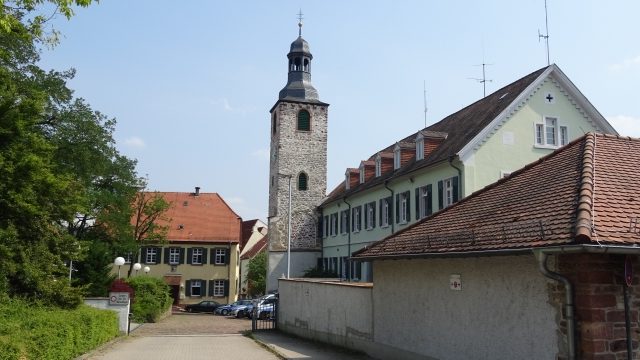
Wiesloch Castle was located in Wiesloch, a town in the Rhein-Neckar district in Baden-Württemberg. The castle dates back to a medieval fortress. After its destruction in the War of the Palatine Succession, the ruinous complex was demolished, except for the old keep. The current buildings, used for administrative purposes, date from the 18th century.
There are no documents regarding the origin of the castle. The oldest scattered finds from the vicinity of the castle date from the 10th century. It is assumed from the historical context that the castle was built in the 11th century to protect the mining settlement south of the Leimbach and was successively expanded. The bossed ashlar stones at the southwestern corner of the curtain wall date, by their form, to the late 12th or early 13th century.
The castle was first mentioned in a document in 1288, when both the castle and the town of Wiesloch already belonged to the Palatinate. From 1288 to 1296, Count Palatine Rudolf I is said to have resided in Wiesloch after the great Heidelberg fire. In 1296, King Adolf issued a document in Wiesloch. In 1292, a castellan Conrad von (Sand-)Hausen is mentioned, and in 1298, a Wolfram von Clingenberg. In 1303 and 1307, the castle was assigned to Countess Palatine Mechthild, daughter of King Adolf, as a widow's dower. In 1365, Count Burkhard von Hohenberg received the castle guard as a pledge from Count Palatine Ruprecht I. In 1407, King Ruprecht held court at the castle, and in 1438, Count Palatine Otto I stayed there. In 1570, Emperor Maximilian II was a guest at the castle.
From the early 17th century, the castle was called a palace. In 1629, according to a report by Schultheiß Johann Baptist Vest, the building was still in good condition. Even in the further course of the Thirty Years' War, the complex does not seem to have suffered major damage. However, in the difficult times back then, there was a lack of maintenance measures, so that in 1669 and 1688, major structural defects were described.
The castle was finally destroyed in 1689 by the French in the War of the Palatine Succession. Except for the mighty keep, the ruins were quickly removed thereafter. In 1713, a place was already described where the castle used to be. In 1724, the place was still desolate, and the Catholic community received permission to build a church there. In the course of the church construction, the old keep was converted into a bell tower. The church was already demolished again in 1837. Stones from the castle were also used between 1746 and 1751 for the construction of the Augustinian monastery church, today's Laurentiuskirche.
The current main building of the complex was also rebuilt in the course of the 18th century. It served as the seat of the Wiesloch district office from 1810 to 1938 and is now used as a police station.
The square tower made of quarry stones was fitted with a slated lantern in the 20th century, crowned by a roof finial with a patriarchal cross.
Take Mobile History with you
You are reading this text for free. Premium adds what matters on the road: descriptions read aloud, sites found through your camera, whole regions taken offline.
- Every description, including the ~17,700 Premium sites
- Audio guide: have descriptions read to you on location
- AR finder: see sites through your camera, with distance and bearing
- Unlimited saved sites
14 days free, then from €2.99 a month. Cancel anytime.
Location: 49.2954, 8.6968