The Castle can be visited
CastlePforzheim
Pforzheim Castle
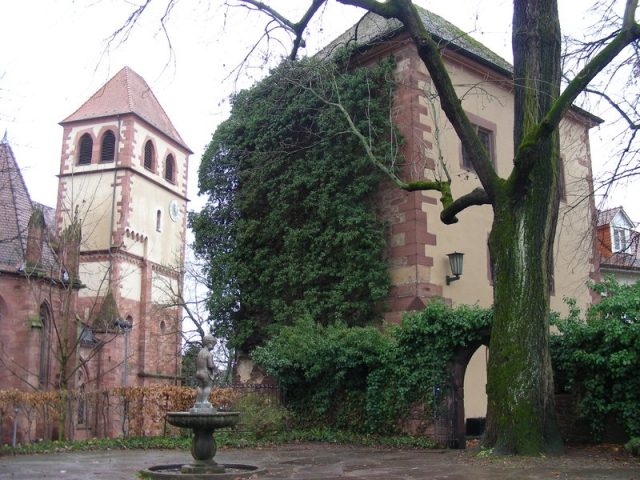
The archive building was constructed around 1560 against an even older castle wall, the remains of which are still visible inside. The archive building, along with the castle church, is the only remaining part of the residential castle of the Margrave of Baden. Until its destruction in the war in 1945, the Margravial Bailiff's Office, which was rebuilt as a tax collection office in 2003, also stood next to it.
The ground floor originally housed a laundry room. After the war, historical fragments of destroyed monuments were collected there. From 1951-1960, it housed a provisional local history museum. Today, it features an exhibition with documentation on the reconstruction and history of the castle church.
The first floor is dedicated to the Friends of the Castle Church to honor their efforts in the reconstruction and preservation of the Castle Church and the Reuchlin Museum.
The "Landschaftsstube" (State Room) on the second floor is the only surviving representative room of the castle. The room is preserved almost in its original state. This only surviving representative room of the castle formerly served as a meeting place for the representatives of the regional estates. The "Landschaftsstube" can be considered a precursor to the Baden State Parliament and is thus also a monument to the regional history of Baden-Württemberg.
The "Landschaftsstube" features a post-Gothic rib vault from the Renaissance period and three coat of arms reliefs. These pay homage to the builder Margrave Karl II and his two wives Kunigunde von Brandenburg and Anna von Veldenz. The year of construction, 1561, is mentioned on a banderole. A portal with a gable and a faun's head in Renaissance style is installed in the south wall. On the first floor, there is a heavily decorated wrought-iron door that once belonged to this portal. Several coat of arms stones are affixed to the walls. These originate from city gates and noble courts. They were installed there in 1924 when the archive building served as a local history museum.
The archive building was severely damaged on February 23, 1945, and restored after the war. From 1952, the building again served as a museum. In 1997, a major restoration took place, during which a historic tiled stove was also reinstalled. The fire opening of the stove is located in the adjacent former battlement walk.
Take Mobile History with you
You are reading this text for free. Premium adds what matters on the road: descriptions read aloud, sites found through your camera, whole regions taken offline.
- Every description, including the ~17,700 Premium sites
- Audio guide: have descriptions read to you on location
- AR finder: see sites through your camera, with distance and bearing
- Unlimited saved sites
14 days free, then from €2.99 a month. Cancel anytime.
Source: Wikipedia · Licence: CC BY-SA 4.0 · Image: http://www.wehrbauten.de/thread.php?threadid=1587
This description draws on the facts documented in the linked Wikipedia article; Wikipedia content is licensed under CC BY-SA 4.0. Wording and editing: Mobile History.
Location: 48.8926, 8.7032