State Court of Rhainland Palatinate
CastleZweibrücken
Zweibrücken Castle
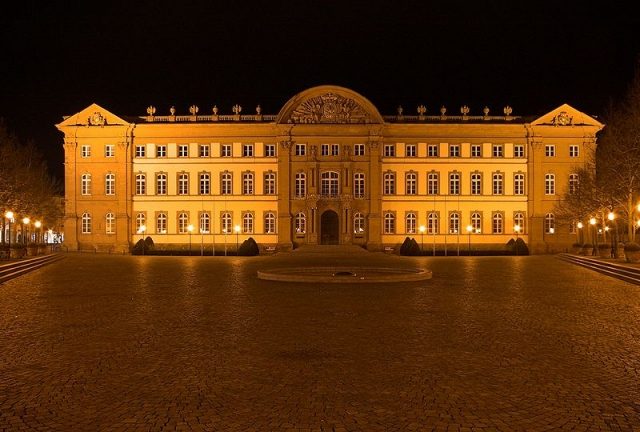
Zweibrücken Castle is a building in the Palatinate city of Zweibrücken. After its reconstruction, it has been the seat of the Palatinate Higher Regional Court and the Public Prosecutor's Office Zweibrücken since 1965. Today, it is the largest secular building in the Palatinate.
The predecessor of the current castle was Zweibrücken Castle, built in the 12th century by the Counts of Zweibrücken to protect a nearby trade route. It was located on the eastern side of the triangle that now forms the Schlossplatz. In the 15th century, Zweibrücken became the residence of the Dukes of Palatinate-Zweibrücken, and in the 16th and 17th centuries, the castle area was repeatedly expanded and adorned with new buildings by the Wittelsbach Dukes. After extensive destruction in 1677 during the Dutch War, Duke Gustav Samuel had the residential castle built in its present form by master builder Jonas Erikson Sundahl between 1720 and 1725. This castle, which, in accordance with the style of the time, no longer served defensive purposes but representative ones, was erected on the northern side of the triangle. On May 3, 1793, it was plundered by revolutionary troops and remained a ruin for 25 years. After the end of French rule, the ruined building was converted into a church between 1818 and 1820 and later into a palace of justice.
In 1817, the Catholic community of Zweibrücken was assigned the ruin of the former ducal castle by a decree of King Maximilian I, with permission to convert it into a church. The partition walls in the middle part of the castle were removed to create a church space, and a roof truss with slate covering was placed on the building. The resulting "Maximilian Church" was consecrated on May 28, 1820, by Vicar General Humann. Later, a bell tower was added. The eastern part of the building was designated as the residence of the Catholic clergyman, while the western part served for a longer period as a royal lodging and was later rented to the Royal Court of Appeal of the Palatinate. In the second half of the century, a new church was built in the former castle garden according to plans by Ludwig Molitor, and after the completion of the Holy Cross Church, the former "Maximilian Church" was given a new use as a palace of justice. The bell tower was removed again.
In 1945, the castle was destroyed again as a result of wartime bombing. Only the massive outer walls partially withstood. The restoration from 1962 to 1964 restored the baroque facade and the flattened roofing of the original construction period, based on the original plans by Jonas Erikson Sundahl found in Nancy.
Take Mobile History with you
You are reading this text for free. Premium adds what matters on the road: descriptions read aloud, sites found through your camera, whole regions taken offline.
- Every description, including the ~17,700 Premium sites
- Audio guide: have descriptions read to you on location
- AR finder: see sites through your camera, with distance and bearing
- Unlimited saved sites
14 days free, then from €2.99 a month. Cancel anytime.
Location: 49.2490, 7.3641