Cultural center
CastleOberspier
Zum Possen Castle (Oberspier)
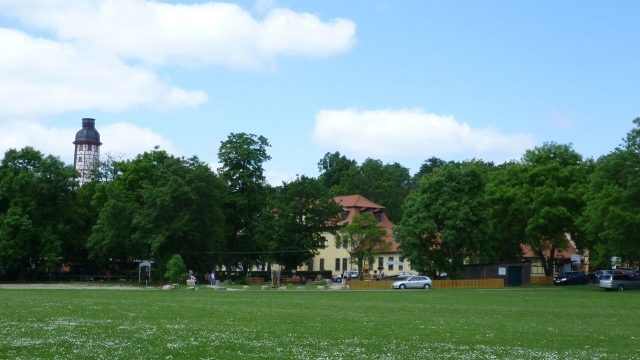
The Possen is a 431.5-meter-high mountain in the Hainleite range in the Thuringian Kyffhäuser district, featuring an observation tower (Possenturm) and a listed ensemble of buildings and a park from the 18th and 19th centuries, located on the high plateau to the southeast. It is situated about four kilometers south of Sondershausen.
Name
The origin of the name Possen is not clearly documented. Therefore, there are countless interpretations. They range from the personal name "Pozzo" to a constantly repeated legend about a member of the princely house who is said to have commented on the new hunting lodge using the word Possen. The name "Zum Possen" first appeared in 1738 after a renovation of the hunting lodge.
An etymological derivation of the word in connection with the time of its appearance can provide an explanation. Starting from the Early New High German "posse, bosse," meaning "ornament, accessory," borrowed from the Old French "boce," a change in meaning occurred in the 16th century in the sense of "joke, prank." On a map of Sondershausen from 1783, the name Bossen can be found. From this, the verb "bossieren, poussieren" developed, meaning "to be merry, to joke, to play pranks." Therefore, it can be assumed that for the renovated hunting lodge in 1738, the name "Zum Possen" was chosen simply to designate a place where one could – in contrast to courtly etiquette – be merry, joke, and play all sorts of pranks. The hunting lodge name was then shortened to refer to the area around this house. The "Vogelgesang" field changed its name to "Possen."
History
A hunting lodge named "Zum neuen Jagdhaus auf dem Oberspierschen Forste" is mentioned in documents with the year 1670. With this name, it must be assumed that there was an older house before it. Due to structural changes between 1732 and 1738, initiated by Prince Günther XLIII. of Schwarzburg-Sondershausen, another name change occurred. Until 1737, the building was called "Jagdschloss auf dem Vogelgesang," a year later, upon completion of the renovations, it was given the name "Zum Possen." Extensions to the residential and farm buildings followed from 1760 to 1762. From 1828, this house was used by the Oberspier forestry office. The dethroned Prince Günther Friedrich Carl I found a residence here from 1835 to 1837.
From 1867, horse breeding was resumed. A constant problem was the water supply. Water was brought in barrels by horse-drawn carriage from the upper Spierenbrunnen, located 700 m northeast. Under Prince Günther Friedrich Carl II (reign 1835–1880), the riding hall, the game enclosure (for deer and birds), and a bear enclosure were built. Preparations for the construction of the Possenturm also began at this time. The uncultivated land was transformed into a park with historical paths, sightlines, and large meadows. After the abdication of the prince in 1918, the estate became the property of the state of Thuringia.
In the mid-1960s, the area was developed into a local recreation center. A bungalow settlement and a restaurant were built south of the Possenturm from 1976 to 1979. Company sports festivals, equestrian events, and music events took place on the large meadow areas. In the last years of the GDR, the installation of an anti-aircraft missile system on the Possen was still planned. After the fall of the Berlin Wall, the Possen remained a popular excursion destination in Northern Thuringia and is now called "Freizeitpark" (Leisure Park).
Current Use
According to the tenant, the Possen is visited by 120,000 to 150,000 people annually. Events such as dog shows take place on the grounds of the "Freizeit- und Erholungspark Possen" (Possen Leisure and Recreation Park).
Buildings
Hunting Lodge
The hunting lodge is a four-wing complex around a closed courtyard with plastered half-timbered farm and residential buildings. The main building has a gabled central risalit on the south side, which bears a coat of arms, a sundial, and trophy sculptures. This decoration was created around 1890. The two-story main building is covered by a mansard roof. Inside, the baroque room structure is still preserved on the upper floor. The former court kitchen was located in the east wing. Below it are the cellar facilities. Otherwise, the main building has no basement.
Riding Hall
With the resumption of horse breeding in 1867, a riding hall became necessary. This is an octagonal building, just like the Possenturm and the Octagon House (1707) in Sondershausen on the Schlossberg. The flat pyramid roof consists of eight side triangles. A hall ceiling was missing. It was only installed in 1967 for energy-saving reasons. During the Second World War, the hall served as a prisoner-of-war camp. After its reconstruction in 1967, the riding hall became the "Ringcafé." The weather vane on the roof peak bears the imperial double-headed eagle. It is in the coat of arms of the Schwarzburgs, after they were elevated to the status of Imperial Princes in 1697. The connecting building to the riding stable is now used as a restaurant. The riding hall itself is now a leisure hall with the possibility to play billiards and table tennis.
Possenturm
The Possenturm is considered the oldest and tallest observation tower in Europe built in half-timbered style. The observation tower was built in 1781 within 11 months and stands on a hewn stone base. The tower height measures 42.18 m. It also served as a landmark for surveying the Schwarzburg region. Hikers could also see the Possenturm from the highest mountain in the Harz, the Brocken, from the "Thurme des Wirthshauses" (tower of the inn), "partly with, partly without a telescope": If one "turns to the right": "... the ruins of Kyffhausen Castle in the golden Aue, the Possenthurm near Sondershausen, the Ettersberg near Weimar ..." it says in Friedrich Gottschalck's 1823 pocket guide for travelers in the Harz. Heinrich Heine demonstrably borrowed the still-wet-from-print travel guide for his Harz journey in 1825.
Visitors reach the observation platform above the tower dome via 214 steps. The octagonal, eight-story half-timbered structure bears a late Baroque, cantilevered ogee dome with an observation platform and lantern. The floors taper upwards. Each has four windows, one for each cardinal direction. Originally, the observation platform was open. It was enclosed with windows during the Second World War and served as an air observation post.
The clock installed during the new construction was moved to the Sondershausen Castle Tower in 1786. The first renovation of the tower was already necessary in 1867. From 1951, the Possenturm was closed to visitors. In the lower part of the tower, load-bearing parts of the timber framework were so damaged that the tower began to lean, and its stability was no longer guaranteed. It threatened to collapse or fall over. Through a campaign "Save the Possenturm," within the framework of the GDR's "National Reconstruction Work," with the help of committed citizens and donations from the population, the most important securing works were carried out in 1958/59, thus saving the tower from decay. After further work, including the installation of sheet metal cladding on the weather side, the tower was reopened to visitors in 1966 after almost 15 years of closure.
Under the sheet metal cladding, fungal and bacterial infestation later occurred, so in 2002, due to an acute risk of collapse, the tower had to be closed to visitors again. Through the construction work that followed until 2004, the tower was renovated, stabilized, and given a new exterior paint. The corrugated iron was replaced by a well-ventilated weather protection shell made of larch planks.
Bear Enclosure
The bear enclosure also originated during the redesign phase of the Possen after 1867. It is an open-top round tower with a crenellated parapet. Four cave-like rooms on the south side served as feeding and bear chambers. The young bears were brought in 1867 by the princes of the court from a hunting ground in the Carpathians, after three mother animals had been killed. The animals from the bear tower, which is still completely preserved today, were relocated to a new cage elsewhere during GDR times. After protests from animal welfare activists, this was expanded in 1998. Two brown bears now live in an enclosure that complies with current legal requirements.
Game Reserve
The game enclosure was created in the second half of the 19th century. Today, fallow deer, red deer, mouflon, wild and pot-bellied pigs, horses, ponies, donkeys, sheep, and goats can be observed in a spacious area.
The aviaries with pheasants and other bird species were replaced in 2011 by a house for meerkats and falcons. Furthermore, there has recently been an Australian corner where emus and dwarf kangaroos can be seen.
South of the parking lot, there is a domestic animal area.
Show Well
When a drinking water pipeline to Oberspier was built in 1976/77, an old well was discovered during the excavation work. It had been built in 1761/62 and had been forgotten. It had a depth of 38 m. Two more wells were dug. One was located at today's playground (1858, 46 m deep), another was south of the riding hall (1922, 14 m deep). In 1987, the oldest well was reconstructed on behalf of the monument preservation authorities. The roofing and well parapet are recreated, as the original design is not known.
Take Mobile History with you
You are reading this text for free. Premium adds what matters on the road: descriptions read aloud, sites found through your camera, whole regions taken offline.
- Every description, including the ~17,700 Premium sites
- Audio guide: have descriptions read to you on location
- AR finder: see sites through your camera, with distance and bearing
- Unlimited saved sites
14 days free, then from €2.99 a month. Cancel anytime.
Source: Wikipedia · Licence: CC BY-SA 4.0
This description draws on the facts documented in the linked Wikipedia article; Wikipedia content is licensed under CC BY-SA 4.0. Wording and editing: Mobile History.
Location: 51.3385, 10.8608