To be privately owned
CastleLichtenau im Mühlkreis-Unterurasch
Zarghof Castle
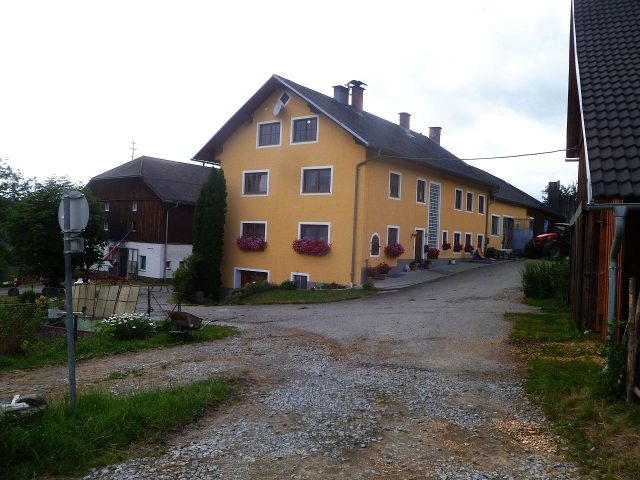
Zarghof Castle (Schloss Zarig), now Zarghof Farm, is located in the Unterurasch district of the municipality of Lichtenau im Mühlkreis in the Rohrbach district of Upper Austria (Unterurasch 5).
The name "Sarg" is documented in 1379 and "Czarig" in 1405. The name is most likely of German origin, but a Slavic origin from "zorica" (= clearing) is also possible. Around 1450, the seat (die Zarg) belonged to a Peter Harwekch. He sold it in 1452 to Hainrich Viechtenstainer. In 1456, it was owned by Andreas Viechtenstainer. The seat was a fief of the Wallseer.
The seat later became part of the Lichtenau estate and thus passed to Heinrich Herleinsperger († 1624), who had inherited Lichtenau in 1621. In 1620, he had Zarghof converted into a widow's residence for his wife Praxedis von Oedt († 1626). It served as a widow's residence until 1682, at that time for Sabine Schifer, née von Oedt. The name "Witwenschlössl" (Widow's Castle) is still common for Zarghof today. This widow's residence was later moved to the north wing of Lichtenau Castle, which, however, fell victim to a fire in September 1945, along with the carriage house and the castle brewery. Zarig Castle was also connected to Lichtenau Castle by a 1.3 km long underground passage, which was discovered during the construction of the new Lichtenau road in the 1970s.
When the Sprinzensteiners became owners of Lichtenau in 1656, Zarghof was used as the residence of the administrator. Siegmund Zarger (* 1497/1514, † 1587) and Hans Erdinger (1607-1612) are known by name as administrators.
As early as around 1700, the property was sold to Martin Hofer and his wife Eva. From a successor named Franz Mayrhofer, the farm was sold to the Welspergs in 1776. In 1800, it was inherited as a farm. In the 19th century, a Franz Obermüller owned the now agricultural property, but had to have it auctioned off due to over-indebtedness. It was bought by a certain Neudorfer from Unterthiergrub, who managed it more successfully and was able to pass the property on to his son Peter Neudorfer. He, too, could not hold onto the property for a longer period.
Zarghof Today+
The building was severely damaged by fire around 1800 and then again on September 13, 1919.
As late as the 1970s, the building was described as a two-story structure with a hip roof, which had preserved the type of an unfortified castle. Even earlier, defensive structures were probably present, as could be seen from the battlements above the entrance gate. Remains of a dismantled tower, as well as stairs and passages in the wall, were also present. Formerly, there was also a prison cell with iron rings attached to the wall.
The house had wrought-iron window grilles, and an early Baroque door frame is present in the west wing of the courtyard. The rooms are hall-like and partly still have the old ceiling beams. Remains of coffered ceilings are visible but painted over. Some door frames and doors date from the Renaissance; they still have the original fittings and box locks from around 1620. A desacralized chapel is present and recognizable by its cross-ribbed vault. Formerly, the castle also included a bird aviary.
Nothing of this is recognizable today. Due to several alterations, Zarghof is now only to be described as a stately agricultural enterprise.
Take Mobile History with you
You are reading this text for free. Premium adds what matters on the road: descriptions read aloud, sites found through your camera, whole regions taken offline.
- Every description, including the ~17,700 Premium sites
- Audio guide: have descriptions read to you on location
- AR finder: see sites through your camera, with distance and bearing
- Unlimited saved sites
14 days free, then from €2.99 a month. Cancel anytime.
Source: Wikipedia · Licence: CC BY-SA 4.0 · Image: http://commons.wikimedia.org/wiki/File:Zarghof.jpg
This description draws on the facts documented in the linked Wikipedia article; Wikipedia content is licensed under CC BY-SA 4.0. Wording and editing: Mobile History.
Location: 48.6019, 14.0435