Vacation apartments
CastleWurschen
Wurschen Castle
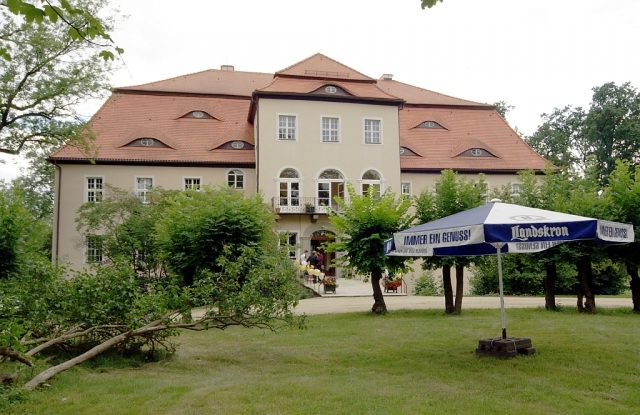
Around 1000 AD, Wurschen was the site of an early German moated castle. The building components and construction methods found during the renovation of the castle at the end of the 20th century suggest that the cellar rooms and the ground floor belonged to a medieval moated castle. A moat surrounding the castle supports this assumption. In 1720, the castle was built in its current external form in the Late Baroque style by Rudolph Wilhelm v. Ziegler und Klipphausen (1688 – 1749). Around 1740, the Wurschen fiefdom was converted into an inheritance (property) through a payment of 35,000 Thalers (privilege of Emperor Maximilian II to the Lusatian knighthood). Changes to ceilings and walls and different types of vaults from various eras bear witness to numerous alterations. Wall paintings are highly likely to date from the Renaissance period. Discovered brick ventilation ducts under the floor still pose a mystery. Charred beams and timbers suggest a fire.
In 1758, during the Seven Years' War (Battle of Hochkirch 14.10.1758), Wurschen and the castle were also shelled by Austrian artillery during retreat battles. This led to the inscription on the eastern side of the castle: En Sigma Proelli: Die XIV Oc MDCCLVIII.
From July 16th to 17th, 1807, Napoleon Bonaparte stayed overnight at Wurschen Castle. He came from signing the "Peace of Tilsit" and traveled back to Paris via Bautzen.
On the eve of the Battle of Bautzen (Wurschen) on May 19th/20th, 1813, the castle served as the headquarters of the Allies. It housed the allied army camp of the Russian Tsar Alexander and his ally, the Prussian King Frederick William III. Furthermore, the generals and field marshals Barclay de Tolly, v. Diebitsch, v. Kleist, v. Blücher, v. Gneisenau were present. A still existing table on the upper floor served as a surface for the staff maps.
After the battle, which was victorious for Napoleon, a commemorative coin was minted, and the inscription Wurschen followed on the Arc de Triomphe in Paris.
In the course of the land reform in 1945, the castle passed to the municipality. It became a home for many refugees and displaced persons. The intention to demolish the castle during GDR times failed due to the resistance of the inhabitants. Instead, a citizens' initiative advocated for meaningful use. A crèche, kindergarten, school meals, gymnasium, and consumer sales facility were housed in the castle. Through the use of the building, construction was always carried out with the means and possibilities available at the time, and the building was preserved. Nevertheless, the castle fell into disrepair over time. The roof, in particular, had suffered greatly in the 1980s. In 1992/93, it could finally be renewed and renovated.
Owners of the Castle
- 1382 Michael Kosbrich (after the death of Michael Kosbrich and his wife, who remained childless, the Wurschen fiefdom belonged to King Wenceslaus of Bohemia. "King Wenceslaus enfeoffs Otto Edler von Kittlitz and Heinrich von Luzan with the estate of Wurssen with all its rights." (Heinrich von Luzan was the king's chamberlain; v. Kittlitz was a representative of the Lusatian landed gentry at the Bohemian court; Otto v. Kittlitz's brother was vicar in St. Peter's Cathedral Budissin)
- 1498 Caspar von Sley
- 1504 Balthasar v. Nadelwitz
- 1527 Franz and Hieronymus v. Nadelwitz (sons of Balthasar v. Nadelwitz)
- 1532 Hans von Muschwitz (no male heirs)
- 1551 Wolf von Muschwitz
- until 1634 Sigmund von Muschwitz
- 1667 Sigmund the Younger v. Muschwitz
- 1668 Wolf Heinrich v. Muschwitz
- from 1677 Ludwig Gerhard v. Hoym
- 1685 Georg v. Ramsey (English nobleman)
- from 1687 Georg Heinrich v. Platen
- 1696 Friedrich Adolph v. Ziegler und Klipphausen
- 1707 Wolf Rudolph v. Ziegler und Klipphausen (1661 – 1708)
- 1718 Rudolph Wilhelm v. Ziegler und Klipphausen (1688 – 1749)
- 1749 Sophie Margarethe née v. Metzrad (1693 – 1762, widow of Rudolph Wilhelm v. Ziegler und Klipphausen, 2nd marriage to Heinrich Adolph v. Gersdorff)
- 1762 Johann Erdmann v. Gersdorff (1726 – 1803)
- 1803 Friederike Louise Christiane née v. Wurmgarten (1756 – 1832, widow of Johann Erdmann v. Gersdorff, 2nd marriage to Friedrich Erdmann v. Thielau)
- 1806 Friedrich Erdmann v. Thielau (1756 – 1821)
- 1821 Friederike Louise Christiane widowed v. Thielau formerly v. Gersdorff née v. Wurmgarten
- 1828 Clara Maria Countess zu Solms-Sonnenwalde née v. Rex-Thielau (died 1886, adopted daughter of Friederike Louise Christiane widowed v. Thielau formerly v. Gersdorff née v. Wurmgarten)
- 1886 Count Peter zu Solms-Sonnenwalde (born 1840, son of Clara Maria Countess zu Solms-Sonnenwalde née v. Rex-Thielau)
- 192? – 45 Count Wilhelm zu Solms-Sonnenwalde (born 1886, dispossessed by land reform, nephew of Count Peter zu Solms-Sonnenwalde)
- from 1997 Count Alfred zu Solms-Sonnenwalde (repurchase)
Moated Castle Today
In 1997, Count Alfred zu Solms-Sonnenwalde bought back the castle, which had once been family property. This enabled a complete renovation. While the lower floor can be made available for public use, the upper floor is in the private area of the Count and his wife.
Take Mobile History with you
You are reading this text for free. Premium adds what matters on the road: descriptions read aloud, sites found through your camera, whole regions taken offline.
- Every description, including the ~17,700 Premium sites
- Audio guide: have descriptions read to you on location
- AR finder: see sites through your camera, with distance and bearing
- Unlimited saved sites
14 days free, then from €2.99 a month. Cancel anytime.
Source: Wikipedia · Licence: CC BY-SA 4.0
This description draws on the facts documented in the linked Wikipedia article; Wikipedia content is licensed under CC BY-SA 4.0. Wording and editing: Mobile History.
Location: 51.1926, 14.5814