To be privately owned
CastleOffenhausen-Würting
Würting Castle
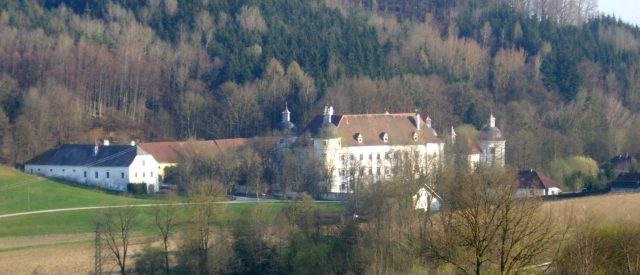
Würting Castle, located in the village of Würting within the municipality of Offenhausen in Upper Austria, was first mentioned in 814 as a Romanesque court (actum ad wirtingen). At that time, it belonged to the Counts of Lambach and later to the Bishops of Würzburg, from whom the Babenberg Duke Leopold purchased it in 1120.
After several changes of ownership, the estate passed to Jörg Perkheimer in 1455, who rebuilt the castle in 1462 on the foundations of the medieval moated castle in the Renaissance style.
In 1534, Jörg III. von Perkheim, at the request of the inhabitants of Offenhausen and through his intercession for the village subject to him, obtained from King Ferdinand I its elevation to a market town. This had developed into a regional center of trade, commerce, and craftsmanship.
From 1604 to 1617, the castle belonged to the Welser merchant and castellan Christoph Weiß. He hoped to be elevated to the rank of baron, had the castle extended to the east and south as early as 1610, and richly furnished it. Only his grandson, Hans Christoph, was elevated to Baron von Weißenberg by Emperor Ferdinand III in 1651. Numerous stucco works and ceiling paintings were installed in the castle during this period.
In 1698, the castle passed into the possession of the Counts of Seeau, who held it until the 19th century. After brief ownership by the Hungarian noble family Földvary von Földvar, it went in 1860 to the commoner Johann Karl Grillmayer, the founder of the Kleinmünchen spinning mill (today Linz Textil AG).
At the beginning of the 20th century, the entire landed property of the castle was gradually sold off. After several changes of ownership, the building fell into increasingly poor condition. In 1921, the Viennese banker Heinrich Gutmann bought the castle for his wife Stefanie, after which it experienced a renewed, brief period of prosperity. The castle building was restored and furnished with valuable furniture and paintings, including oil paintings by the painter John Quincy Adams, Stefanie Gutmann's first husband.
In 1923, Richard Nikolaus Coudenhove-Kalergi wrote his programmatic book Pan-Europa at Würting Castle, in which he described his ideas for a united Europe, which he soon intended to propagate through the founding of the Paneuropean Union.
In 1938, the castle went to the Reichsgau Oberdonau for a fraction of its value. The valuable furnishings were sold or disappeared through unknown channels, and an SA school moved into the castle. After the Second World War, refugees were housed there for a short time. In 1952, Stefanie Gutmann received the heavily damaged estate back but sold it immediately. Again, multiple changes of ownership followed until the castle went to the artist and paleontologist Herbert Schaffer in 1975, who housed his paleontological collection there.
Despite public support, the castle is currently in poor condition. The estate is not publicly accessible.
Take Mobile History with you
You are reading this text for free. Premium adds what matters on the road: descriptions read aloud, sites found through your camera, whole regions taken offline.
- Every description, including the ~17,700 Premium sites
- Audio guide: have descriptions read to you on location
- AR finder: see sites through your camera, with distance and bearing
- Unlimited saved sites
14 days free, then from €2.99 a month. Cancel anytime.
Source: Wikipedia · Licence: CC BY-SA 4.0 · Image: http://commons.wikimedia.org/wiki/File:Schloss_W%C3%BCrting_2009.jpg
This description draws on the facts documented in the linked Wikipedia article; Wikipedia content is licensed under CC BY-SA 4.0. Wording and editing: Mobile History.
Location: 48.1458, 13.8308