Uninhabited
CastleTeutschenthal
Würdenburg Castle
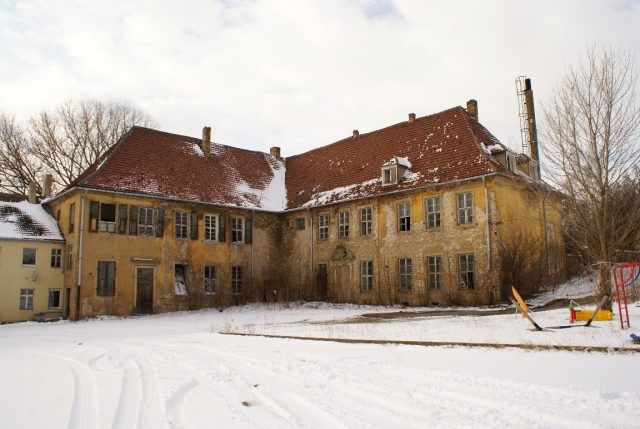
Würdenburg Castle is a former knight's estate in Teutschenthal in the Saalekreis district in Saxony-Anhalt. The original Renaissance building was owned by the von Trotha family for centuries and is now left to decay.
Originally, the lands along the Würdebach stream were owned by the Counts of Seeburg. Through various detours, large parts of these territories came into the possession of the Mansfeld Counts in 1287. Following the custom of the time, they had their estates administered by so-called "Hausvögte" (house reeves).
In 1438, such a house reeve, named Hans von Trotha, was enfeoffed with estates along the Würde. In a feudal charter of the Mansfeld Counts dated July 10, 1443, he is referred to as Hans zu Deussenthal and is considered today as the founder of the Teutschenthal-Bennstedt family line of the von Trotha. The new Trotha possessions were administered from a free court in "Würden," the smallest village of the then villages in the Würdebach valley. From here, the Seeburg lords had already administered the region in the 13th century. It is possible that a small ministerial castle with a chapel dedicated to Saint Nicholas already existed there at that time.
Since this seat of power probably no longer met the representative needs of the Renaissance, Friedrich von Trotha had the old buildings, along with the Niklas Chapel, which had probably become dilapidated in the meantime, demolished. In their place, he had a stately knight's seat with an L-shaped floor plan built before 1600.
However, the greatest recognition from the dynasty of the Lords of Trotha among the people of Teutschenthal was earned by Wolf Thilo von Trotha. In his "Contribution to the Thousand-Year History of the Place" from 1929, Pastor Albert Schröder describes this nobleman as a "true philanthropist," to whom it was owed that the place was rebuilt at all after the massive destruction in the Thirty Years' War. Of the once 200 houses in "Deutsches Thal," only the two churches and Würdenburg Castle had been spared after the devastating plundering of 1640/41. Wolf Thilo von Trotha helped the returning residents by providing them with building materials free of charge for the reconstruction of their houses.
Under Franz Casimir von Trotha, the manor house was adapted to the now Baroque style and partially rebuilt in 1710. However, after his death, only one year after the renovations, the castle was no longer used as a family residence by the heirs and was instead leased to a tenant named Nilius.
The almost 400-year rule of the Nobles of Trotha in Teutschenthal ended with the sale of Würdenburg Castle in 1832. Financial difficulties had forced Ludwig von Trotha to sell the knight's estate, along with all associated possessions, to the tenant of the Seeburg office, Chief Administrator Friedrich Bartels.
Würdenburg Castle experienced a last highlight in the mid-19th century when several Prussian royal maneuvers were held on the surrounding knight's estate fields. The knight's estate repeatedly served as headquarters and a venue for various military parades. At one of these parades, in September 1857, in addition to various high-ranking representatives of the European high nobility, King Frederick William IV of Prussia and the Prince of Prussia, the later German Emperor Wilhelm I, were present.
After that, the knight's estate gradually sank into insignificance and, after further changes of ownership and as a result of inheritance, came into the possession of Chief Administrator Carl Wentzel in 1915. Under him, the last alterations to the manor house were also carried out. The famous architect and castle researcher Hermann Wäscher was commissioned with the work in 1920. Among other things, he extended the west wing by two window axes.
In the adjacent courtyard of Würdenburg Castle, numerous farm buildings such as sheep, ox, and horse stables with straw, hay, and chaff lofts had been built over time. A so-called "Hochfahrtscheune" (high-drive barn) had already been demolished after the expropriation and expulsion of the Wentzel family by the communists in 1945. From this time on, the Agricultural Trade Cooperative used the courtyard. The LPG (Agricultural Production Cooperative) set up a cider mill here, which ceased operation in the early 1990s. A daycare center was housed in the main building until 1986. The associated nursery moved out in September 1991. Until then, there was also a small apartment in the west wing of the former manor house.
Current Condition+
Since the nursery moved out in 1991, the main building of the former knight's estate has been empty and is decaying. Part of the facade next to the main entrance has already collapsed; other parts are acutely threatened. The widely visible octagonal stair tower of the castle with its distinctive ogee dome was already demolished in 1951 due to dilapidation. The farm buildings in the courtyard are also unused and left to decay. Only the former servant's house, which has directly adjoined the old manor house since the last additions in 1920, is now partially renovated and inhabited.
Despite the neglect of the last two decades, some Renaissance and Baroque family coats of arms and portals have been preserved in and on the building and in the farmyard. Furthermore, original Baroque stucco ceilings from around 1710 still exist in the manor house. Even if some of these have already fallen from the false ceilings, they still represent a unique art-historical treasure of inestimable value for the community.
In view of the significance and acute threat to the historic masonry, there are now efforts by committed citizens of Teutschenthal, with the help of a support association, to save the former castle from final decay and preserve it for posterity.
Take Mobile History with you
You are reading this text for free. Premium adds what matters on the road: descriptions read aloud, sites found through your camera, whole regions taken offline.
- Every description, including the ~17,700 Premium sites
- Audio guide: have descriptions read to you on location
- AR finder: see sites through your camera, with distance and bearing
- Unlimited saved sites
14 days free, then from €2.99 a month. Cancel anytime.
Source: Wikipedia · Licence: CC BY-SA 4.0 · Image: Roland Neubert, Halle (Saale)
This description draws on the facts documented in the linked Wikipedia article; Wikipedia content is licensed under CC BY-SA 4.0. Wording and editing: Mobile History.
Location: 51.4488, 11.8116