The object is currently for sale. If you are interested, please contact us here.
CastleWrangelsburg
Wrangelsburg Castle
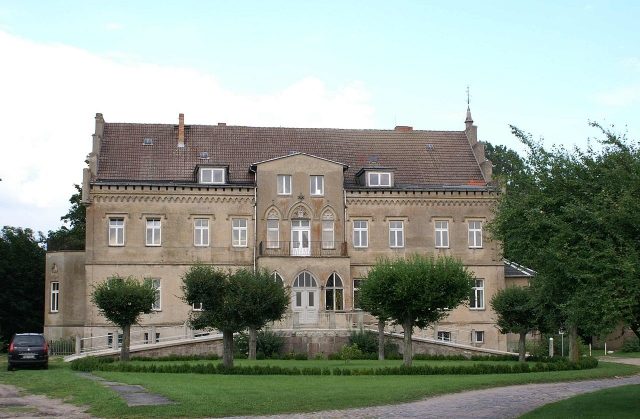
Wrangelsburg Castle is a manor house in Wrangelsburg in the district of Vorpommern-Greifswald. It was built in 1880 and today belongs to the municipality of Wrangelsburg.
Wrangel's Castle+
The place, then still called Vorwerk, was granted as a fief to the noble family von Neuenkirchen in 1426. According to not entirely secure traditions, this was done in gratitude for Rolef von Neuenkirchen, who had accompanied Duke Wartislaw VIII on a pilgrimage to Jerusalem in 1393, having supposedly helped him out of a financial predicament. After a fire, Christoph von Neuenkirchen had a four-winged Renaissance castle built around 1600, which was destroyed in the Thirty Years' War. After the male line of the von Neuenkirchen family died out, Vorwerk came into the possession of the von Wrangel family in 1643 and was renamed Wrangelsburg in 1653.
Carl Gustav Wrangel, Governor-General of Swedish Pomerania, had a Baroque castle built on the remains of the now dilapidated building from 1652 onwards and resided at Wolgast Castle after its completion. For the construction, he engaged the Erfurt master builder Casper Vogell, who had already designed the plans for Friedenstein Castle in Gotha.
The castle was significantly enlarged by the addition of two side wings. The roofs received glazed Dutch tiles and lead gutters. The building was equipped with a water pipe, fed from a nearby spring. Water was led through pipes into a copper container under the roof, from where it reached the rooms and also fed fountains in the garden.
Caspar Vogel, who returned to Erfurt after a short time, handed over the construction management to his son-in-law Barthel Volkland, who was also responsible for the wood carving work. For the stucco work, Wrangel brought Antonius Lohr and his assistant Nils Erikson in 1657, who had previously worked at his Spyker Castle. The interior work was completed in 1664. Wrangel used the castle for only a few years, most recently staying at Spyker Castle on Rügen.
During the Swedish-Brandenburg War, the castle was damaged in 1677. Further damage was caused by a fire in 1686. The building, which was no longer repaired by Wrangel's heirs, changed owners several times. In 1770, Malte Friedrich von Putbus became the owner of Wrangelsburg. Malte Friedrich had the usable decorations brought to Putbus and parts of the castle demolished. In 1773, Wrangelsburg was acquired by the von Normann family. However, the von Normanns continued to live on their estate Krebsow, as the mere re-manufacture of the numerous missing windows of Wrangel's castle was too costly.
Wrangelsburg Manor House+
A nephew of the Wolgast grain merchant August Wilhelm Homeyer acquired the Wrangelsburg estate in 1862. Carl Leopold von Homeyer, who was ennobled in 1865, had the new manor house built around 1880. Some putto heads from the old castle were preserved and walled into the front of the ramp. Two preserved sculptures can be found today on the neighboring building. The manor house is said to have been built on the central part of Wrangel's castle. Above the high plinth, the two-story, eleven-axis building received historicizing Neo-Gothic forms. Of the originally four stepped gables decorated with finial turrets, two of which were on the central risalits, three are still preserved. The three-axis and tower-like risalit facing the village street originally reached the height of the roof ridge. Its roof had the shape of a truncated pyramid. Above the upper floor is the Homeyer coat of arms, depicting a grain plant. An annex with an exit to the park was placed in front of the two-axis central risalit on the park side. A high-lying terrace on the south gable was later extended into a closed annex. Inside, some stucco ceilings and interesting door fillings are preserved.
In 1929, the manor house came into the possession of Karz von Kameke through inheritance. After the Second World War, the building became the quarters of the Soviet military administration. Subsequently, it served as a nursing home until 1958. After that, it was used as an orphanage until 1997. Since 1999, the municipality of Wrangelsburg has owned the manor house, which it uses for municipal administration and events.
Several of the estate's farm buildings are still preserved. A secondary building is also still partially inhabited.
Park+
Christoph von Neuenkirchen had already laid out a pleasure garden divided into quarters. An inventory list from September 1641, compiled after von Neuenkirchen's death, however, only listed fruit trees of good quality. An inventory carried out in 1643 when Wrangel's family took over the estate described a walled Renaissance garden with flowerbeds. For Carl Gustav Wrangel, the garden next to the castle was of great importance as a representative facility befitting his status. He ordered plaster statues in Hamburg and acquired a fountain there. He had two pavilions built as pleasure houses by Barthel Volkland.
From this period, the names of several master gardeners who were in Wrangel's service have been handed down. Since some of the exotic plants in the garden were not suited to the local climate, Wrangel ordered glass cloches from his accountant in Stockholm, which were used at the time to cover melons, among other things. The garden was made accessible to esteemed officers and nobles, but also to people from the bourgeoisie, by invitation or on their own request, for viewing and "recreation".
In 1672, changes were made as the complex had been classified as old-fashioned. An inventory in 1678 counted 830 trees. In addition to a pleasure pavilion with four towers, there were twelve sculptures in the park. The Swedish land survey of Vorpommern showed the garden in Wrangelsburg to have an area of approximately two hectares. In addition, there were other orchards of 1.25 hectares. A round castle church built in 1674 had to be removed after less than 100 years due to dilapidation.
The park, which stretches along the southern shore of the castle lake, was extended into an English landscape park at the end of the 19th century. An ash tree declared a natural monument is located in the park.
Take Mobile History with you
You are reading this text for free. Premium adds what matters on the road: descriptions read aloud, sites found through your camera, whole regions taken offline.
- Every description, including the ~17,700 Premium sites
- Audio guide: have descriptions read to you on location
- AR finder: see sites through your camera, with distance and bearing
- Unlimited saved sites
14 days free, then from €2.99 a month. Cancel anytime.
Source: Wikipedia · Licence: CC BY-SA 4.0
This description draws on the facts documented in the linked Wikipedia article; Wikipedia content is licensed under CC BY-SA 4.0. Wording and editing: Mobile History.
Location: 54.0157, 13.5978