Cultural Events
To be privately owned
CastleRoseburg-Wotersen
Wotersen Castle
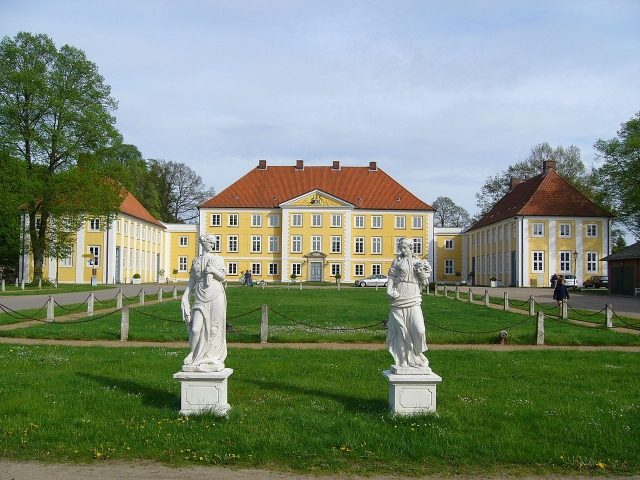
The noble estate of Wotersen, also known as Wotersen Castle, was owned for almost three centuries by the Bernstorff family, who significantly shaped Hanoverian and Danish politics in the 18th century. The estate is located in the municipality of Roseburg in the district of Herzogtum Lauenburg in southeastern Schleswig-Holstein.
A village named Wotersen was first mentioned in 1230 in the Ratzeburg tithe register. The estate, endowed with its own jurisdiction, was demonstrably owned by the von Dalldorf family (also: Daldorff) since 1408, who originated from Dalldorf and took over the complex from the von Schack family. In 1672, it was mortgaged to the von Falkenberg family, but shortly thereafter redeemed by General Valentin Johann von Dalldorf.
In 1717, the estate, along with the surrounding farms, was acquired by Andreas Gottlieb Freiherr von Bernstorff (1649–1726), who came from the Mecklenburg knighthood. He was one of the most influential politicians at the Celle and Hanoverian courts and was also politically active in England under King George I. In addition to Wotersen, he acquired the Stintenburg estate in Lauenburg and the Gartow estate in Hanover, with the land primarily serving as an investment; the latter two are still owned by the Bernstorff family today. From 1720, Andreas Gottlieb von Bernstorff had new buildings erected by Johann Caspar Borchmann in place of the castle destroyed in the Thirty Years' War. In the same year, Gut Wotersen was converted into a family fideicommissum, a foundation in which the family inherits the estate undivided.
The diplomat and Danish minister Johann Hartwig Ernst Graf von Bernstorff (1712–1772), who inherited the estate in 1737, had plans for its reconstruction drawn up by Johann Paul Heumann just two years later, which was completed in 1765. In 1770, von Bernstorff retired to the estate after being overthrown by Johann Friedrich Struensee. In 1772, von Bernstorff died on the estate at the age of 59. The garden planned under him was never realized, and the interior work was only completed in the mid-19th century, when the estate was permanently inhabited by a great-grandnephew of Bernstorff. He also had the Baroque garden transformed into a landscape park and modernized the estate's farm buildings.
The estate remained in family ownership until 1996. Today it is owned by Kurt-Peter Gaedeke.
Buildings and Complex+
The complex is laid out in a north-south direction and was accessible via a dam. There was and is no gatehouse; the manor house is a three-winged complex with a courtyard of honor. In the center of the complex is a water basin, which was used as a watering hole or for washing.
Manor House
The manor house received its current form during a renovation in the mid-18th century, during which the building was raised. The eleven-axis building with a high hip roof is now three stories high on the courtyard side, and only two on the garden side due to the rising terrain. With a central risalit, whose gable contains the colored family crest executed in sandstone, and through the grouping of the windows, the facade is rhythmically structured. On each side there is a one-and-a-half-story side wing, which is connected to the main building by a flat angled structure.
Through the entrance hall, one enters a representatively designed staircase, where a large part of Bernstorff's portrait collection is exhibited. Most of the other rooms in the manor house are rather simple.
Farm Buildings
The farm buildings, constructed from split fieldstones – a building material untypical for the region – were originally symmetrically arranged along a central axis. The bakehouse and washhouse with oat storage and the rye barn still date from the 18th century. The administrator's house was also built in 1721, the riding hall only in the 19th century.
Current Use+
The estate is still used today to cultivate the surrounding lands. The manor house is not accessible today, but events, for example concerts in the riding hall as part of the Schleswig-Holstein Music Festival, regularly take place on the courtyard grounds and in the halls. In addition, these can also be rented for private events.
The outdoor shots of the series "Das Erbe der Guldenburgs" (The Guldenburg Heritage), broadcast on ZDF from 1987 to 1990, were filmed at Gut Wotersen.
Take Mobile History with you
You are reading this text for free. Premium adds what matters on the road: descriptions read aloud, sites found through your camera, whole regions taken offline.
- Every description, including the ~17,700 Premium sites
- Audio guide: have descriptions read to you on location
- AR finder: see sites through your camera, with distance and bearing
- Unlimited saved sites
14 days free, then from €2.99 a month. Cancel anytime.
Source: Wikipedia · Licence: CC BY-SA 4.0 · Image: http://de.wikipedia.org/wiki/Datei:Gut_Wotersen_Herrenhaus.jpg
This description draws on the facts documented in the linked Wikipedia article; Wikipedia content is licensed under CC BY-SA 4.0. Wording and editing: Mobile History.
Location: 53.5418, 10.6022